The three major indices of the U.S. New York stock market surged by 1-2% in the early session on the 14th (local time) as Treasury yields fell due to a consumer price index (CPI) that came in below expectations. Following additional signals of progress in the war against inflation, market bets on the Federal Reserve (Fed) raising interest rates further in December have sharply declined.
At around 10:12 a.m. on the New York Stock Exchange (NYSE), the blue-chip-focused Dow Jones Industrial Average was trading at 34,798, up 1.34% from the previous close. The large-cap S&P 500 index rose 1.76% to 4,489, while the tech-heavy Nasdaq index gained 2.12% to 14,059.
Currently, all 11 sectors within the S&P 500 are advancing. Real estate stocks jumped over 4%, and consumer discretionary stocks rose more than 3%. Utilities, materials, and communication stocks also increased by around 2%. Home Depot rose more than 6% after reporting earnings that exceeded expectations. Nvidia climbed over 2%, marking its 10th consecutive day of gains. Tesla also rose more than 3%. Boston Properties surged 11%, and SolarEdge Technologies jumped over 8%.
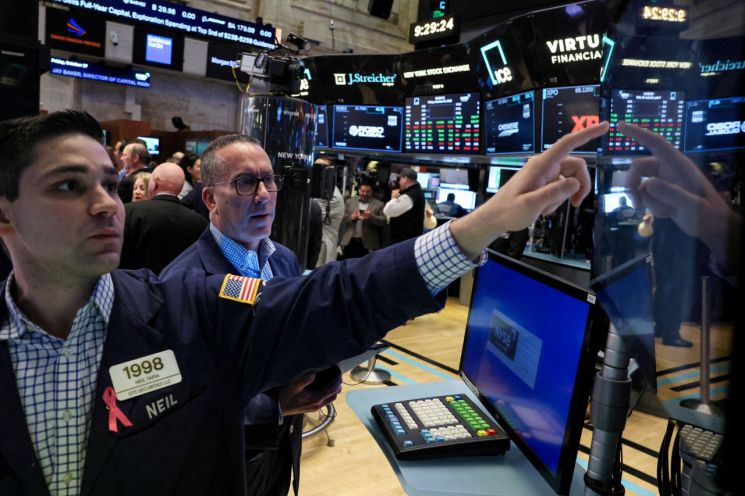
The market is rallying as it digests the CPI report released before the opening. According to the U.S. Department of Labor, the October CPI rose 3.2% year-over-year. This is a significant slowdown from the previous month's increase of 3.7% and also below the 3.3% forecast compiled by Dow Jones experts. On a month-over-month basis, the October CPI was flat, falling short of both September's 0.4% increase and the market expectation of 0.1%.
This immediately strengthened expectations that the Fed will not pursue further rate hikes. Treasury yields plunged. The 10-year yield in the New York bond market dropped to around 4.49%. The 2-year yield, which is sensitive to monetary policy, fell to about 4.87%. The dollar index, which measures the value of the U.S. dollar against six major currencies, declined more than 1% to 104.45.
Sonu Bagga, Global Market Strategist at Carson Group, told CNBC that the CPI report "triggers serious discussions about potential rate cuts in the first half of next year." Oscar Munoz, U.S. Chief Macro Strategist at TD Securities, said, "This is a good report for the Fed. They will maintain the possibility of another rate hike, but the market will not accept it," effectively signaling the end of the tightening cycle.
Market expectations for a 0.25% rate hike (a baby step) in December, which had been above 14% the previous day, briefly disappeared entirely. According to the Chicago Mercantile Exchange (CME) FedWatch tool, the federal funds futures market this morning priced in about a 95% chance that the Fed will hold rates steady at 5.25-5.5% at the next meeting. This was up from the previous day's 85% and briefly hit 100% immediately after the CPI release. Expectations for the timing of rate cuts are also spreading. Earlier, UBS predicted that as a recession takes hold, the current 5.25-5.5% rate would fall to the 2.5-2.75% range by the end of next year and drop to 1.25% by early 2025. The Fed, which has held rates steady twice in a row, is expected to release a new dot plot in December.
However, James Bullard, former President of the St. Louis Federal Reserve Bank and a known hawk (favoring monetary tightening), warned in an interview with CNBC released today that "so far, the disinflation trend has been good for the Federal Open Market Committee (FOMC)," but he believes "there is a very high chance that the disinflation trend will reverse and go down the wrong path." He emphasized the ongoing risk of inflation rebounding, stating, "The good disinflation we have seen over the past 12 months may not continue, which remains a risk for the FOMC," and added, "They need to do more."
The following day, the Producer Price Index (PPI), a wholesale price gauge, and retail sales data, which provide insight into U.S. consumer spending, are scheduled to be released. October retail sales are expected to decline by 0.1%. Until September, retail sales had shown a 0.9% year-over-year increase over about three months, but a sharp drop is anticipated this month. However, this consumer slowdown could reinforce expectations of the Fed ending its tightening, which may be positive for the stock market. Following Home Depot, retailers such as Target and Walmart are also scheduled to report earnings this week.
The financial markets are also watching the possibility of a U.S. federal government shutdown. The temporary budget bill, which Congress barely passed earlier, is set to expire on the 17th. If the budget bill does not pass Congress by then, a shutdown will be inevitable. Additionally, a face-to-face summit between U.S. President Joe Biden and Chinese President Xi Jinping is scheduled during the Asia-Pacific Economic Cooperation (APEC) meeting in San Francisco, which runs through the 17th.
European stock markets are also rising. Germany's DAX index gained 1.66%, France's CAC index rose 1.55%, and the UK's FTSE index is trading slightly higher.
© The Asia Business Daily(www.asiae.co.kr). All rights reserved.
![Clutching a Stolen Dior Bag, Saying "I Hate Being Poor but Real"... The Grotesque Con of a "Human Knockoff" [Slate]](https://cwcontent.asiae.co.kr/asiaresize/183/2026021902243444107_1771435474.jpg)















