"Mixing Political Messages Dilutes the Essence
Focus Should Be on Strengthening Labor Rights"
As the two major labor unions continue to hold rallies demanding the enforcement of the recently passed 'Yellow Envelope Act (Amendment to the Labor Union Act)' in the National Assembly plenary session, the so-called 'MZ unions' are distancing themselves from the existing unions. The MZ unions, formed mainly by people in their 20s and 30s, view the Yellow Envelope Act positively, saying it "provides a channel for subcontracted workers and primary contractors to communicate directly," but they criticize rallies that carry political messages.
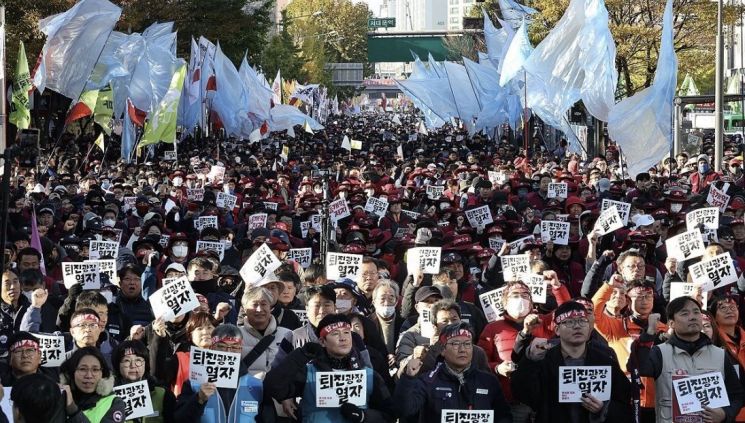 On the 11th, near Seodaemun Station in Seoul, participants at the Korean Confederation of Trade Unions National Workers' Rally held placards calling for the resignation of the government and shouted slogans. [Image source=Yonhap News]
After the Yellow Envelope Act was passed in the National Assembly plenary session on the 9th, the two major labor unions held large-scale rallies urging the immediate promulgation and enforcement of the Act. On the 11th, the Korean Confederation of Trade Unions (KCTU) held a large rally in Seodaemun, Seoul, and the Federation of Korean Trade Unions (FKTU) held one in Yeouido, each chanting slogans such as 'Immediate enforcement of the Yellow Envelope Act' and 'Resignation of the Yoon Seok-yeol administration.' On the morning of the 13th, rallies continued in front of the Presidential Office in Yongsan-gu, Seoul, demanding the promulgation of the amended Labor Union Act.
However, the MZ unions criticize the behavior of the existing unions separately from their support for the Yellow Envelope Act. Yoo Jun-hwan, chairman of the LG Electronics People-Centered Office Workers' Union (32), said, "I support the overall content of the Yellow Envelope Act in terms of strengthening labor rights," but added, "I don't think labor law necessarily has to be related to political struggles." He evaluated the recent rallies by the two major unions, which emphasized regime change, as 'political rallies.' The LG Electronics office workers' union is the first MZ union in a private large corporation, launched in February 2021, mainly by office workers in their 20s and 30s, using anonymous communities like 'Blind' and Google platforms. Yoo also serves as the chairperson of the 'Refresh Workers' Council,' an MZ union coalition launched in February this year. Yoo stated, "We will not engage in struggles unrelated to labor rights."
Kim Han-yeop, chairman of the Kumho Tire Office Workers' Union (36), also said, "If political messages such as regime change are shouted at rallies like those of the two major unions last weekend, the essence could be diluted." The Kumho Tire office workers' union was also formed in April 2021, mainly by MZ generation office workers. Kim pointed out, "Unions should emphasize workers' rights and interests. Ordinary citizens might not be able to tell whether the union wants the enforcement of the Yellow Envelope Act or the resignation of the regime."
The MZ unions are not opposed to the enforcement of the Yellow Envelope Act. The Refresh Workers' Council issued a statement in July supporting the Act. They argued that expanding the scope of employers through the amendment to the Labor Union Act would open a channel for dialogue between subcontracted employees and primary contractors, thereby strengthening labor rights. Including 'rights disputes' such as interpretation and application of collective agreements, in addition to 'interest disputes' limited to existing working conditions, aligns with International Labour Organization conventions and major advanced countries' legislation.
However, even when issuing the supportive statement, there was internal debate within the council. Regarding the limitation on employers' claims for damages due to illegal strikes, a minority opposing view stating "violence, not dialogue, cannot be justified" was explicitly included in the statement. A council official said, "There was an internal opinion that claims for damages due to illegal strike activities should be an exception." As a result, while issuing a supportive statement, the council explicitly noted internal opposition concerning the core issue of limiting claims for damages in the Yellow Envelope Act, distinguishing it from statements and commentaries by existing unions.
The MZ unions thus reject the traditional labor movement methods. They perceive that the two major unions have deviated from the essence of strengthening labor rights and have become biased toward illegal and political activities. Their stance is to engage in labor movements focused on the essence of strengthening labor rights, such as fair treatment and compensation. This 'support for labor rights enhancement, opposition to radical actions' stance was also evident in the subway strike led by the Seoul Metro Workers' Union under the KCTU on the 9th and 10th. The Seoul Metro MZ union, Olbareun Nojo, did not participate in the strike, and the Seoul Metro Integrated Union under the FKTU, which initially planned to join, ultimately declared non-participation at the last minute. Song Si-young, chairman of Olbareun Nojo at Seoul Metro (31), said, "Collective actions that harm citizens only deepen negative perceptions of the labor movement. Illegal violent rallies are the same. Union members should unite to make reasonable demands to management while pursuing coexistence and aiming for collective actions that gain public sympathy."
Experts see this attitude of the MZ unions as reflecting the practical nature of the MZ generation. Kim Dae-jong, professor of business administration at Sejong University, said, "The MZ generation is more interested in improving treatment and rights themselves and chooses methods to efficiently achieve desired results. They think political struggles or illegal strikes do not help with this." He added, "One reason the MZ generation opposes the Yellow Envelope Act is that they believe the corporate environment should improve, attracting more domestic investment and allowing companies to prosper, which increases the pie to be shared." Kim Seong-hee, professor at Korea University's Labor Issues Research Institute, said, "The traditional labor movement grew alongside democratization in the late 1980s. The MZ generation lacks that experience, so they distinguish political and social messages and make practical and pragmatic claims for strengthening rights."
© The Asia Business Daily(www.asiae.co.kr). All rights reserved.
![Clutching a Stolen Dior Bag, Saying "I Hate Being Poor but Real"... The Grotesque Con of a "Human Knockoff" [Slate]](https://cwcontent.asiae.co.kr/asiaresize/183/2026021902243444107_1771435474.jpg)















