Expansion of Software-Enabled 'Component Pairing'
Number of Components Increased from 3 in 2017 to 7 This Year
Malfunctions Occur When Repairing LCD, Battery, etc. Externally
Apple is expanding and applying a system that disables proper functioning if major components such as the display or battery break down and the user visits an external repair shop or performs self-repair instead of an official repair center, according to a report by The New York Times (NYT) on the 12th (local time).
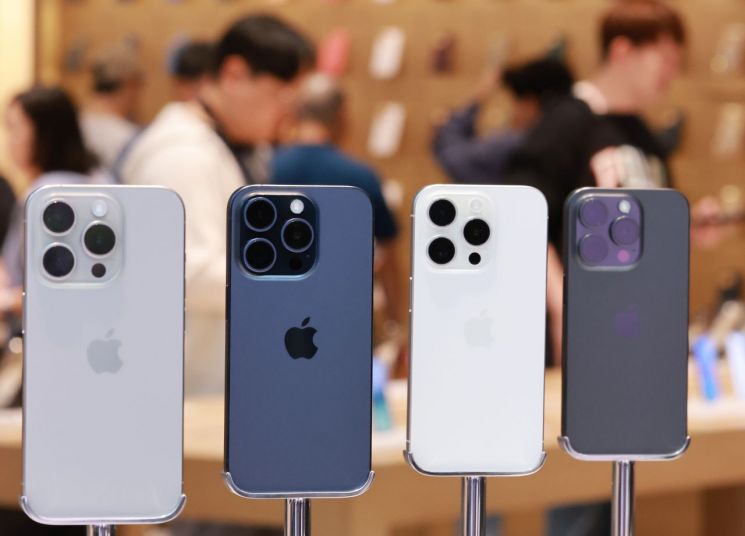
On the same day, NYT cited data from iFixit, a U.S. electronics repair parts seller, reporting this issue related to iPhone repairs since 2017. The software is coded to recognize the serial numbers of individual iPhone parts, and if parts are replaced, the iPhone malfunctions. This phenomenon is called 'part pairing.'
According to iFixit, when Apple introduced the facial recognition system to the iPhone in 2017, there were three parts causing such problems, but the iPhone 15 released this year has increased to seven. This phenomenon, which began in 2013, initially caused issues only with the Touch ID sensor until 2016, but the number of affected parts has gradually increased since then.
Testing the iPhone 15 Pro Max version released last month revealed that even when repaired with parts installed in a new iPhone of the same specifications, parts that did not function as expected included the Face ID or Touch ID sensors, battery, display, and front camera. The battery and display also continuously showed warning alerts after repair.
As a result, iPhone users must have their devices repaired only at Apple official stores or authorized repair centers if parts fail. Like cars, it becomes difficult to use local external repair shops or perform self-repair. NYT explained, "Replacing the display usually costs $300 (about 400,000 KRW), which is more than $100 higher than repairing at an external repair shop."
At the same time, Apple can expand subscribers to its iPhone insurance product, 'AppleCare.' Because part pairing causes high costs at official repair centers, users tend to subscribe to AppleCare, which helps cover these expenses, NYT reported. Apple earns $9 billion annually through AppleCare.
In the U.S., to address this issue, state governments such as New York and California have raised their voices, calling for regulations to prevent smartphone manufacturers from restricting the use of external repair shops. In fact, New York, Minnesota, and California have passed bills requiring electronics manufacturers to supply parts, tools, and manuals to third parties.
The Biden administration has also urged the Federal Trade Commission (FTC) to establish regulations to resolve this issue, but most current regulations do not explicitly address it.
Apple stated that based on state government bills, it has offered a Self Service Repair program since 2021, providing users with desired options. Apple is expanding the Self Service Repair program and increasing the number of eligible devices, allowing users to obtain necessary parts, tools, and manuals without separately contacting Apple.
© The Asia Business Daily(www.asiae.co.kr). All rights reserved.
![Clutching a Stolen Dior Bag, Saying "I Hate Being Poor but Real"... The Grotesque Con of a "Human Knockoff" [Slate]](https://cwcontent.asiae.co.kr/asiaresize/183/2026021902243444107_1771435474.jpg)















