A venous injection needle that minimizes damage to blood vessels and completely prevents reuse has been developed.
KAIST announced on the 13th that Professor Jae-woong Jeong's research team from the Department of Electrical Engineering and Computer Science, in collaboration with Professor Won-il Jeong's research team from the Graduate School of Medical Science and Engineering, succeeded in developing a ‘variable stiffness venous injection needle’.
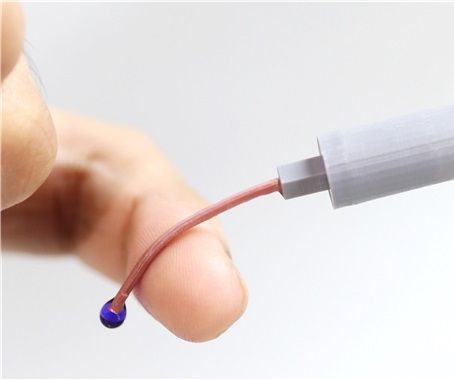
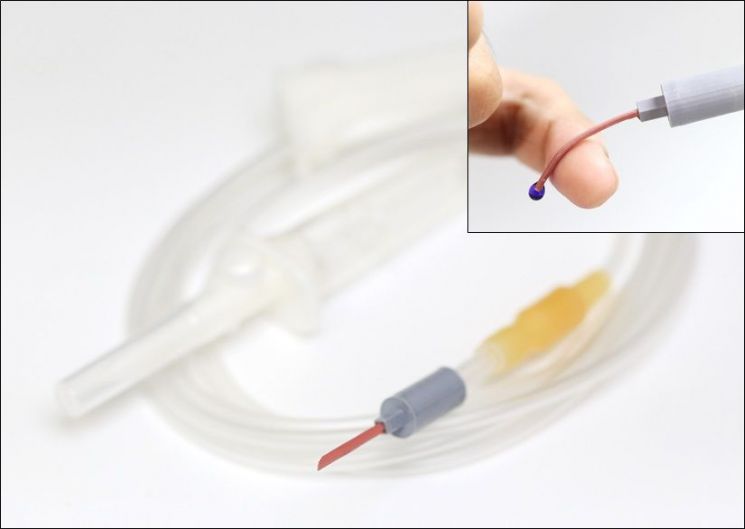
This injection needle becomes soft when inserted into the body, increasing biocompatibility with tissues, and features a design that makes reuse impossible.
In particular, the stiffness that changes according to body temperature has the advantage of minimizing problems such as blood vessel damage or inflammation when administering drugs intravenously with the injection needle.
This is based on the principle that the needle becomes flexible according to body temperature, ensuring free movement at the injection site when injecting drugs into the vein, thereby preventing damage to the blood vessel walls caused by the needle.
Additionally, the function that prevents reuse of the needle after a single use is expected to help solve the unethical reuse problem of needles (infection of blood-borne diseases).
This study involved Karen-Christian Agno, a doctoral researcher from the Department of Electrical Engineering and Computer Science at KAIST, and Kyung-mo Yang from the Graduate School of Medical Science and Engineering as co-first authors. The research results were also published in the international journal Nature Biomedical Engineering (October 30 issue).
Professor Jae-woong Jeong said, "The developed ‘variable stiffness venous injection needle’ solves the problems of existing rigid medical needles, ensuring the safety of both patients and medical staff, and has great value in addressing infection issues caused by needle reuse.”
Meanwhile, venous injection is a method of directly injecting drugs into blood vessels, inducing rapid effects and enabling continuous drug administration, making it a globally used treatment method.
However, needles have traditionally been made from hard materials such as metal and plastic, raising concerns about damage and inflammation to soft biological tissues, which restricts patient movement during treatment and causes additional treatments and medical costs to resolve blood vessel damage and pain.
Also, some unethical practices of reusing needles to reduce costs have led to serious blood-borne infections such as human immunodeficiency virus (HIV) and hepatitis B/C viruses in patients.
For the same reasons, the World Health Organization (WHO) emphasizes the importance of infection control and encourages the development and use of smart syringes that cannot be reused.
© The Asia Business Daily(www.asiae.co.kr). All rights reserved.
![Clutching a Stolen Dior Bag, Saying "I Hate Being Poor but Real"... The Grotesque Con of a "Human Knockoff" [Slate]](https://cwcontent.asiae.co.kr/asiaresize/183/2026021902243444107_1771435474.jpg)
















