Amid reports that medical schools nationwide have requested an increase of more than 2,000 admissions slots, the government will announce the results of the demand survey next week. Based on the survey results, the government plans to review each university's capabilities and finalize the specific scale by April next year.
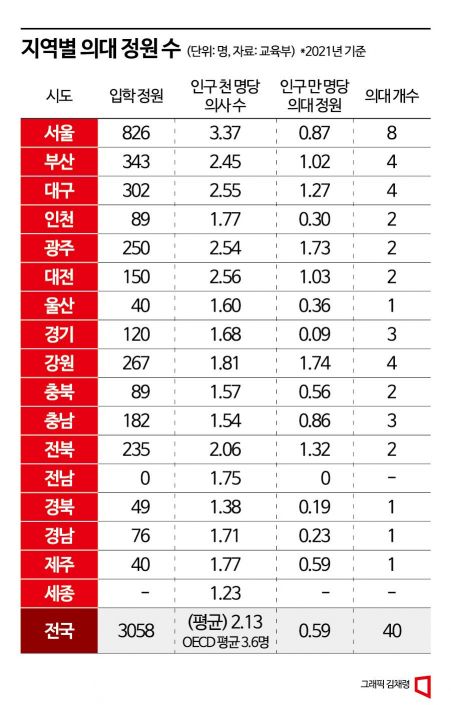
According to the Ministry of Health and Welfare on the 12th, the Ministry of Health and Welfare and the Ministry of Education conducted a demand survey for increasing admissions quotas at 40 medical schools nationwide from the 27th of last month to the 10th of this month. It is known that the total desired increase in admissions quotas by medical schools exceeds 2,000. Currently, the admissions quota for new medical students is 3,058. Seventeen small medical schools with fewer than 50 admissions slots (10 schools with 40 slots, 7 schools with 49 slots) have reportedly requested to more than double their quotas for the 2025 academic year. Ten national university medical schools and private universities in the metropolitan area with quotas of 100 or more also hope to increase their medical school admissions.
After the demand survey, the Medical Education Inspection Team will review each university's capabilities through document review and on-site investigations. They will verify four major requirements: teaching facilities (university facilities), campus land, faculty, and basic property for profit use. The Medical Education Inspection Team is led by the Director of the Health and Medical Policy Office of the Ministry of Health and Welfare and consists of government officials from the Ministry of Health and Welfare and the Ministry of Education, as well as experts from the Korea Institute of Medical Education and Evaluation, the Korean Association of Medical Colleges and Medical Schools, the Korean Society of Medical Education, the Korea Development Institute, and the Korea Institute for Health and Social Affairs.
Separately from the demand survey, the Ministry of Health and Welfare is also meeting with medical organizations and consumer groups to hear opinions from the field. This is to narrow differences with the medical community. The opposition from the Korean Medical Association remains strong. Over the weekend, the KMA replaced the negotiation team involved in the ongoing 'Medical Issues Consultative Body' talks with the government. The KMA is also pushing for disciplinary action against Professor Kim Yoon of Seoul National University College of Medicine (Health Care Management), who advocates for expanding medical school admissions.
© The Asia Business Daily(www.asiae.co.kr). All rights reserved.
![Clutching a Stolen Dior Bag, Saying "I Hate Being Poor but Real"... The Grotesque Con of a "Human Knockoff" [Slate]](https://cwcontent.asiae.co.kr/asiaresize/183/2026021902243444107_1771435474.jpg)















