Increase in Offline Store Visits but Decrease in Purchase Price
Wallets Open Only for Essential Items Like Groceries
After the end of the COVID-19 pandemic, as outdoor activities increased, the number of consumers visiting offline retail stores also rose. However, the overall consumer spending volume was found to have decreased.
According to sales trend data from major retailers released by the Ministry of Trade, Industry and Energy on the 12th, the number of purchases at offline stores such as department stores, convenience stores, large supermarkets, and corporate supermarkets showed a monthly increase of 3.9% to 13.1% compared to last year.
However, the purchase unit price, which refers to the amount consumers spend per transaction, decreased in most months compared to the same period last year, except for September. Starting with a 5.6% decline in January, the purchase unit price recorded negative growth throughout the first half of the year and also dropped by 6.7% in August. In July, it was at the same level as last year, and in September, it increased by 1.2%, but considering inflation, this is analyzed to be virtually negative as well.
Despite continuous inflation, the decrease in the amount consumers put in their shopping baskets is attributed to reduced spending power due to economic recession and high interest rates. As disposable income declined, consumers spent only on essential items such as groceries and purchased relatively inexpensive products.
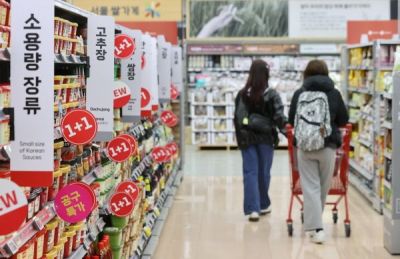
Researcher Sanghoon Cho from Shinhan Investment Corp. explained, “The purchase unit price is decreasing across most retail channels, and sales in all categories except food have been sluggish,” adding, “There is a phenomenon of reduced consumption itself due to fatigue from rising prices.”
In particular, department stores showed a clear decline in sales of high-priced products such as overseas luxury goods, which had supported growth last year. As of September, sales of accessories (-0.2%), women's suits (-7.5%), women's casual wear (-1.3%), men's clothing (-11.4%), children’s and sportswear (-4.3%), and famous overseas brands (-3.5%) all decreased, while only household goods (6%) and food (35.1%) saw sales growth.
Large supermarkets also failed to avoid a decline in sales of product groups other than food. As of September, sales of non-food items such as electronics and culture (-13.1%), clothing (-11.5%), sports (-10.4%), and accessories (-7.3%) mostly decreased compared to the same month last year. Only food (17.9%) managed to maintain growth, supported by the Chuseok holiday demand.
Researcher Cho analyzed, “The fact that consumers frequently purchase only essential items while the overall shopping basket size shrinks is a typical consumption pattern observed during economic recessions.”
© The Asia Business Daily(www.asiae.co.kr). All rights reserved.
![Clutching a Stolen Dior Bag, Saying "I Hate Being Poor but Real"... The Grotesque Con of a "Human Knockoff" [Slate]](https://cwcontent.asiae.co.kr/asiaresize/183/2026021902243444107_1771435474.jpg)















