Annual Insurance Payouts Increase by 16%
No Clear Treatment Standards... Treatment Time, Costs, and Composition Vary
Need to Strengthen Insurance Fraud Investigations

As indemnity medical insurance payments related to manual therapy increase, various side effects such as insurance fraud and overtreatment are also on the rise. Since the burden of premium increases could be passed on to general consumers, there are calls for the establishment of guidelines and coverage limits for manual therapy.
On the 12th, the Korea Insurance Research Institute released a report titled "Current Status and Challenges of Indemnity Medical Insurance for Manual Therapy" containing these findings.
Manual therapy is a treatment method where a skilled and specialized practitioner uses their hands to improve physical functions, targeting musculoskeletal disorders. As of this year, the average cost of manual therapy increased by 3.7% compared to last year, and the highest cost (600,000 KRW) is about six times the median cost (100,000 KRW), showing a large price disparity. In particular, the highest, median, and average costs tend to increase as the medical institution size decreases, with smaller clinics charging more than tertiary or general hospitals.
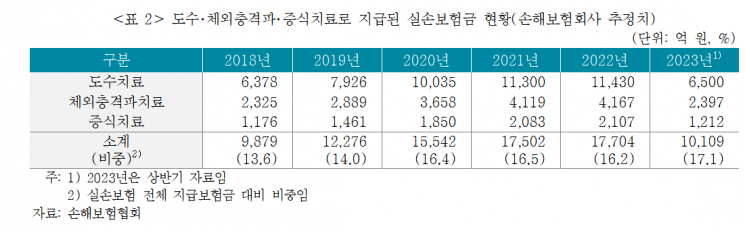
Insurance payments for treatments related to musculoskeletal disorders, including manual therapy, extracorporeal shock wave therapy, and prolotherapy, have also steadily increased. According to the Financial Supervisory Service and the General Insurance Association of Korea, insurance payments for these treatments reached 1.7704 trillion KRW last year. In the first half of this year alone, payments have already exceeded 1 trillion KRW. While the number of patients treated for musculoskeletal disorders increased by an average of 3.2% annually from 2009 to 2019, insurance payments for non-reimbursable items related to musculoskeletal disorders increased by an average of 15.7% annually from 2018 to 2022, far outpacing the patient growth rate.
No Clear Treatment Standards... Treatment Time, Cost, and Composition Vary
The problem is not the increase in manual therapy itself. The lack of clear treatment standards causes differences in treatment time, cost, and composition across medical institutions, leading to consumer complaints.
According to a survey by the Korea Consumer Agency on manual therapy at clinics in Seoul, the average cost per session in 2016 varied by more than twice depending on the district. Seocho-gu had the highest average cost per session at 113,889 KRW, while Gangbuk-gu had the lowest at 56,000 KRW. The average treatment time per session also varied by about twofold, ranging from a maximum of 75 minutes to a minimum of 37 minutes.
Related insurance fraud is also on the rise. According to the Financial Supervisory Service, the number of insured persons referred for investigation due to insurance fraud related to manual therapy increased by 110% over three years, from 679 in 2019 to 1,429 in 2022. These individuals received cosmetic procedures not covered by indemnity insurance and then falsely claimed to have undergone manual therapy by obtaining fake medical receipts and treatment confirmations. Some hospitals colluded with broker organizations to systematically lead insurance fraud.
"Establish Treatment Guidelines and Strengthen Insurance Fraud Investigations"
Therefore, there are calls for the establishment of standards for manual therapy. Although manual therapy may vary by hospital due to its non-reimbursable nature, the large discrepancies among medical institutions necessitate at least minimum guidelines on treatment time and cost. Workers' compensation insurance and automobile insurance already regulate the number of manual therapy sessions, treatment duration, and the responsible party. Additionally, proposals include setting limits per outpatient visit for manual therapy, extracorporeal shock wave therapy, and prolotherapy, as well as introducing special clauses that limit coverage or impose co-payments to prevent overtreatment.
Strengthening insurance fraud investigations is also a key task. Kim Kyung-sun, a research fellow at the Korea Insurance Research Institute, explained, "Manual therapy involves relatively small amounts (an average of less than 2 million KRW), making it difficult to allocate sufficient personnel and resources for insurance fraud investigations. However, as insurance payments for manual therapy have surged recently and organized insurance fraud is occurring, it is necessary to strengthen insurance fraud investigations."
© The Asia Business Daily(www.asiae.co.kr). All rights reserved.


















