Report on Impeachment Proposal to the Plenary Session
If not voted within 72 hours after 24 hours, it will be discarded
Depends on whether the plenary session is convened
Controversy possible over the principle of non bis in idem as well
On the 9th, the People Power Party abruptly withdrew the unlimited debate (filibuster) on the Yellow Envelope Act (Amendment to the Labor Union and Labor Relations Act) and the Three Broadcasting Acts (Amendments to the Broadcasting Act, the Broadcasting Culture Promotion Act, and the Korea Educational Broadcasting System Act) to prevent the impeachment motion against Lee Dong-gwan, Chairman of the Korea Communications Commission. The fate of the impeachment motion against Chairman Lee is expected to be decided depending on whether a plenary session is held within 72 hours after 24 hours from now.
Yoon Jae-ok, floor leader of the People Power Party, announced the sudden suspension of the filibuster ahead of the vote on the Yellow Envelope Act and others. He said, "I want to inform the public in detail and appeal regarding the four bad laws, but please understand that we had no choice but to give up the filibuster to prevent the bad political intention of impeaching the Chairman of the Korea Communications Commission and thereby paralyzing the functions of the state agency, the KCC, for a long time."
Originally, the People Power Party planned to mobilize all first-term lawmakers to participate in the filibuster to point out the problems of the Yellow Envelope Act and highlight the unfairness of its passage. However, they abruptly gave up this opportunity just before the vote. This was a decision to block the vote on the impeachment motion against Chairman Lee and prosecutors Son Joon-sung and Lee Jung-seop.
According to the current National Assembly Act, an impeachment motion must be processed within 72 hours after 24 hours from being reported to the plenary session. For the vote on the impeachment motion against Chairman Lee, the plenary session must be held within 72 hours, and Yoon, the floor leader, gave up the filibuster to prevent this. Earlier, the Democratic Party had planned, according to Article 86 of the National Assembly Act, that if the ruling party's filibuster on the four bills including the Yellow Envelope Act and the Three Broadcasting Acts continued, they would forcibly end the filibuster through a vote 24 hours after the bills were submitted and process these bills. Since there are four bills, the plenary session would be held for five days.
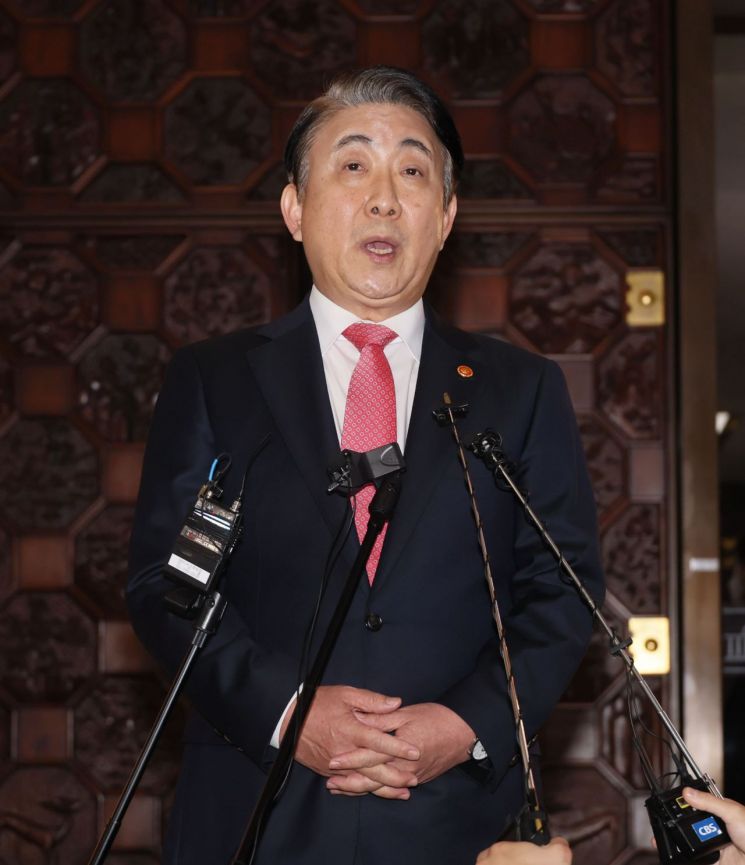 Lee Dong-kwan, Chairman of the Korea Communications Commission, is expressing his position regarding the impeachment motion against him at the Rotunda Hall of the National Assembly on the 9th. [Image source=Yonhap News]
Yoon told reporters, "I had been thinking about stopping the filibuster since the morning." He said, "I pleaded that it was politically inappropriate to add the impeachment motion on top of the politically burdensome filibuster schedule against the Democratic Party and the Speaker of the National Assembly, but it was not accepted," adding, "I decided not to do the filibuster without telling anyone."
Will the plenary session be held to process the impeachment motion?
If the filibuster had continued, the vote on the impeachment motion against Chairman Lee and others could have proceeded after 24 hours. However, due to Yoon's decision, a new plenary session schedule must be set for the impeachment motion against Chairman Lee and others. The Democratic Party plans to hold a plenary session on the 10th to demand a vote on the impeachment motion against Chairman Lee.
However, since the ruling and opposition parties have not agreed on the plenary session agenda, a decision from Speaker Kim is required. Regarding this, a National Assembly Speaker's office official said, "We need to look at precedents and regulations," adding, "Usually, plenary sessions are held by agreement between the floor leaders of both parties, but when only one side requests it, various considerations are necessary."
If the plenary session is not held despite the Democratic Party's demand, the impeachment motion against Chairman Lee and others will be discarded.
Whether the principle of non bis in idem applies even if discarded is also an issue
However, whether the Democratic Party can reintroduce the impeachment motion against Chairman Lee is a contentious issue. Article 92 of the current National Assembly Act states that "a rejected agenda cannot be reintroduced or submitted again during the same session." According to the principle of non bis in idem, the impeachment motion against the three individuals can only be made after the regular session ends. A National Assembly official said, "There is an issue of how to interpret the principle of non bis in idem," adding, "Since it is a reported matter, it needs to be determined by the administrative department whether it should be considered officially discarded or if it can be reintroduced."
Regarding this, Hong Ik-pyo, floor leader of the Democratic Party, told reporters, "It can be done again within the regular session." There is also a prospect that they could proceed with impeachment by presenting other reasons. When asked by reporters whether there is a possibility that the Democratic Party might attempt impeachment with new grounds, Yoon said, "Of course."
© The Asia Business Daily(www.asiae.co.kr). All rights reserved.
![Clutching a Stolen Dior Bag, Saying "I Hate Being Poor but Real"... The Grotesque Con of a "Human Knockoff" [Slate]](https://cwcontent.asiae.co.kr/asiaresize/183/2026021902243444107_1771435474.jpg)















