As the prolonged yen depreciation continues, the fortunes of individual investors who have invested in Japan are diverging. While those who bet on a rebound of the yen suffered losses due to the yen depreciation lasting longer than expected, those who invested in Japanese stocks have reportedly earned decent profits.
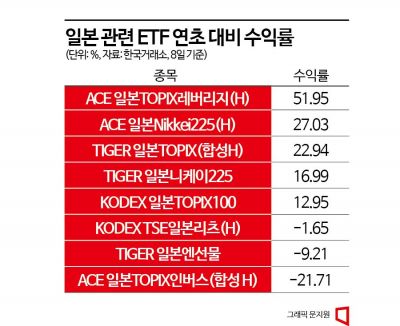
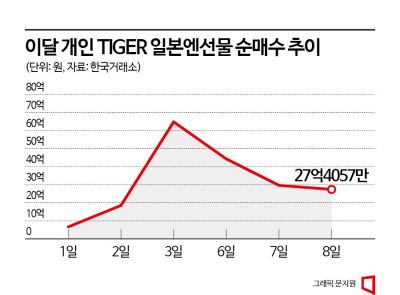
According to the Korea Exchange on the 10th, the yen exchange-traded fund (ETF) 'TIGER Japan Yen Futures' fell 9.21% compared to the beginning of the year. The won-yen exchange rate rose to the 1,000 won level in April but dropped below 900 won in July. As the won-yen exchange rate fell below 900 won, individual investors bought 23.1 billion won worth of TIGER Japan Yen Futures over two months from July to August, expecting a yen rebound. However, the yen exchange rate recently declined again, causing the ETF's returns to drop. The exchange rate, which had been hovering near the 900 won level, recently fell to the 860 won range. On the 6th, it recorded 867.59 won, marking the first time in 15 years and 9 months that it reached the 860 won level.
Although investors who bet on a yen rebound earlier suffered losses, funds are flowing back into TIGER Japan Yen Futures due to the recent yen depreciation. Individual investors have purchased 19.1 billion won worth of TIGER Japan Yen Futures just this month.
The stocks most heavily net-bought by individual investors this year have also shown disappointing returns. According to the Korea Securities Depository's SaveRo, the most purchased stock by individual investors this year is the iShares 20+ Year US Treasury Bond JPY Hedged ETF (ISHARES 20+ YEAR US TREASURY BOND JPY HEDGED ETF). They net-bought $357.35 million (approximately 468.66452 billion won) this year. This product invests in US long-term bonds with maturities over 20 years, hedged in yen. It attracted individual investors because it offers potential currency gains if the yen appreciates against the won. However, due to a sharp rise in US Treasury yields, it has fallen more than 16% since the beginning of the year, and the prolonged yen depreciation added to currency losses.
On the other hand, investments in Japanese stocks have recorded favorable returns. According to financial information provider FnGuide, Japanese funds have posted a year-to-date return of 20.39%, ranking third among major regional and country funds after North America (33.32%) and Emerging Europe (23.39%). This is attributed to the favorable performance of the Japanese stock market supported by the yen depreciation this year.
ETFs tracking Japanese stock indices also showed high returns. ACE Japan TOPIX Leverage (H) rose 51.95% this year. ACE Japan Nikkei 225 (H) increased by 27.03%, and TIGER Japan TOPIX (Synthetic H) (22.94%), TIGER Japan Nikkei 225 (16.99%), and KODEX Japan TOPIX 100 (12.95%) also recorded double-digit returns.
Seonghwan Kim, a researcher at Shinhan Investment Corp., analyzed, "The Japanese stock market, which had been languishing in the 'lost 30 years,' emerged as a leader in the global stock market starting in May. The strong performance of the US economy has led to rising interest rates and a strong dollar, which in turn results in yen weakness, high exports from Japanese manufacturing companies to North America, and increased travel demand."
There is a forecast that a sharp yen appreciation will not occur. Researcher Kim said, "Although there is a view that changes in the Bank of Japan's (BOJ) monetary policy could create a yen appreciation phase, the pace of interest rate increases (and yen appreciation) will proceed very gradually." Amin Kwon, a researcher at NH Investment & Securities, said, "Along with the BOJ's cautious tightening, a gradual yen appreciation is expected," adding, "The current exchange rate level, which differs from the past, is favorable to Japan's macroeconomic situation."
© The Asia Business Daily(www.asiae.co.kr). All rights reserved.
![Clutching a Stolen Dior Bag, Saying "I Hate Being Poor but Real"... The Grotesque Con of a "Human Knockoff" [Slate]](https://cwcontent.asiae.co.kr/asiaresize/183/2026021902243444107_1771435474.jpg)
















