Customized Proactive Policies Through Survey Research Service
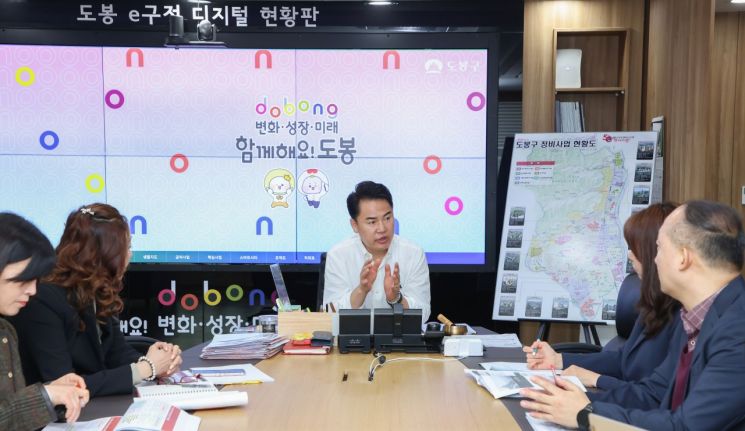 Dobong-gu, Seoul, has decided to create proactive single-person household policies that reflect local characteristics through a research service on the actual conditions of single-person households. On the 27th, Oh Eon-seok, the district mayor, spoke about the future direction of single-person household policy implementation at the final research service report meeting. (Photo by Dobong-gu Office)
Among single-person households residing in Dobong-gu, Seoul (Mayor Oh Eon-seok), 6.5 out of 10 people reported being satisfied with living alone due to reasons such as privacy protection and the ability to utilize leisure time.
According to Dobong-gu on the 7th, a ‘Single-Person Household Survey Research Project’ conducted since June targeting 500 single-person households in the district found that 65% of respondents were satisfied with their overall life as a single-person household. The reason given was “privacy is guaranteed and I can use my leisure time alone.”
Meanwhile, 35% said they were “not satisfied,” citing reasons such as “difficulty in responding to emergencies related to health and challenges in managing meals alone.”
Regarding the reasons for living alone, 31.8% of respondents answered that it was to live close to their workplace or school, followed by 29.2% due to divorce, separation, or bereavement of a spouse. Additionally, 16.8% mentioned privacy protection and freedom.
Among single-person households in Dobong-gu, 85.4% answered that they are “working,” and among the 14.6% who are not working, 47.9% cited poor health as the reason. Other reasons included being too old (24.7%), lack of jobs meeting desired conditions (20.5%), job searching or preparing for employment (19.2%), and lack of jobs matching their experience (17.8%).
Regarding the most needed policies to support single-person households, people in their 20s, 40s, and 50s chose employment support at rates of 31.5%, 27.4%, and 29.6%, respectively, while those in their 30s preferred housing stability support (27.6%), and those in their 60s wanted health management support (22.6%).
When examining general youth and reclusive youth separately, 68.7% of general youth live in Ssangmun and Changdong areas, while 55.8% of reclusive youth live in the Changdong area. Additionally, when asked if they frequently or almost daily felt depressed in the past year, 8.8% of general youth and 26.9% of reclusive youth answered yes.
Based on the research results, the district has set the direction for Dobong-gu’s single-person household policies as ▲establishing a target discovery system ▲activating networks ▲building a mental health cooperation system ▲strengthening support for social isolation and reclusive youth ▲supporting activities for middle-aged and older single-person households. Moving forward, the district plans to strengthen social network programs to activate single-person household networks, promote activities based on the interests of single-person households, and establish an early identification and intervention system for crisis households to discover reclusive individuals.
Oh Eon-seok, Mayor of Dobong-gu, said, “We conducted this survey research project to understand the welfare needs of single-person households and to develop policies reflecting those needs,” adding, “Based on the research results, we will enhance what we are doing well and adopt excellent cases from other local governments to create proactive policies that reflect the characteristics of Dobong-gu.”
This research project was promoted to develop customized policies for single-person households reflecting age, gender, and regional characteristics. The survey was conducted in collaboration with a professional research institution, using both online surveys and individual face-to-face interviews.
© The Asia Business Daily(www.asiae.co.kr). All rights reserved.
![Clutching a Stolen Dior Bag, Saying "I Hate Being Poor but Real"... The Grotesque Con of a "Human Knockoff" [Slate]](https://cwcontent.asiae.co.kr/asiaresize/183/2026021902243444107_1771435474.jpg)















