Realizing the Dream of Living Abroad
Experiencing Foreign Corporate Culture
Turning to Overseas as COVID Restrictions Ease
Choi Min-ji (25, female), who quit her job after two years, headed to Canada in July this year. She wanted to realize one of her long-held dreams of 'living abroad.' Choi said, "I came impulsively, but I had a romantic desire to live abroad at least once." Park Ga-bin (29, female) is also currently living in Canada. She said, "In Korea, there are things you have to do by age, like getting a job or getting married, so I think I kept comparing myself to others. Overseas, the stress about age disappeared, and I was freed from the obsession that I had to do something without any gap."
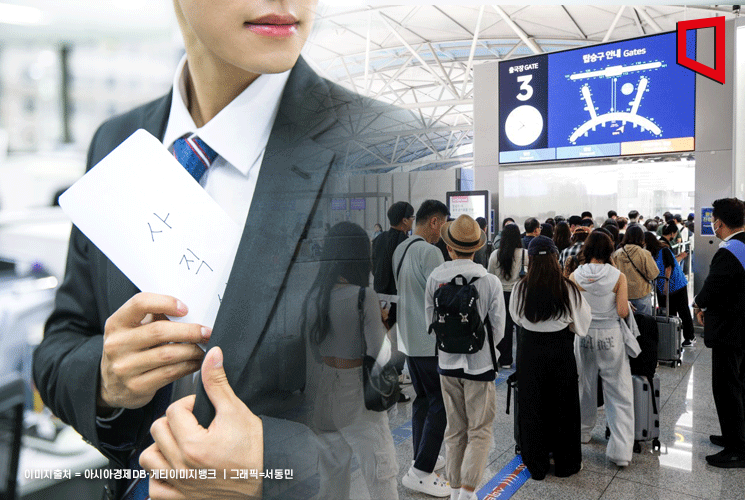
As COVID-19 restrictions have eased, the 20s and 30s generation are turning their eyes abroad again. Many have boarded planes to pursue new experiences, whether quitting their jobs to study language abroad or to realize their dream of 'living overseas.'
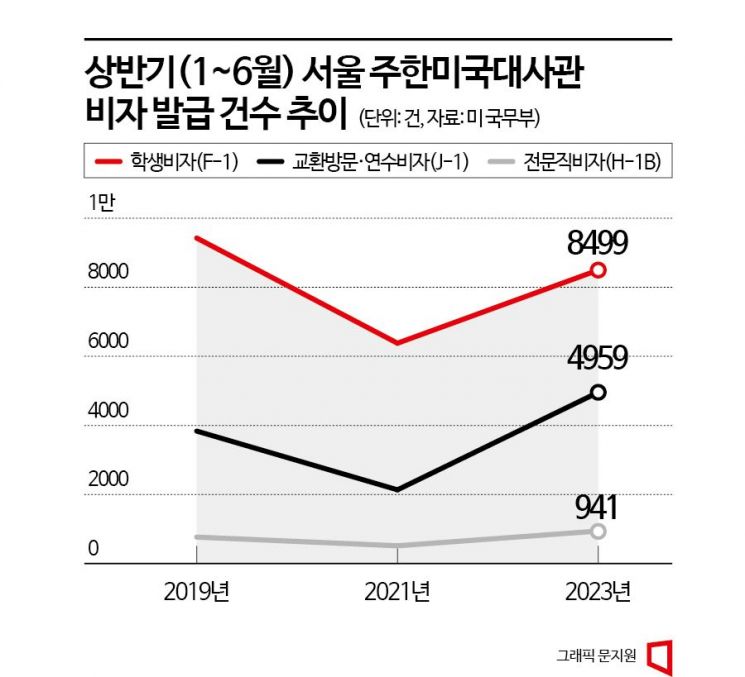
According to the U.S. Department of State's 'Nonimmigrant Visa Issuance Statistics' on the 7th, the number of student visas (F-1), exchange visitor/training visas (J-1), and specialty occupation visas (H-1B) issued by the U.S. Embassy in Seoul in the first half of this year (January to June) were 8,449, 4,959, and 941 respectively, recovering to pre-COVID-19 levels. In the first half of 2019, before the pandemic, the numbers were 9,426 for F-1, 3,836 for J-1, and 766 for H-1B. The F-1 visa is for studying at U.S. middle/high schools or universities or participating in language training; the J-1 visa is for internships and training; and the H-1B visa is for professionals seeking employment in the U.S. During the height of the COVID-19 pandemic in the first half of 2021, the numbers were 6,381, 2,135, and 514 respectively.
The Ministry of Foreign Affairs also expects that working holiday visas, which allow part-time work in countries with agreements, will recover to pre-COVID-19 levels this year. South Korea currently has working holiday agreements with 23 countries including the Netherlands, Germany, Japan, Canada, France, and Australia. Typically, working holiday visas can be applied for by those aged 18 to 30, with some countries allowing applications up to age 34. A Ministry of Foreign Affairs official said, "Although exact counts need to be confirmed by each embassy, it seems that working holiday visas will return to normal levels this year as the impact of COVID-19 diminishes." Until 2019, before COVID-19, about 40,000 people annually received working holiday visas. The Ministry reported that in 2021 and 2022, due to COVID-19, the numbers were around 10,000 each year.
One of the biggest reasons young people who are leaving their jobs to go abroad cited was the desire to experience foreign corporate culture. Jung (27, female), who worked as a marketer, is preparing to go to Canada next month. Her decision was influenced by her frustration with the company culture where even if the staff reached consensus, the work proceeded according to the wishes of higher-ups. Jung said, "I plan to utilize my marketing skills and work overseas."
Lee (26, female) is also preparing to go abroad after leaving a job she held for five years. She needed a breakthrough from long-lasting burnout (extreme physical and mental fatigue from work). Lee is currently honing her English skills at a language institute and plans to participate in a co-op program combining study and work as early as January next year. Lee said, "Life in Korea was competitive and intense. I want to experience if foreign companies are different in some way."
There are also young people who headed abroad to realize their long-held dream of 'living overseas.' Kim (27, male) has been working part-time at a large brand clothing store abroad on a working holiday visa since May. Kim said, "Four years ago, when my father passed away, I started thinking about 'death,' and I vowed not to give up on what I want to do because of the pressures of daily life."
Experts say this reflects the characteristics of the current 20s and 30s generation who take risks and challenge new things. Gu Jung-woo, a professor of sociology at Sungkyunkwan University, said, "Exposure through various media has greatly reduced the apprehension or fear of foreign languages and cultures, leading to many challenges in living abroad. If the hierarchical and closed aspects still present in Korean corporate organizations were a motivation to quit jobs, then the free atmosphere and cultural richness abroad have become factors attracting them."
© The Asia Business Daily(www.asiae.co.kr). All rights reserved.
![Clutching a Stolen Dior Bag, Saying "I Hate Being Poor but Real"... The Grotesque Con of a "Human Knockoff" [Slate]](https://cwcontent.asiae.co.kr/asiaresize/183/2026021902243444107_1771435474.jpg)

















