Financial Services Commission Temporarily Bans Short Selling Until First Half of Next Year
Ruling Party Calls It a "Drastic Measure" VS Opposition Party "Agrees to Suspension"
The ruling party and government have consecutively unveiled megaton-level policy cards ahead of next year's general election, including the incorporation of Gimpo City into Seoul and a temporary ban on short selling, putting the opposition party in a difficult position. Since public opinion on these issues is sharply divided, it is difficult for the opposition to openly oppose them. While the prevailing view is that the ruling party has preempted issues that will shake up the next general election, the side effects of these policies are also clear, making it uncertain whether the ruling party will maintain the initiative until the election.
On the 6th, Yoon Jae-ok, floor leader of the People Power Party, referred to the Financial Services Commission's decision the previous day to ban short selling until the first half of next year during the party's Supreme Council meeting, saying, "There was a high level of dissatisfaction among 14 million retail investors," and evaluated it as "an extraordinary measure to prevent the exploitation of honest retail investors and to ensure fair price formation." Yoon said, "If market manipulation and illegal short selling continue to cause unfair competition, market trust will collapse and investors will withdraw," adding, "I hope this will be an opportunity to improve the fairness and reliability of the Korean capital market and take a step forward, as retail investors wish."
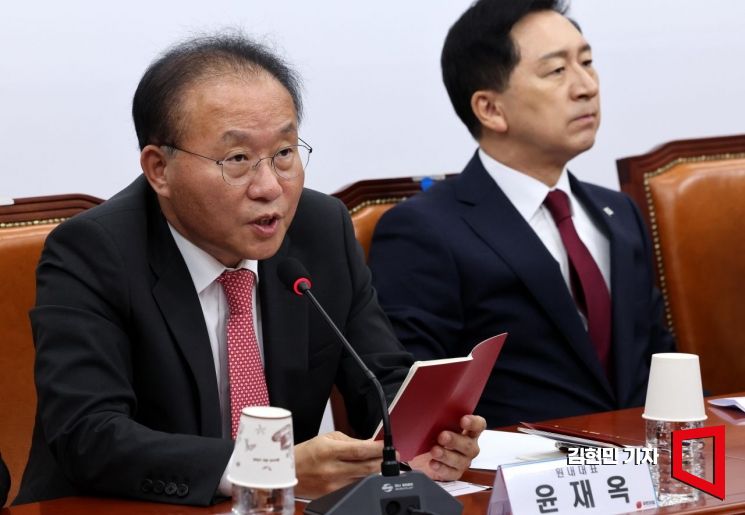 Yoon Jae-ok, floor leader of the People Power Party, is speaking at the Supreme Council meeting held at the National Assembly on the 6th. Photo by Kim Hyun-min kimhyun81@
Yu Eui-dong, chairman of the People Power Party's Policy Committee, said regarding this measure, "It is a step to improve the tilted playing field between individuals and institutional forces and the beginning of stock market normalization," and added, "I hope that naked short selling will be eradicated and a progressive improvement direction will be derived." Yu said, "The People Power Party will do its best to improve the system to protect the people's assets and stock market companies," and "This measure is not the end but the beginning."
In political circles, this short selling ban is seen as part of an election strategy targeting individual investors' votes ahead of the general election. Since the COVID-19 pandemic, individual investors, including those in their 20s and 30s who have entered stock investment, have had significant dissatisfaction with short selling, the ban on short selling is seen as a plan to regain their support. On the 15th of last month, a national consent petition advocating for the improvement of the short selling system received over 50,000 signatures and was referred to the National Assembly's Political Affairs Committee. On the same day, Lee So-young, a Democratic Party lawmaker, criticized on CBS Radio that the ban on short selling and the incorporation of Gimpo into Seoul are "both procedurally very hasty and are populist policies planned for short-term political gain." On the other hand, Park Jeong-ha, chief spokesperson for the People Power Party, told reporters after the Supreme Council meeting, "I find it hard to agree with some criticisms that the short selling ban was hastily prepared," and asked to view it from the perspective of stock market normalization and resolving Korea discount issues.
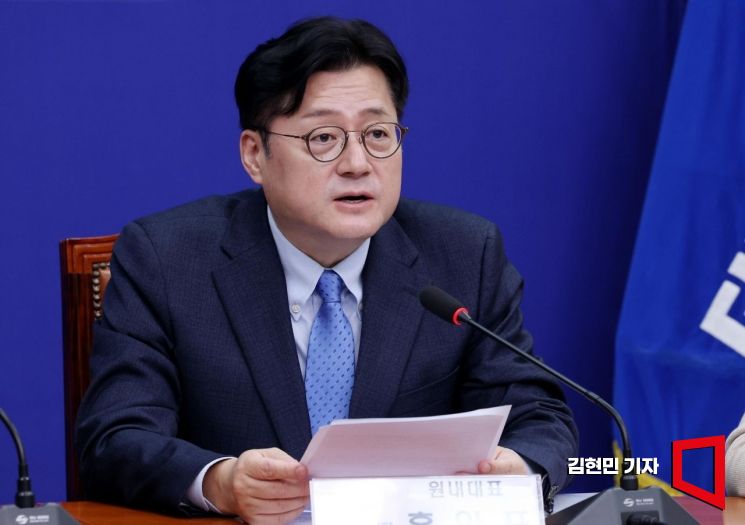 Hong Ik-pyo, the floor leader of the Democratic Party of Korea, is speaking at the Supreme Council meeting held at the National Assembly on the 6th. Photo by Kim Hyun-min kimhyun81@
However, the opposition party does not seem to have an appropriate countermeasure. Hong Ik-pyo, floor leader of the Democratic Party, said on MBC Radio, "There are too many forces manipulating short selling in the financial market, so our party has been the first to say that it should be temporarily suspended or fundamentally reformed," and added, "So we agree with the suspension of the system itself." Although they see it as a populist policy for the general election, they appear to avoid direct confrontation. Previously, regarding the Gimpo Seoul incorporation issue, the Democratic Party proposed a nationwide administrative reform with five mega-cities including the Busan-Ulsan-Gyeongnam, Chungcheong, Gwangju-Jeonnam, Daegu-Gyeongbuk, and the metropolitan area as a countermeasure. However, they have withheld clear answers on their stance regarding the pros and cons of the controversial Gimpo Seoul issue.
Meanwhile, both ruling and opposition parties formed election planning teams on the same day to begin full-scale preparations for the general election. The People Power Party formed an election planning team led by Lee Man-hee, secretary-general of the People Power Party, at the Supreme Council meeting. The Democratic Party held the first meeting of its election planning team with party leader Lee Jae-myung in attendance.
© The Asia Business Daily(www.asiae.co.kr). All rights reserved.
![Clutching a Stolen Dior Bag, Saying "I Hate Being Poor but Real"... The Grotesque Con of a "Human Knockoff" [Slate]](https://cwcontent.asiae.co.kr/asiaresize/183/2026021902243444107_1771435474.jpg)
















