IBS Research Team Develops Material to Replace Damaged Tissue
Injection into Injury Site... Also Aids Recovery
A new bio-nanomaterial that aids rapid regeneration in the early stages of muscle or nerve damage has been developed. This nanomaterial is an injectable implant, and its rapid regenerative effects have been confirmed in animal experiments.
The research team led by Professors Shin Mi-kyung and Son Dong-hee from the Brain Science Imaging Research Group at the Institute for Basic Science (IBS) and Sungkyunkwan University developed an injectable implant material that replaces the function of damaged tissues.
Typically, if patients with early-stage muscle damage do not receive appropriate treatment, chronic muscle function loss occurs, which can lead to disabilities. To prevent muscle strength reduction, it is necessary to promote muscle recovery while also undergoing rehabilitation therapy.
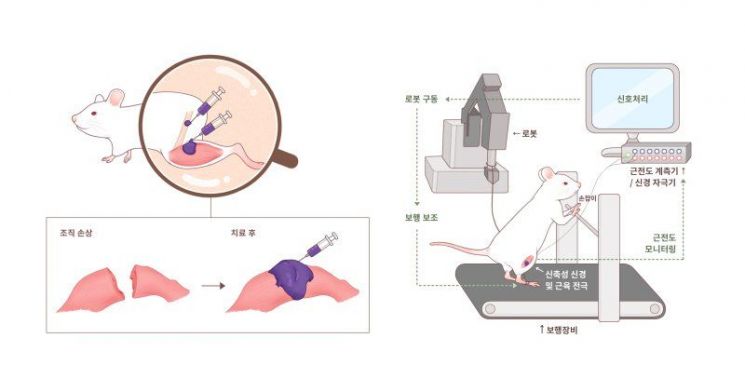 Hydrogel Material for Injectable Tissue Prosthetics
 [Image Source=Institute for Basic Science (IBS)]
Recently, technologies such as robots, wearable devices, and implantable devices that assist damaged muscles or nerves have gained attention. However, the devices connecting external equipment to internal tissues tend to be too large, making implantation difficult.
The newly developed nanomaterial is soft like biological tissue, adheres well to tissues, and has low electrical resistance, allowing it to transmit electrical signals between muscles and nerves.
This material is a hydrogel based on hyaluronic acid, which is frequently used as a filler for skin beauty treatments. Gold nanoparticles were added to reduce electrical resistance. Most importantly, like fillers, it can be injected into damaged areas, making implantation relatively easy.
The researchers confirmed that when the implant was injected, it closely adhered to the surface of the damaged tissue. Additionally, the implant successfully transmitted electrophysiological signals that promote the formation of healthy tissue.
In animal experiments, rapid muscle regeneration and rehabilitation effects were also observed. Simply filling the tissue damage area with the injected implant improved tissue regeneration.
Regarding this, Professor Shin Mi-kyung explained, "This injectable electrically conductive soft tissue implant can be easily applied to severe muscle injuries that require neuromuscular rehabilitation training. In the future, it could be utilized as a new material for tissue regeneration applicable to various organs such as the brain and heart."
Professor Son Dong-hee also anticipated, "It could be expanded to precise diagnosis and treatment of various organs within the human body in the future."
© The Asia Business Daily(www.asiae.co.kr). All rights reserved.
![Clutching a Stolen Dior Bag, Saying "I Hate Being Poor but Real"... The Grotesque Con of a "Human Knockoff" [Slate]](https://cwcontent.asiae.co.kr/asiaresize/183/2026021902243444107_1771435474.jpg)















