Won-Dollar Exchange Rate Plummets 35 Won in Last Two Days
Dollar Weakness Reverses, Driving Exchange Rate Down
International Oil Prices, Affecting Inflation, Also Weak for 2nd Week
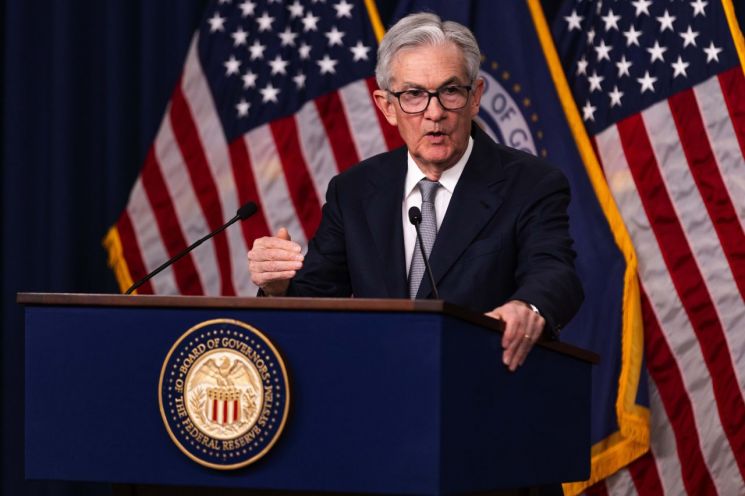 Jerome Powell, Chairman of the U.S. Federal Reserve (Fed), is holding a press conference after the Federal Open Market Committee (FOMC) meeting ended on the 1st (local time) in Washington DC. [Image source=Yonhap News]
The won-dollar exchange rate has dropped nearly 35 won since the beginning of this month. This is because expectations for additional interest rate hikes by the U.S. Federal Reserve (Fed) have diminished, causing the dollar to weaken. The previously strong U.S. employment indicators have shown signs of slowing down, and with international oil prices also recently declining, there is analysis suggesting that the won-dollar exchange rate could fall further in the future.
According to the Seoul foreign exchange market on the 4th, the won-dollar exchange rate closed at 1,322.4 won, down 20.5 won from the previous day. Based on closing prices, it has fallen a total of 34.9 won over two days since the 1st (1,357.3 won). Considering that the exchange rate had surged to 1,360 won intraday as recently as the 26th of last month, this represents a clear downward trend.
This is due to the dollar weakening. The dollar index, which reflects the dollar's value against six major currencies, fell from 106.129 to 105.120. The Fed's dovish stance, demonstrated by holding the policy rate steady at 5.25-5.50% annually during the Federal Open Market Committee (FOMC) meeting on the 1st (local time), had a significant impact.
In September, the Fed had hinted at the possibility of one more rate hike within the year through its dot plot, but this time it distanced itself by explaining that the dot plot merely reflects the individual views of Fed members at a given point in time. Particularly, Fed Chair Jerome Powell positively assessed the inflation situation during the press conference, stating that "inflation has moderated since mid-last year."
Of course, Chair Powell left the door open for further hikes, saying, "There is a notion that if the benchmark rate is held steady once or twice, it will be difficult to raise it again, but that is not true." However, the market generally viewed this FOMC as dovish. The UK economic research firm Capital Economics explained, "While the Fed has left the possibility of further hikes open, considering Chair Powell's dovish press conference and the expected slowdown in future data, the likelihood of additional hikes has diminished."
The recent slowdown in U.S. employment data could also be a factor in the won-dollar exchange rate decline. On the 3rd (local time), the U.S. Department of Labor reported that nonfarm payrolls increased by 150,000 in October compared to the previous month, which not only fell short of the 170,000 forecast compiled by The Wall Street Journal (WSJ) experts but was also only about half of the revised 297,000 figure for September.
Due to the slowdown in the U.S. labor market, investors judged that the possibility of further Fed rate hikes has further retreated. Consequently, U.S. Treasury prices rebounded, and the 2-year Treasury yield fell to 4.85%, the lowest in two months. The International Finance Center explained, "Immediately after the employment data release, the futures market brought forward the expected timing of the first rate cut next year from July to June, and the possibility of additional hikes within this year is considered to have significantly weakened."
 On the 2nd (local time), smoke and flames rose from an Israeli airstrike in Tal al-Hawa, Gaza City, Palestine. [Image source=Yonhap News]
International oil prices, which greatly influence inflation and monetary policy in major countries including the U.S., have also turned downward. On this day at the New York Mercantile Exchange, the December delivery West Texas Intermediate (WTI) crude oil price closed at $80.51 per barrel, down $1.95 (2.36%) from the previous session. It fell $5.03 (5.88%) just this week, marking two consecutive weeks of weakness.
This is despite expectations that the Fed will halt further rate hikes, influenced by reduced concerns over the escalation of the Israel-Hamas war. Although Israel, focusing on eradicating the Palestinian militant group Hamas, has launched a full-scale ground offensive in the Gaza Strip, the conflict has not spread to other Middle Eastern countries, leading the market to form expectations that global oil supply and trade disruptions can be avoided.
In a report on the day, the International Finance Center stated, "International oil prices fluctuated mainly due to demand concerns stemming from weak Chinese economic indicators and increased U.S. inventories as worries about the spread of the Middle East conflict eased." It added, "In the options market, the previously sharp increase in WTI and Brent crude call option purchases immediately after the outbreak of the armed conflict has been quickly unwound, weakening the call option buying dominance and lowering implied volatility."
However, uncertainties surrounding international oil prices remain. Saudi Arabia may extend its voluntary production cuts beyond the end of December, and Russia is reportedly unlikely to lift restrictions on diesel maritime exports until domestic shortages are fully resolved.
© The Asia Business Daily(www.asiae.co.kr). All rights reserved.
![Clutching a Stolen Dior Bag, Saying "I Hate Being Poor but Real"... The Grotesque Con of a "Human Knockoff" [Slate]](https://cwcontent.asiae.co.kr/asiaresize/183/2026021902243444107_1771435474.jpg)
















