"If It Was Food the Deceased Liked, It's Okay"
Recommendation to Simplify from 15 to 8 Types of Food
"Family Conflicts Should Not Arise Because of Jesa"
Sungkyunkwan has issued a recommendation for simplifying ancestral rites food, one of the causes of family conflicts during holidays, advising that the whole family prepare it together.
On the 2nd, the Sungkyunkwan Ritual Establishment Committee held a press conference at the National Assembly Communication Center and announced the "Recommendation for the Preservation and Modernization of Traditional Ancestral Rites."
The committee proposed the presentation method of the ancestral rites table for the memorial rites held on the day of the ancestor's death and the tomb rites held at the tombs of ancestors from the third month onward. The committee explained, "It is good to naturally set the table with simple everyday side dishes and also offer foods that the deceased liked."
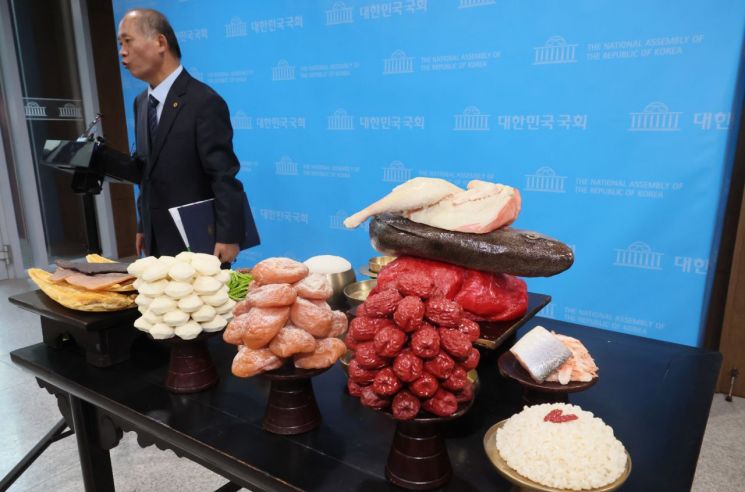 The Gyungkwan Ritual Establishment Committee held a press conference on the 2nd at the National Assembly Communication Hall to promote the correct understanding of traditional ancestral rites in 2023, announcing recommendations for ancestral rites considering the characteristics of modern society and measures to preserve traditional rites.
 [Photo by Yonhap News]
Choi Young-gap, Chairman of the Sungkyunkwan Confucianism Association Headquarters, said, "The important thing in ancestral rites is the attitude when performing them, not the types or number of dishes, which can be adjusted according to each family's circumstances."
Sungkyunkwan had previously suggested that it is not necessary to place pan-fried jeon (Korean pancakes) made with oil on the holiday ritual table. Chairman Choi also said that it is not necessary to fry jeon during ancestral rites.
Regarding the time of the rites, it should, in principle, be held at the first dawn of the day the ancestor passed away (11 PM to 1 AM), but it is also acceptable to hold it in the early evening (6 to 8 PM) of the day of death with family agreement. Concerning the preparation of ancestral rites food, which has mainly been handled by women, Sungkyunkwan stated, "It is better for all family members who commemorate the deceased to prepare together."
The committee also left room for flexibility in other matters according to circumstances. It stated that the ritual prayer can be written in Hangul instead of classical Chinese, and the ancestral tablet can be replaced with a photo or a memorial tablet. Even if the parents' death anniversaries are on different days, rites can be held together, and if there are no ritual vessels, ordinary dishes can be used.
The committee also cited Supreme Court precedents, stating that the deceased's children should agree on the person in charge of the rites, and regardless of gender, the eldest can take the role.
"Ancestral rites must change with the times"
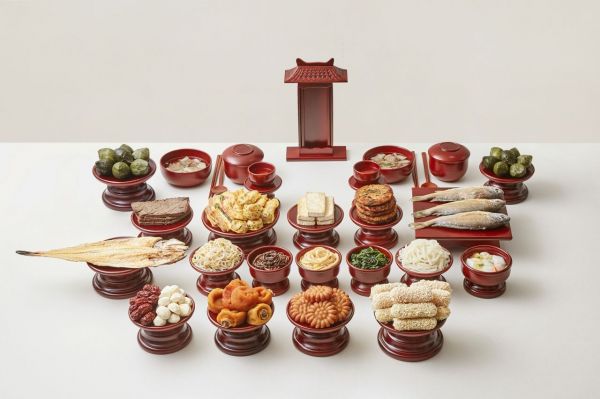 Separate from simplifying ancestral rites in ordinary households, it was stated that measures are needed to prevent the loss of traditional ceremonial culture preserved and passed down mainly by Jongga families for the preservation and succession of traditional rites.
 [Photo by Asia Economy DB]
This simplification plan for ancestral rites reflects recent survey results. In a perception survey conducted last September targeting 1,500 men and women aged 20 and over, 55.9% of respondents said they do not plan to hold ancestral rites in the future, and 44.9% expressed the need for simplification of food and format.
However, the committee stated that, separate from simplifying rites for ordinary households, measures are needed to prevent the loss of ritual culture preserved mainly by the head families for the preservation and succession of traditional ancestral rites.
In particular, the committee proposed that rites held for the spirit tablets of those who have made great contributions and are permanently enshrined in ancestral shrines with government permission, known as Bulcheonwi (不遷位), be designated as "World Intangible Cultural Heritage" or "National Intangible Cultural Heritage."
Finally, the committee stated that ancestral rites are "a way to commemorate ancestors, revive memories, and promote harmony among family members," and that "if conflicts arise because of ancestral rites, it is not the right way."
© The Asia Business Daily(www.asiae.co.kr). All rights reserved.
![Clutching a Stolen Dior Bag, Saying "I Hate Being Poor but Real"... The Grotesque Con of a "Human Knockoff" [Slate]](https://cwcontent.asiae.co.kr/asiaresize/183/2026021902243444107_1771435474.jpg)

















