October SSI Records Largest Drop in 1 Year
Signal of Market Bullish Phase Reversal
There is a forecast that the U.S. stock market, which has been experiencing a sluggish trend recently, will soar next year.
On the 1st (local time), Bank of America predicted that the S&P 500 index, composed of large-cap U.S. stocks, will rise by about 15.5% over the next 12 months. Savita Subramanian, an analyst at Bank of America, said in an investor memo that day, "The S&P 500 index will rise to around 4850, a 15.5% increase from the current level, within the next 12 months."
She analyzed, "The sell-side index (SSI) falling by the largest margin in a year last month is a sign that the stock market is beginning to shift into a bullish phase." This means that the U.S. stock market, which has recently been in a correction phase, has passed its worst point. The sell-side index is an indicator used by Wall Street financial institutions to predict the stock market's direction, and a decline in the sell-side index signals the start of a bull market.
She added, "The outlook that the high interest rate environment will act as a further downward factor for the U.S. stock market is partially greatly exaggerated," and said, "Although the prolonged high interest rate outlook has burdened investor sentiment, U.S. companies and consumers are strong enough to overcome this burden." She also predicted, "Since more than 75% of the debt held by S&P 500 companies and 85% of mortgage rates are financed with long-term fixed rates, the impact of the recent surge in market interest rates will be limited."
European financial group UBS also expects the U.S. stock market to rebound next year. In a stock outlook report released on the 23rd of last month, UBS set the S&P 500 index targets at 4500 by the end of the first half of next year and 4700 by the end of the year. These levels are 6.2% and 11% higher than the current closing price, respectively. UBS stated, "The earnings growth rate of S&P 500 companies, which was around 3-4% in the third quarter this year, is expected to rise to 9% next year."
David Lefkowitz, an analyst at UBS, said, "The stock market rebound will be delayed more than initially expected," adding, "We still expect a soft landing for the U.S. economy, which will lead to corporate earnings growth rates approaching double digits." He continued, "Although the current valuation of the U.S. stock market is historically high, considering the low unemployment rate and inflation situation, it is judged to be at a reasonable level." UBS initially expected the S&P 500 index to reach 4700 by the end of the first half of next year.
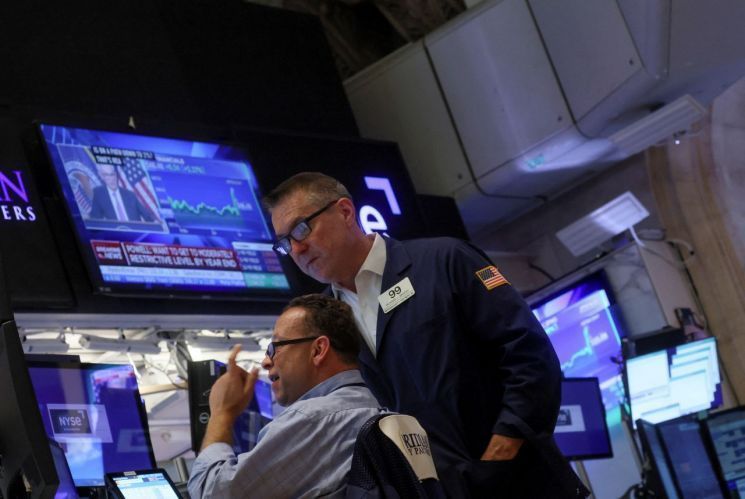
The three major U.S. stock indices have been declining for three consecutive months since August. Reversing the sharp rally that continued in the first half of this year, the S&P 500 index fell back to the level seen at the end of May. The S&P 500 index dropped by 2.2% last month alone and by 8% over the past three months. In September, following Jerome Powell's hawkish remarks at the Federal Open Market Committee (FOMC), concerns deepened, and the rise in U.S. Treasury yields, a safe-haven asset, dampened investor sentiment.
Additionally, the outbreak of armed conflict between Israel and the Palestinian militant group Hamas, which stimulated inflation and highlighted factors prolonging monetary tightening, further weakened investor sentiment. The U.S. stock market's three-month consecutive downward trend is the first since early 2020. However, due to the strong rally in the first half of this year, the S&P 500 index has shown an approximately 10% increase from the beginning of the year to the present.
© The Asia Business Daily(www.asiae.co.kr). All rights reserved.
![Clutching a Stolen Dior Bag, Saying "I Hate Being Poor but Real"... The Grotesque Con of a "Human Knockoff" [Slate]](https://cwcontent.asiae.co.kr/asiaresize/183/2026021902243444107_1771435474.jpg)















