US Fed Holds Interest Rates Steady... Expectations Rise for Rate Hike End
Dollar Weakens, KRW-USD Exchange Rate Declines
However, October Consumer Price Inflation Widens
With High Uncertainty, Bank of Korea Likely to Hold Rates in November
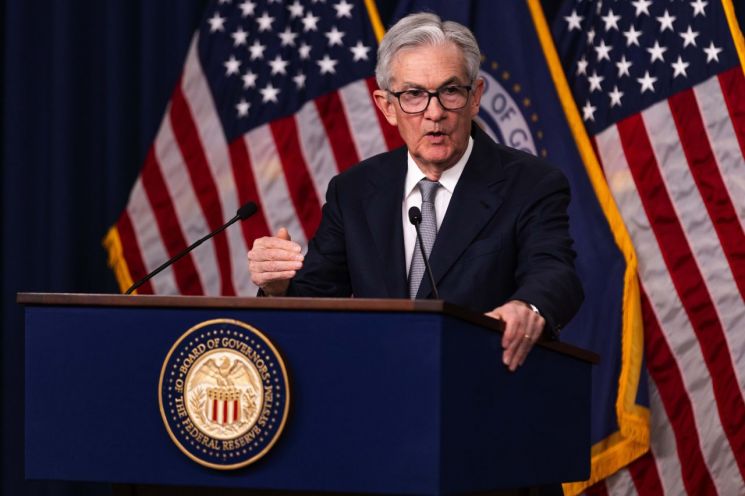 Jerome Powell, Chairman of the U.S. Federal Reserve (Fed), is holding a press conference after the Federal Open Market Committee (FOMC) meeting ended on the 1st (local time) in Washington DC. [Image source=Yonhap News]
As expectations for additional interest rate hikes by the U.S. Federal Reserve (Fed) weaken, the strength of the dollar has slightly eased. However, domestic consumer prices have increased for three consecutive months, maintaining uncertainty surrounding the Bank of Korea's (BOK) monetary policy direction.
If U.S. tightening concludes, the BOK could advance the timing of its 'pivot' (monetary policy shift). Conversely, if the U.S. maintains a high interest rate stance for an extended period and domestic inflation continues to rise, the BOK's timing for cutting its benchmark interest rate could be delayed until after the first half of next year, according to some analyses.
On the 2nd, the BOK held a market situation review meeting chaired by First Vice Governor Lee Sang-hyung to assess the impact of the overnight U.S. Federal Open Market Committee (FOMC) results on domestic financial and foreign exchange markets. The Fed kept its policy rate unchanged at 5.25-5.50%, as expected by the market, maintaining a 2 percentage point gap between the Korean and U.S. benchmark interest rates.
The BOK evaluated that the FOMC policy statement and Fed Chair Jerome Powell's press conference were interpreted somewhat dovishly (favoring monetary easing), leading to a decline in government bond yields and a rise in stock prices. Since Chair Powell acknowledged that the recent rise in long-term U.S. Treasury yields is substituting for the effects of policy rate hikes, the possibility of further rate increases has diminished.
Accordingly, the won-dollar exchange rate also showed a downward trend. According to the Seoul foreign exchange market on the day, the won-dollar exchange rate opened at 1,348.5 won, down 8.8 won from the previous trading day, and fluctuated in the low to mid-1,340 won range during the early session. Considering that the exchange rate surged to 1,360 won on the 26th of last month, this represents a clear decline.
In particular, Chair Powell's positive assessment that "U.S. inflation has moderated since mid-last year" has led many in the market to conclude that the Fed's rate hikes have effectively ended. The UK economic research firm Capital Economics stated, "While the Fed has left the door open for further hikes, considering Chair Powell's dovish press conference and expected data slowdown, the likelihood of additional increases has diminished."
With the Monetary Policy Board meeting scheduled for the 30th, the BOK is also expected to decide on a seventh consecutive rate hold. Amid mixed uncertainties about inflation's upside and downside risks, the BOK has kept the benchmark rate steady at 3.5% since February, leaving open only the possibility of future hikes. Given Korea's strong sensitivity to U.S. monetary policy, it is difficult for the BOK to raise rates alone while the Fed remains on hold.
First Vice Governor Lee Sang-hyung said, "At this FOMC meeting, the recent sharp rise in long-term yields was cited as a factor tightening financial conditions, which has somewhat eased market concerns about further rate hikes," but added, "it is important to note that Chair Powell consistently emphasized the need to maintain a tightening stance to achieve the inflation target during the press conference."
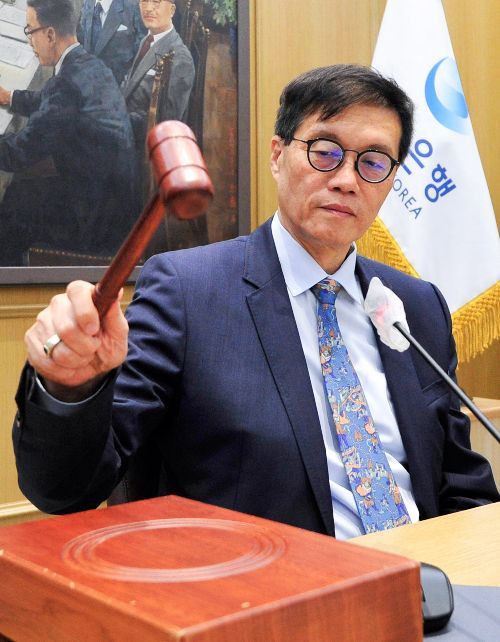 Lee Chang-yong, Governor of the Bank of Korea, is striking the gavel at the Monetary Policy Committee meeting held at the Bank of Korea in Jung-gu, Seoul, on the 19th of last month. Photo by Joint Press Corps
However, rising international oil prices due to geopolitical risks in the Middle East and the expanding increase in domestic consumer prices could exert upward pressure on the BOK's benchmark interest rate. According to Statistics Korea on the day, consumer prices increased by 3.4% in August, 3.7% in September, and 3.8% in October, marking three consecutive months of accelerating inflation.
Amid abnormal weather causing significant rises in agricultural product prices, the war between Israel and the Palestinian armed group Hamas has further unsettled international oil prices. Lee Chang-yong, Governor of the Bank of Korea, said at a seminar co-hosted with the Korea Chamber of Commerce and Industry the previous day, "If international oil prices rise above $90, our (inflation and growth) forecasts could change significantly." The BOK had initially expected international oil prices to average $84 in the second half of this year and the first half of next year.
The BOK also anticipates that inflation trends will exceed initial expectations, considering rising oil and agricultural product prices. Kim Woong, BOK First Vice Governor, explained at a morning inflation review meeting, "Uncertainties have increased significantly regarding the development of the Israel-Hamas conflict, resulting oil price trends, and domestic and international economic conditions. However, if oil prices do not rise sharply further, inflation is expected to show a slowing trend going forward."
Market forecasts suggest that the BOK will maintain a hawkish hold stance for the time being and consider rate cuts only after clear signs of a U.S. pivot emerge after the second quarter of next year. Ha Geon-hyung, a researcher at Shinhan Investment Corp., said, "The Fed's hawkish (monetary tightening preference) tone is clearly beginning to weaken," but added, "Since there are no hints yet of a shift to monetary easing, it is likely that the high interest rate environment will persist, and the BOK will make similar policy decisions."
© The Asia Business Daily(www.asiae.co.kr). All rights reserved.
![Clutching a Stolen Dior Bag, Saying "I Hate Being Poor but Real"... The Grotesque Con of a "Human Knockoff" [Slate]](https://cwcontent.asiae.co.kr/asiaresize/183/2026021902243444107_1771435474.jpg)
















