President Yoon Criticizes 'Monopoly Abuse'
Unveils 'Commission Reform' Card
But Kakao Mobility Faces No Clear Solution
Kakao Mobility has emerged as a crisis trigger for the Kakao Group, following SM Entertainment. Amid intense government scrutiny over accounting fraud, discrimination against non-affiliated taxis, and the exploitation of startup technology, even President Yoon Suk-yeol has criticized the company for 'monopolistic tyranny.' Although Kakao Mobility is under comprehensive pressure due to unprofitable businesses, both sale and IPO options are blocked, leaving virtually no way out.
Kakao Mobility plans to hold an emergency meeting with taxi organizations soon to discuss a revision of the commission system. This move comes after President Yoon pointed out Kakao Taxi's monopolistic behavior during the Emergency Economic and Livelihood Meeting on the 1st, prompting urgent countermeasures. President Yoon instructed government officials to devise measures, saying, "When a monopoly is formed by eliminating all competitors and completely dominating the market, raising prices to extract profits is predatory pricing."
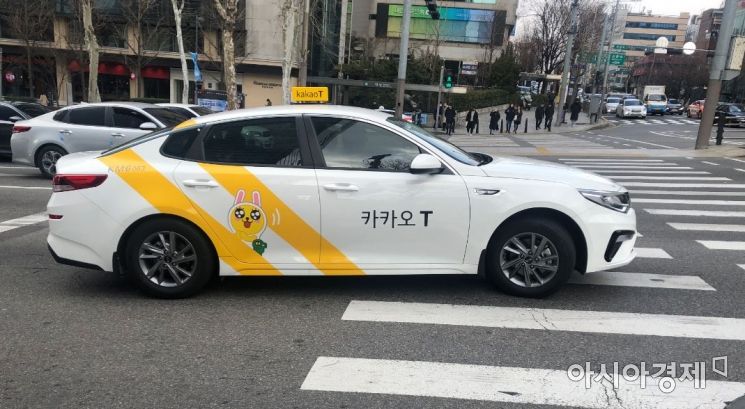
Recently, pressure from authorities on Kakao Mobility has intensified. The Fair Trade Commission sent a review report last week stating that Kakao Mobility's practice of favoring affiliated taxi calls violates the Fair Trade Act and should be reported to the prosecution. The commission is also reviewing a petition alleging that Kakao Mobility stole ideas from the startup Hwalmang. The Financial Supervisory Service is conducting an accounting investigation over suspicions of accounting fraud.
The controversy surrounding Kakao Mobility persists because the company effectively monopolizes the taxi-hailing app market. Every time new revenue models such as 'carpool' and 'smart call' were introduced, they faced backlash from the taxi industry accusing them of 'monopolistic bullying.' This led to disputes over infringement on local businesses and criticism from political circles. With business expansion stalled, Kakao pulled out the card of selling its mobility business but retracted it due to internal opposition.
Another option is an initial public offering (IPO). Kakao Mobility is under pressure from global investors to go public. Although investments were made on the condition of listing from the early stages, the plan has been delayed. This has become uncertain recently due to accounting fraud allegations. To proceed with the listing process, conclusions on the accounting fraud suspicions must be reached. It could take years to go through the Financial Supervisory Service audit and the Securities and Futures Commission's resolution.
Amid accumulating adverse factors, Kakao Mobility's profitability has worsened. Last year's revenue was 791.5 billion KRW, with a net loss of 27.7 billion KRW. Despite increased revenue, the company turned to a loss due to fines imposed by the Fair Trade Commission. Even excluding fines, operating profit barely increased. Except for proxy call and parking lot businesses, it is known to be in the red. If Kakao Mobility lowers commissions as demanded by the taxi industry under these circumstances, it will inevitably have a negative impact on performance.
Although Kakao Mobility said it would hold an emergency meeting with the taxi industry to find a breakthrough, the lack of effective measures is also a problem. The most realistic option is to reduce commissions, but the taxi industry demands changes to the commission system itself, revenue calculation methods, and dispatch algorithm revisions. The accounting fraud suspicions raised by the Financial Supervisory Service also originated from complaints by the taxi industry. The accounting method of charging commissions to taxi operators and then refunding them inflated operating revenue, increasing tax burdens. Demands from the industry and political circles to separate brokerage business (general call) and franchise business (Blue Call) or to abolish commissions on roaming operations would shake Kakao Mobility's current business structure, making realization unlikely. Differences in opinions between affiliated and non-affiliated taxi operators are also obstacles. A Kakao Mobility official said, "We take the various concerns raised recently very seriously," adding, "Through the meeting, we will listen to the voices of taxi drivers, passengers, and the government, and make every effort to reform the service to satisfy everyone more."
© The Asia Business Daily(www.asiae.co.kr). All rights reserved.
![Clutching a Stolen Dior Bag, Saying "I Hate Being Poor but Real"... The Grotesque Con of a "Human Knockoff" [Slate]](https://cwcontent.asiae.co.kr/asiaresize/183/2026021902243444107_1771435474.jpg)















