Petroleum Products July -25.9% → October 1.3%
Decline Slows Amid Middle East Tensions
Agricultural Products Up 7.3% Since Last October
"Slower Decline Than Expected... Special Measures"
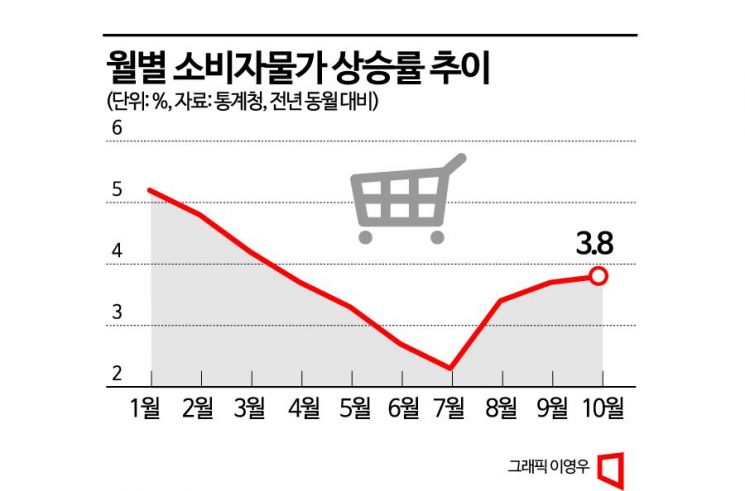
The policy of ‘price stability’ is being shaken. This is due to geopolitical factors such as the Israel-Palestine war reducing the extent of the oil price decline, and agricultural product prices rising due to adverse weather conditions. As the pace of price decline became more gradual than expected, the government decided to activate a special inter-ministerial response system. However, it maintained the forecast that prices will fall to the low 3% range by the end of the year.
Oil price fluctuations are the biggest variable
According to the ‘Consumer Price Trends’ announced by Statistics Korea on the 2nd, the consumer price index last month rose 3.8% compared to the same period last year. The inflation rate fell from 5.2% in January this year to 4.2% in March and 2.3% in July, but then rose for three consecutive months, approaching the 4% range. The living cost index, which reflects perceived inflation, rose more sharply from 1.8% in July to 4.6% in October.
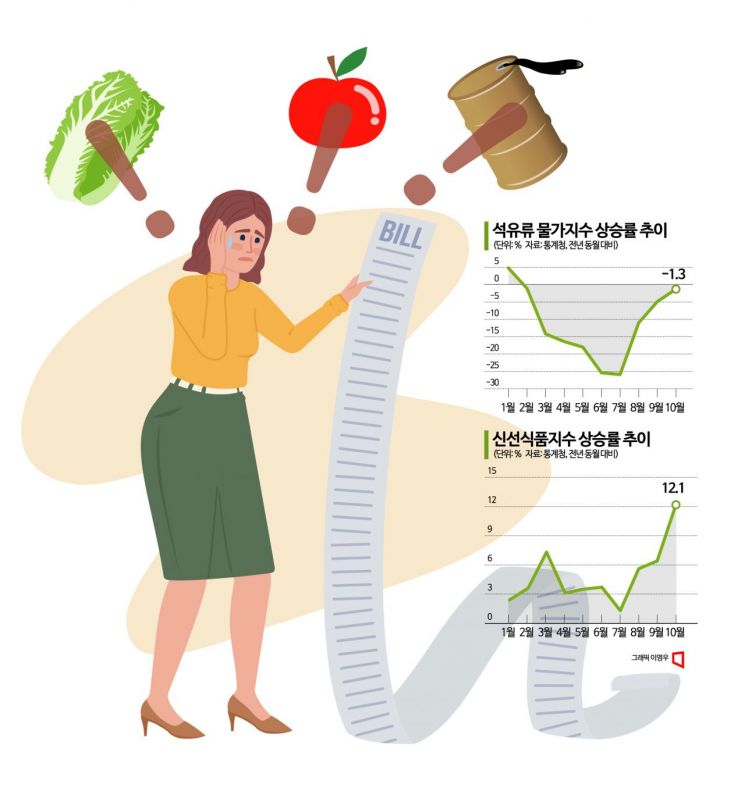
The reason for the increased rise is oil prices. Last month, the petroleum product index fell by only 1.3% compared to the same month last year. Petroleum products have shown a slowing decline with -25.9% in July, -11.0% in August, and -4.9% in September. Kim Bo-kyung, Economic Trend Statistics Officer at Statistics Korea, explained, “Although it is still negative compared to last year, the gap is gradually narrowing,” and added, “(Petroleum products) have significantly contributed to the rise in consumer prices over the past three months.”
The World Bank (WB) predicted in its ‘Commodity Market Outlook’ report on the 30th of last month that if the conflict between Israel and Palestine escalates into a ‘large-scale disruption’ in the Middle East, oil prices could rise by 56-75%. Lee Chang-yong, Governor of the Bank of Korea, also said the day before, “If oil prices reach $90 next year, the Bank of Korea’s forecasts could change significantly,” and “The oil price fluctuations in August and September are causing concern.”
Agricultural, livestock, and fishery products also rose 7.3% compared to October last year, fueling inflation. The increase was about twice that of September (3.7%). In particular, the inflation rate for agricultural products, including vegetables (5.3%), reached 13.5%, the highest in 29 months since May 2021 (14.9%). Among items, apples (72.4%), lettuce (40.7%), green onions (24.6%), and tomatoes (22.8%) rose sharply.
The fresh food index rose 12.1%, the highest in 13 months since September last year’s 12.8%. The fresh food index includes vegetables and fruits, which have large price fluctuations, and the impact of reduced harvests due to abnormal cold weather was significant. Among items, fresh fruits rose 26.2%, the largest increase since January 2011’s 31.9%.
The Ministry of Economy and Finance expects consumer prices to stabilize by the end of the year, despite the slower-than-expected decline. Although the average petroleum product price last month was higher than in September, the prices of gasoline and diesel continue to decline. The international price of Dubai crude oil fell from $93 per barrel in September to $88 at the end of last month. Agricultural product prices are expected to begin falling significantly from mid to late October.
Releasing stockpiles of kimchi-making ingredients
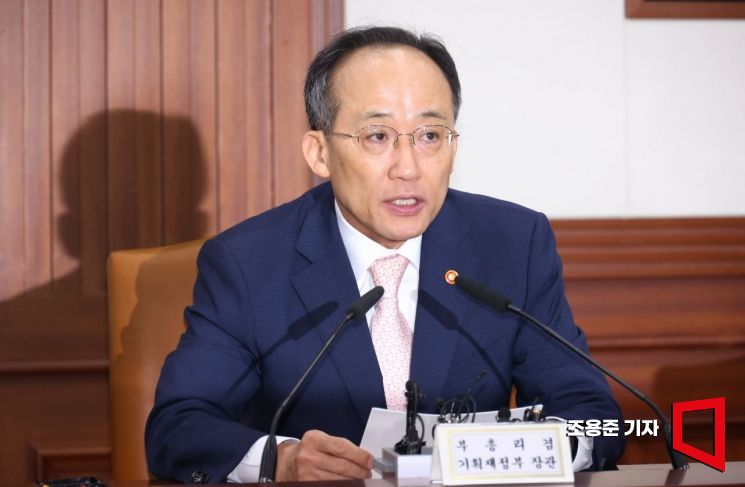 Deputy Prime Minister and Minister of Economy and Finance Choo Kyung-ho (left) is speaking about the inflation situation at the Emergency Economic Ministers' Meeting and Price-Related Ministers' Meeting held on the 2nd at the Government Seoul Office in Jongno-gu, Seoul. Photo by Jo Yong-jun jun21@
The government plans to lower consumers’ costs for purchasing kimchi-making ingredients compared to last year to stabilize prices during the kimchi-making season. Government stockpiles (about 11,000 tons) of napa cabbage, radish, red pepper powder, and green onions will be released as much as possible. In particular, 10,000 tons of solar salt, the highest ever, will be supplied to traditional markets and supermarkets at about one-third of the market price.
245 billion won will be invested in discounts for agricultural and fishery products, which is 77.5% (107 billion won) more than last year (138 billion won). The government will cooperate with the National Agricultural Cooperative Federation and others to support price reductions for napa cabbage, green onions, and ginger supplied to large supermarkets. By supporting 20-30% discounts at large supermarkets and allowing additional discounts by individual companies, consumer burdens are expected to be reduced by up to 50%. Using about 600 million won from the Korean Pork Producers Association, discounts of about 20% will also be encouraged for pork belly and front leg cuts.
The government will expand the purchase limit for Onnuri gift certificates at traditional markets to a maximum of 300,000 won per person per month until the end of December and will encourage kimchi ingredient sellers to join the gift certificate merchant network.
The government will also ease winter heating cost burdens by increasing energy cost support for vulnerable groups and facilities. Childcare centers have been added to the list of facilities eligible for city gas fee discounts, allowing them to receive fee reductions starting next month. About 20,000 childcare centers nationwide are expected to receive about a 16% discount. Heating cost support for senior centers nationwide (68,000 locations) during winter (November to March) will increase by 50,000 won to 370,000 won per month.
The energy voucher support amount will remain at the temporarily expanded level from last year, providing an average of 304,000 won per household. For about 4,500 households of children’s homes and single-parent families among livelihood and medical aid recipients using kerosene for heating, support will increase from 310,000 won to 641,000 won. Coal briquette coupons provided to about 40,000 households of basic livelihood recipients, near-poverty groups, elderly living alone, disabled persons, single-parent, and children’s homes will increase from 472,000 won to 546,000 won per household. Small business owners will be allowed to pay city gas bills used during winter (October to March) in equal installments over four months.
Deputy Prime Minister and Minister of Economy and Finance Choo Kyung-ho said, “Each ministry’s vice minister will serve as the price stabilization officer, taking full responsibility for stabilizing prices of their respective items,” and added, “For matters requiring cooperation among related agencies, such as supply and demand management and system improvements, we will respond immediately through the Price-Related Ministers’ and Vice Ministers’ meetings, with all ministries making every effort to stabilize prices.”
© The Asia Business Daily(www.asiae.co.kr). All rights reserved.
![Clutching a Stolen Dior Bag, Saying "I Hate Being Poor but Real"... The Grotesque Con of a "Human Knockoff" [Slate]](https://cwcontent.asiae.co.kr/asiaresize/183/2026021902243444107_1771435474.jpg)

















