China's annual real estate loan balance has decreased for the first time since 2005 amid a housing market downturn over the past two years.
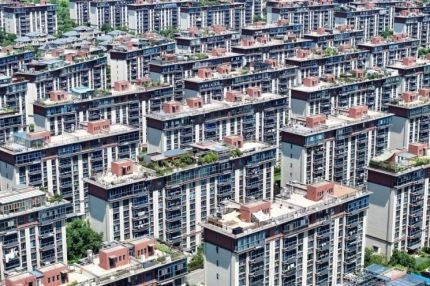 The Country Garden residential complex in Nanjing City, Jiangsu Province, China, completed last August [Image source=AFP Yonhap News]
According to local media such as Caixin on the 1st, the People's Bank of China, the country's central bank, announced in a statement that as of the end of September, the outstanding loans in the real estate sector amounted to 53.19 trillion yuan (approximately 984.5 trillion won), down 100 billion yuan (about 18.5 trillion won) from a year earlier.
This marks the first decline since records began in 2005. Experts interpret this as evidence of the pressure on the real estate market despite the authorities' stabilization efforts.
During the same period, the outstanding balance of mortgage loans decreased by 490 billion yuan (about 90.7 trillion won) to 38.42 trillion yuan (approximately 711.4 trillion won).
Despite the continued decline, the People's Bank of China stated that the overall slowdown in real estate loans is stabilizing, and the pace of loan reduction as of the end of September remained unchanged from August.
Although industrial production has somewhat improved in recent months, the ongoing real estate slump continues to weigh on China's economy.
Real estate development investment from the first to the third quarter fell 9.1% compared to the same period last year. The depressed real estate market shows little sign of recovery.
Previously, Chinese authorities implemented strict capital regulations in 2020 to eliminate the real estate market bubble and curb speculative overheating.
However, as the prolonged real estate downturn began to impact the broader economy, regulatory easing measures were introduced from the end of last year. This year, active stimulus policies, including the relaxation of mortgage loan requirements, have been announced.
Despite the reopening of economic activities, the slow economic recovery and defaults faced by major real estate developers such as Evergrande and Biguiyuan have led to analyses suggesting that real estate investment sentiment will be difficult to revive.
Bruce Pang, Chief China Economist at real estate advisory firm Jones Lang LaSalle, said, "As the real estate market continues to search for a bottom, a tug-of-war is taking place among homeowners, developers, and local governments."
© The Asia Business Daily(www.asiae.co.kr). All rights reserved.
![Clutching a Stolen Dior Bag, Saying "I Hate Being Poor but Real"... The Grotesque Con of a "Human Knockoff" [Slate]](https://cwcontent.asiae.co.kr/asiaresize/183/2026021902243444107_1771435474.jpg)















