Gwangju City "Safety is the Most Important, Will Be Careful"
As a tax revenue decrease of approximately 394.8 billion KRW is expected in 2024, there have been calls to devise budget-saving measures for the construction of Urban Railway Line 2.
Shim Cheol-ui, a member of the Gwangju Metropolitan Council (Democratic Party of Korea, Seo-gu 4), argued during a 5-minute speech at the 1st plenary session of the 2nd regular meeting of the 321st session on the 1st that using reclaimed steel decking plates could reduce the budget for the Urban Railway Line 2 construction.
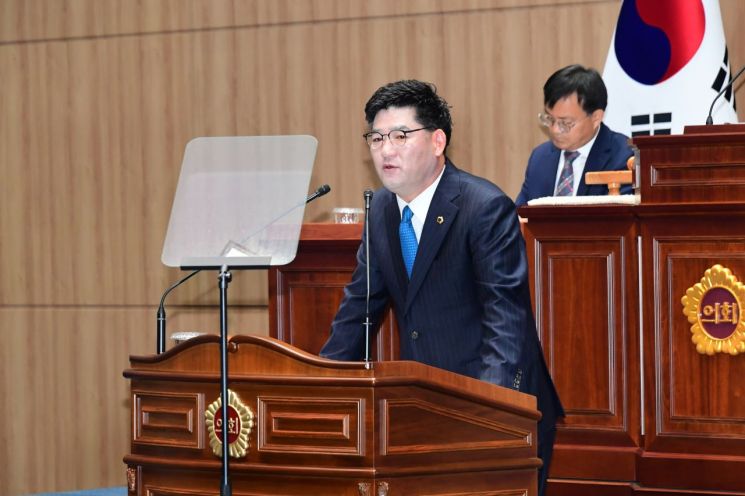
Originally, Gwangju City had proposed opening Phase 1 of Line 2 by the end of this year, but due to issues such as rising raw material prices and extended construction periods causing additional costs, it announced a delayed opening plan for Phase 1 in 2026, three years later than initially planned.
The total project cost for the Line 2 construction is 2.8772 trillion KRW, with Phase 2 costing 1.5036 trillion KRW. The cost for decking plates, materials that serve as temporary roads during road and subway construction, is expected to be around 24 billion KRW.
Shim stated, “The 24 billion KRW cost for decking plates is based on the unit price proposed by the city in 2020, which did not account for inflation.” He added, “Although raw material prices have risen by 40% over the past three years, the city’s proposed inflation adjustment rate is only 18.05%.”
Shim claimed that the city and the decking plate suppliers are currently engaged in litigation to renegotiate delivery prices due to inflation.
He emphasized, “If the city loses the lawsuit, the budget required for decking plate construction, including re-costs and inflation rates based on the lowest price information, will amount to 33 billion KRW. Even if the city wins, an additional budget of about 4.4 billion KRW will be needed.”
Shim argued that if the city wins, the suppliers, anticipating losses, may abandon the contract, which would not only require a budget of 57 billion KRW but also extend the construction period by at least six months, increasing inconvenience for citizens.
He further stated, “Using reclaimed steel decking plates could save 14 billion KRW or 42 billion KRW regardless of the lawsuit outcome.” He explained, “According to the Construction Quality Management Guidelines, quality inspections are conducted on one plate per 200 reclaimed decking plates, and if the inspection results meet the Ministry of Land, Infrastructure and Transport’s standards, reclaimed decking plates can be used at construction sites.”
He added, “No one can predict what additional complaints, incidents, or accidents might arise due to the extension of the Urban Railway Line 2 construction period.” He urged, “In the current situation where a tax revenue decrease of several hundred billion KRW and local bond issuance are expected, active efforts to find budget-saving measures are necessary.”
In response, Gwangju City stated in a written reply that safety is the top priority at all construction sites, including Urban Railway Line 2, and that decking plates are critical materials that must support tens of thousands of vehicles daily, so safety is handled with utmost care.
Therefore, the decking plates used in subway construction are new products with guaranteed strength, and the use of new products is mandated for safety in the Phase 2 construction of Urban Railway Line 2 as well.
A city official said, “If decking plates used in Phase 1 are to be reused at the Phase 2 construction site, a ‘100% material quality test’ is deemed unavoidable for safety reasons.” He explained, “This is because even one defective decking plate could cause a major fatal accident if it falls.”
He also clarified, “If a 100% material quality test is conducted, the estimated cost would be 148.2 billion KRW, so there would be no budget-saving effect.”
Regarding the claim that “instead of a full quality test of all Phase 1 decking plates (148.2 billion KRW), a quality test of one plate per 200 (500 million KRW) is legally acceptable,” the city official rebutted.
The official explained, “According to the Construction Quality Management Guidelines, quality inspections are applied at a rate of one plate per 200 only for newly introduced materials.”
He added that if decking plates used in Phase 1 are reused at the Phase 2 site, a ‘100% material quality test’ is considered unavoidable to ensure safety. The decking plates currently used in Phase 1 are mainly installed on heavily trafficked main roads and have been subjected to repeated loads from tens of thousands of vehicles, including city buses and freight trucks, for over four years, so it is necessary to check for deformation and corrosion affecting material strength.
The city clarified that there is no legal basis for the claim regarding reuse of decking plates or sampling inspections of 200 plates per test for reused materials, and even if reused decking plates meet quality standards, the existing material purchase agreement must be canceled and a re-selection process conducted.
Furthermore, regarding the claims of “reuse of decking plates during the Urban Railway Line 1 construction” and “ongoing litigation related to renegotiation of decking plate delivery prices,” the city stated that no reuse occurred and there is currently no litigation related to decking plates.
© The Asia Business Daily(www.asiae.co.kr). All rights reserved.
![Clutching a Stolen Dior Bag, Saying "I Hate Being Poor but Real"... The Grotesque Con of a "Human Knockoff" [Slate]](https://cwcontent.asiae.co.kr/asiaresize/183/2026021902243444107_1771435474.jpg)















