GS Construction and its modular detached housing subsidiary, XIGIEST, announced on the 1st that they have secured technology that meets the domestic zero-energy housing airtightness performance standards for modular houses through their own research and development.
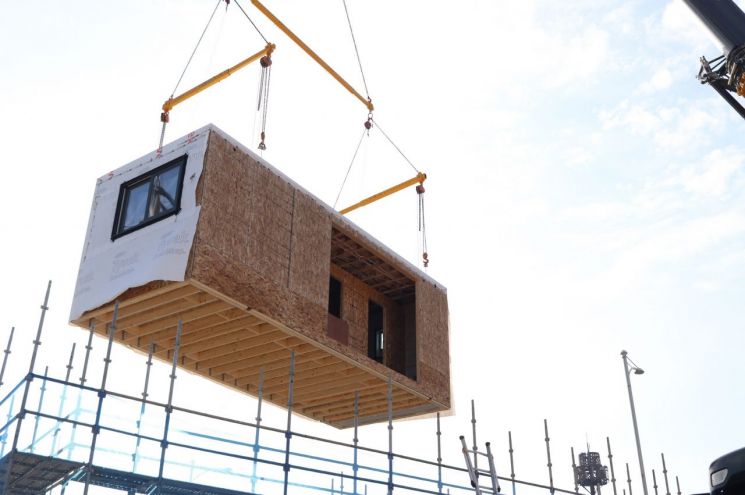 Jaigaist is installing modular houses using the 'upper lifting method' with a balance beam. This method was jointly developed by GS Construction and Jaigaist.
 [Photo by GS Construction]
GS Construction addressed the airtightness performance, which has been pointed out as a weakness of modular houses, by improving the modular lifting method and reinforcing the joints. As a result of measurements conducted independently by GS Construction’s Prefab Research Team and Eco-friendly Architecture Research Team, they achieved performance that satisfies the domestic zero-energy building airtightness standard of 1.5 ACH (Air Change Per Hour) or less.
Airtightness performance is expressed as the air change rate per hour (ACH) occurring in a building when maintaining a pressure of 50 Pa (Pascal) by blowing wind into the building; the higher the airtightness, the lower the value. According to the zero-energy housing airtightness guidelines of the Korea Land and Housing Corporation (LH), the target airtightness performance for multi-family housing is currently 3.0 ACH or less. The “Airtightness Performance Standards for Buildings” published by the Korean Society of Green Building and Environmental Equipment states that zero-energy buildings must satisfy an airtightness level of 1.5 ACH or less.
Last year, XIGIEST applied a “lower lifting method” using a Sling Belt during the installation of a sample house but identified an issue where the joints between modules were not 100% completed. To improve the module coupling method, which is the most critical factor in securing airtightness in modular houses, they collaborated with GS Construction’s technology development organization, RIF Tech (LifeTech), to develop an “upper lifting method” and filed a patent for it.
The upper lifting method is characterized by securing higher assembly precision and work stability through a self-developed lifting system and balance beam during module lifting. In addition, by applying airtight finishing materials and adjusting gaps between modules using expansion tape and dedicated equipment, airtightness performance was dramatically improved, enabling the technology to meet the zero-energy housing airtightness performance standards, GS Construction explained.
Meanwhile, to commemorate the achievement of airtightness performance, XIGIEST is conducting a promotion starting from the 1st of this month, offering the “LX Hausys Jiin Automatic Ventilation System” free of charge to contracted customers on a first-come, first-served basis. The automatic ventilation system maintains indoor air quality comfortably through automatic ventilation in highly airtight houses. The “LX Hausys Jiin Automatic Ventilation System,” optimized for XIGIEST modular houses, can be installed in modular houses supplied after January 2024.
A XIGIEST official stated, “By improving the lifting method and joint technology, we have enhanced the most critical airtightness of modular houses, enabling us to supply energy-efficient homes. We will continue research and development to improve technology and marketability for modular houses and lead the domestic modular housing market.”
© The Asia Business Daily(www.asiae.co.kr). All rights reserved.
![Clutching a Stolen Dior Bag, Saying "I Hate Being Poor but Real"... The Grotesque Con of a "Human Knockoff" [Slate]](https://cwcontent.asiae.co.kr/asiaresize/183/2026021902243444107_1771435474.jpg)















