Creation of Five Major Innovation Clusters for Future New Industries Focused on Digital and Eco-Friendly Sectors by Region
Efforts and Designation of Government Special Zones Including Opportunity Development Zones, Urban Convergence Zones, and Adv
Busan City announced that Busan's industrial map is densely filled with regional innovation clusters and is being newly transformed around future new industries.
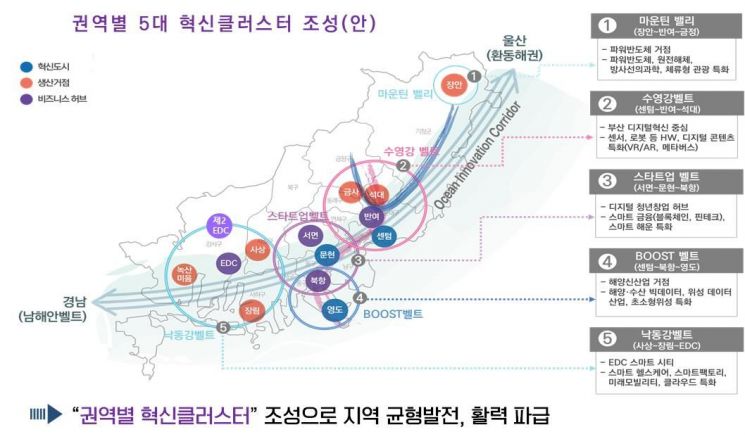
In the past, the western Busan manufacturing sector and the eastern Busan Haeundae and Centum tourism and information and communication (IT) industries, which led South Korea's rise and fall, accounted for most of Busan's industrial map. Now, however, new colors of digital and eco-friendliness are being newly overlaid throughout the city.
Future industry innovation clusters linked to existing core industries are being newly established and expanded throughout East Busan, the old downtown, and West Busan, and examining the industrial portfolios of each cluster reveals that they can be called a melting pot of new industries.
The five major new industry innovation clusters newly drawn across Busan consist of future core new industries centered on eco-friendly technology development and digital transformation to become a global 'green smart city.'
In particular, a major feature is the advanced development and concentration of industrial groups with distinct regional characteristics, linked to geographical advantages in the surrounding areas.
The five major new industry innovation clusters are (East Busan) ① Mountain Valley ② Suyeong River Belt,
(Old Downtown) ③ Startup Belt ④ Boost Belt, (West Busan) ⑤ Nakdong River Belt.
First, the East Busan area is advancing northeast toward Gijang County, creating new growth engines for Busan such as power semiconductors and secondary batteries, while continuing digital innovation.
The radiation medical science and E-Park industrial complexes in the Gijang area are transforming into ① 'Mountain Valley,' an industrial complex specializing in core technologies of the 4th industrial revolution such as power semiconductors and secondary batteries.
Excellent companies such as Geumyang and STI are continuously investing in new industries, and in particular, the radiation medical science complex has been designated as a specialized complex for power semiconductor materials, parts, and equipment, with an expected economic ripple effect of about 7 trillion won, including 800 billion won in private investment.
Also, starting from the saturated Centum City and connecting Unicorn Tower and Centum 2 District, the ② Suyeong River Belt is growing as a hub for advanced information and communication technology (ICT) industries such as extended reality (XR) and metaverse, as well as digital hardware like sensors and robots.
Next, the old downtown area connecting Seomyeon, Munhyeon, Bukhang, and Yeongdo is being reborn as an urban waterfront space specialized for youth startups, smart finance, and marine new industries.
Based on areas with high accessibility such as Seomyeon, Busan Station, and Bukhang, the ③ Startup Belt is steadily being established, and the creation of youth startup digital hubs such as the private-led 'Open Innovation Startup Town' and 'Green Startup Town' is being actively promoted.
Additionally, with the BIFC, blockchain regulatory free zone, and promotion of digital asset exchanges, the Munhyeon financial district is growing into a global financial special zone representing Asia beyond Korea.
The Bukhang and Yeongdo areas, the planned sites for the 2030 Busan World Expo, are being developed as the ④ Boost Belt, focusing on marine new industries such as marine and fisheries big data, micro satellites, and urban air mobility (UAM), as well as specialized stay-type workation tourism utilizing the sea.
Finally, the West Busan area, connecting Sasang, Jangrim, and Eco Delta City, is the ⑤ Nakdong River Belt, specializing in smart manufacturing, and is expected to become a mecca for advanced research and development (R&D) industries such as bio, future mobility, and cloud centered on Eco Delta City (EDC).
With an investment of about 300 billion won, the aging Sinpyeong and Jangrim industrial complexes are being transformed into 'Smart Green Industrial Complexes,' and the innovation ecosystem for small and medium manufacturing industries is steadily progressing by integrating smart factory technology into traditional manufacturing.
Within Eco Delta City, bio and cloud industries are being intensively fostered through the development of the 'Smart Healthcare Cluster' and 'Green Data Center Complex,' and plans are underway to fully utilize the 160,000-pyeong exclusive corporate attraction zone in Busan to attract numerous advanced technology companies.
The ambitiously prepared 'Second Eco Delta City (EDC)' west of Gimhae Airport is expected to play a new central role bringing a quantum leap to Busan as an aviation industry cluster including aircraft maintenance (MRO), drones, and an international business district.
Considering various synergy effects such as logistics benefits from the opening of Gadeok New Airport, the creation of an airport complex city (Air City) behind the new airport, additional designation of the Gadeokdo area as an economic free zone, and expansion to the South Coast Belt, the industrial growth potential of West Busan is limitless.
Companies are responding to Busan City's efforts, and the rush of excellent companies centered on new industries moving to Busan is in full swing. Last year, a record investment attraction of 3 trillion won was achieved, and this year, more than 3.9 trillion won in investment has already been secured, making it certain to achieve the largest investment attraction record ever.
Not only large corporations such as Samsung Heavy Industries and Hanwha Power Systems but also many strong small and medium enterprises are consecutively establishing bases in Busan due to Busan's differentiated cluster industrial policies, incentives, and the resulting managerial advantages and growth potential for companies.
Various economic special zones and districts designated by the central government are also strong supporters of Busan City's new industrial map reorganization. Among them are the Yoon Suk-yeol administration's ambitious 'Opportunity Development Zone' and the Ministry of Land, Infrastructure and Transport's 'Urban Convergence Zone.'
The 'Opportunity Development Zone' is one of the core means of regional balanced development, promoting local investment and relocation of excellent companies with unprecedented incentives such as tax reductions, regulatory exceptions, financial support, and improved living conditions.
The city has already presented 'finance,' 'power semiconductors,' and 'secondary batteries-mobility' as special zone models among future new industries, aiming to maximize synergy with industrial clusters.
The 'Urban Convergence Zone' is a project to create youth-centered industrial, residential, and cultural spaces in the heart of the city. In Busan, Centum 2 District in Haeundae-gu was selected as a special zone site in 2021. It is steadily advancing as an important axis of the East Busan 'digital innovation hub' and a hub for the new industry ecosystem through 'innovation and co-growth.'
In addition, various economic special zones already designated or newly pursued, such as the 'Advanced Investment Zone' in Myeongji District, 'Urban Advanced Industrial Complex' in Centum 2 District, the 14 km² 'Research and Development Special Zone,' blockchain, marine mobility, ammonia 'Regulatory Free Zones,' 'Research Industry Promotion Complex,' and foreign investment zones in Mium and Jisa, as well as the 'Global Innovation Zone' and 'National Advanced Industrial Complex,' are creating a three-dimensional overlapping designation of economic special zones, forming an 'industrial specialized comprehensive gift set' tailored to the needs of companies and youth throughout the city.
The future of the new industry-centered industrial map reorganization is even brighter. This is because excellent talent, the seed for sustainable quantitative and qualitative growth of the new industrial map, is continuously being nurtured through 'industry-academia cooperation.'
Centered on 68 industry-academia cooperation branches, a virtuous cycle ecosystem of industry-academia cooperation is on track, where companies gather youth and talent, and youth and talent attract excellent companies. With the Ministry of Education's 'Regional Innovation-Centered University Support System (RISE)' pilot area and the designation of glocal universities, advanced talent suited to Busan is expected to spring forth abundantly.
With talent and companies as the foundation, the creation of numerous high-quality jobs based on new industries is expected to encourage youth to stay, work, settle in Busan, and breathe new life into Busan's economy.
It is also encouraging that Busan City's efforts to advance industrial clusters and discover next-generation Busan-type new growth engines continue steadily. The city's five-year strategic industries are being newly reorganized, and plans to discover and foster 'Busan-type future advanced industries' that will drive Busan's future growth are being intensively discussed, with efforts to produce concrete results in the second half of the year.
Mayor Park Hyung-jun said, "Regional innovation clusters will become new industry power plants that create synergistic effects by organically combining hardware centered on companies and infrastructure with software centered on talent and technology," adding, "In keeping with Busan's name meaning 'cauldron (釜),' we will do our best to ensure that youth, talent, and companies bubble and boil vigorously inside the Busan cauldron as soon as possible."
© The Asia Business Daily(www.asiae.co.kr). All rights reserved.
![Clutching a Stolen Dior Bag, Saying "I Hate Being Poor but Real"... The Grotesque Con of a "Human Knockoff" [Slate]](https://cwcontent.asiae.co.kr/asiaresize/183/2026021902243444107_1771435474.jpg)















