2400 Clinics in Gangnam Handle Narcotics
But Only 7 Narcotics Monitors at District Health Centers
Need for Gangnam Area Integrated Narcotics Addiction Management Center
Interview with Gangnam District Council Members Park Dami and Son Minki
First 'Narcotics Eradication Policy Research Group' Established in District Council

The entire nation is abuzz over a drug scandal involving famous celebrities. South Korea has long lost its status as a drug-free country, and drug-related crimes have become commonplace.
In Seoul, Gangnam-gu, which has a large floating population and a concentration of entertainment establishments and medical clinics, is a region severely affected by the distribution and misuse of drugs. It is known that a doctor was involved in the drug case implicating actor Lee Sun-kyun and singer G-Dragon (real name Kwon Ji-yong), and doctors and medical clinics have frequently appeared in past high-profile drug cases as well.
In April, there was even the ‘Daechi-dong Academy District Drug Beverage Incident’ targeting middle and high school students. The Gangnam District Council rolled up its sleeves to prevent the misuse and spread of drugs following this incident.
Earlier this year, the council formed a research group called the ‘Drug Eradication Countermeasure Research Group’, and after several months of policy research, recently released the ‘Research Results on the Prevention of Misuse and Safety Measures for Drugs and Harmful Substances in Gangnam-gu’.
Meeting with Councilor Park Dami (head of the Drug Eradication Countermeasure Research Group) at the Gangnam District Council, she said, "We used to think drug crimes were secretly distributed through criminal groups, but now they have reached our children, and no one is safe. This made us focus on the drug issue." She added, "Gangnam-gu is so serious about drug problems that the number of drug-related reports per police station in commercial areas is comparable to the total number of reports in entire police stations of other districts."
Therefore, this research focused more on proposing practical policies rather than just the current status or actual conditions of drug spread in Gangnam. The policy development research was conducted by the Korea Policy Management Institute.
Councilor Son Minki (secretary of the research group) emphasized, "The research concluded that the distribution of psychotropic drugs among ordinary people is more serious than drug crimes within criminal organizations, the entertainment industry, or entertainment workers," and stressed, "Administrative efforts must focus on preventing misuse and spread of drugs in medical clinics."
According to Gangnam District Office, Gangnam-gu, a medical tourism special zone, has 2,819 medical clinics, accounting for 15.2% of all clinics in Seoul, and 440 plastic surgery clinics, which is 70.5% of the total in Seoul.
Councilor Son said, "Although 2,396 clinics, which is 86% of all medical clinics in Gangnam-gu, handle medical narcotics, there are only seven drug monitoring officers working at the Gangnam District Health Center," adding, "It is practically impossible for seven people to manage so many medical institutions."
These criticisms by the two councilors are well-founded. According to data received from Gangnam and Suseo Police Stations by the Drug Eradication Countermeasure Research Group, the five-year average of drug offenders related to psychotropic drugs in Gangnam-gu was 78.6%, far exceeding marijuana (17.5%) and narcotics (3.9%). Especially last year, the drug crackdown rate for people in their 20s in Gangnam-gu was 55.2%, more than double the national five-year average of 25.7% for that age group, highlighting the severity.
Councilor Park said, "The concentration of medical clinics is highly likely to be a cause of psychotropic drug misuse and drug spread," and emphasized, "We need to increase the mandatory monitoring capacity for handling medical narcotics to prevent drug misuse, and establish an integrated addiction management support center in the Gangnam area to strengthen prevention, education, and publicity."
The Drug Eradication Countermeasure Research Group, active until the end of this year, includes councilors Jeon Insu, Han Yunsu, Bok Jinkyung, and Kim Hyunjung. We met with Councilors Park Dami and Son Minki, who serve as the head and secretary of the research group, at the Gangnam District Council on the 25th of last month.
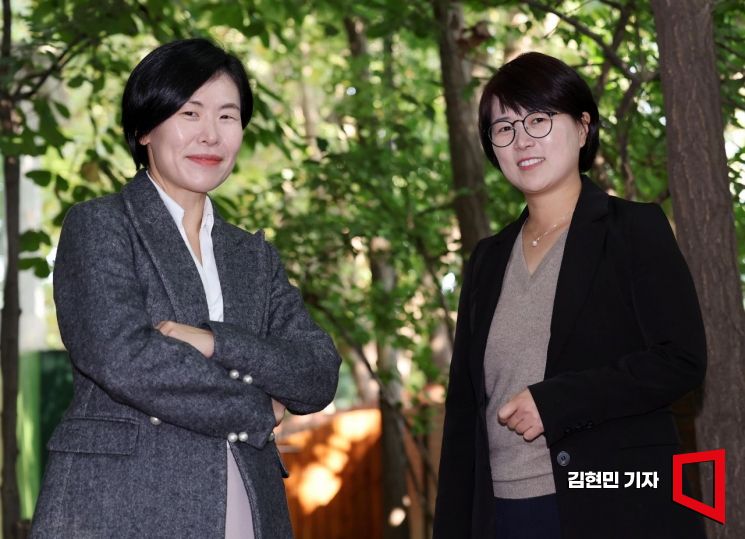 Councilor Park Dami (right) and Councilor Son Mingi (left) of Gangnam District Council, who are active in the 'Drug Eradication Policy Research Group,' identified the prevention of medical narcotics abuse as the most urgent and practical priority for solving drug problems. Councilors Park and Son emphasized, "We need to increase monitoring personnel at public health centers and establish an Integrated Addiction Management Support Center in the Gangnam area to focus on prevention and education." Photo by Kim Hyunmin kimhyun81@
-Why focus on drugs when the problem is not limited to Gangnam-gu?
▲While conducting activities to block harmful environments for youth, such as indiscriminate distribution of flyers for entertainment establishments near Jinseon Girls’ High School and Daechi-dong food alley, we were deeply shocked by the Daechi-dong Academy District Drug Beverage Incident that occurred in our area this year, which made us focus more on the drug issue.
In April, the district council showed strong determination by enacting the ‘Ordinance on Drug and Substance Misuse in Gangnam-gu,’ which enabled us to put more effort into establishing independent policies and legal and institutional grounds at the Gangnam-gu level.
-Is it common for local district councils to engage in such activities?
▲Gangnam District Council is probably the first. We formed a research group with like-minded councilors (Drug Eradication Countermeasure Research Group) and recently released the policy research results titled ‘Research Results on the Prevention of Misuse and Safety Measures for Drugs and Harmful Substances in Gangnam-gu.’ We held a kickoff meeting in July, a mid-term report meeting in August, and submitted the final report in October. At the mid-term report meeting, we invited about 100 people including district office officials, experts, and local residents for discussions.
Everyone was surprised by the contents. Some parents tried to keep it quiet, but we emphasized the need for awareness improvement. We conveyed that the serious drug problem in Gangnam should not be hidden but addressed through rehabilitation, treatment, prevention, and education activities. We also promoted that Seoul offers free anonymous drug testing.
During the research, we conducted a survey and were very surprised to find that almost no one knew which number to call for counseling or problem-solving when exposed to drugs. Awareness improvement and publicity are truly necessary.
-What should be done?
▲Along with prevention education and awareness campaigns, what drug addicts really need is an integrated addiction management support center. Such a facility is needed in the Gangnam area but does not exist where it is most needed. Some say it is because land prices are high and the facilities are inconvenient, but when it comes to our children’s issues, such excuses cannot be accepted.
It is a matter that the Gangnam District Office must decide on. The district office is currently considering it. Councilors have pledged to actively assist. Since this is not just a problem of a specific district office, the will and support of Seoul City are also necessary. People need to recognize that victims are not others but our own families, and that we could become victims ourselves.
Drug misuse problems like the Apgujeong Rolls-Royce accident (where a driver under the influence of drugs hit a pedestrian in their 20s, leaving them in a brain-dead state) are very serious. While K-beauty is thriving, the hidden reality of drug misuse and addiction behind it is much greater than is publicly known.
-The final report shows drug exposure among people in their 20s is particularly severe.
▲According to police data, the crackdown rate for people in their 20s in Gangnam-gu was as high as 55%, more than twice the national average. Not all cases cracked down in Gangnam-gu involve Gangnam residents, but compared to the national crackdown rate, the proportion of people in their 20s in Gangnam-gu is indeed quite high. This is also related to the regional characteristic of having many clubs and entertainment establishments frequented by people in their 20s.
Also, people in their 20s are very interested in body shape and beauty, and there are many drugs for weight loss and propofol used in plastic surgery anesthesia. When asked where they first encountered drugs, about 65% said medical clinics. The majority also purchase drugs from medical clinics. People think young people approach drugs out of mere curiosity, but the reality is different.
-Are you saying that if medical clinics pay special attention to preventing misuse and actively participate in prevention activities, the problem can be significantly reduced?
▲Yes. Since the drugs are given by hospitals, people think it is legally fine and accept them, but then their bodies crave more, leading to repeated purchases through illegal channels. Sedatives account for 25%, and these are also drugs from medical clinics. Propofol was used as an anesthetic before being designated as a narcotic, so its usage frequency is high. Weight loss drugs also require a doctor’s prescription. These three combined account for a very high proportion.
Misuse means that within appropriate standards, it is medicine, but beyond those standards, it becomes a narcotic. The dosage prescribed by the doctor determines whether it is considered a narcotic or misuse.
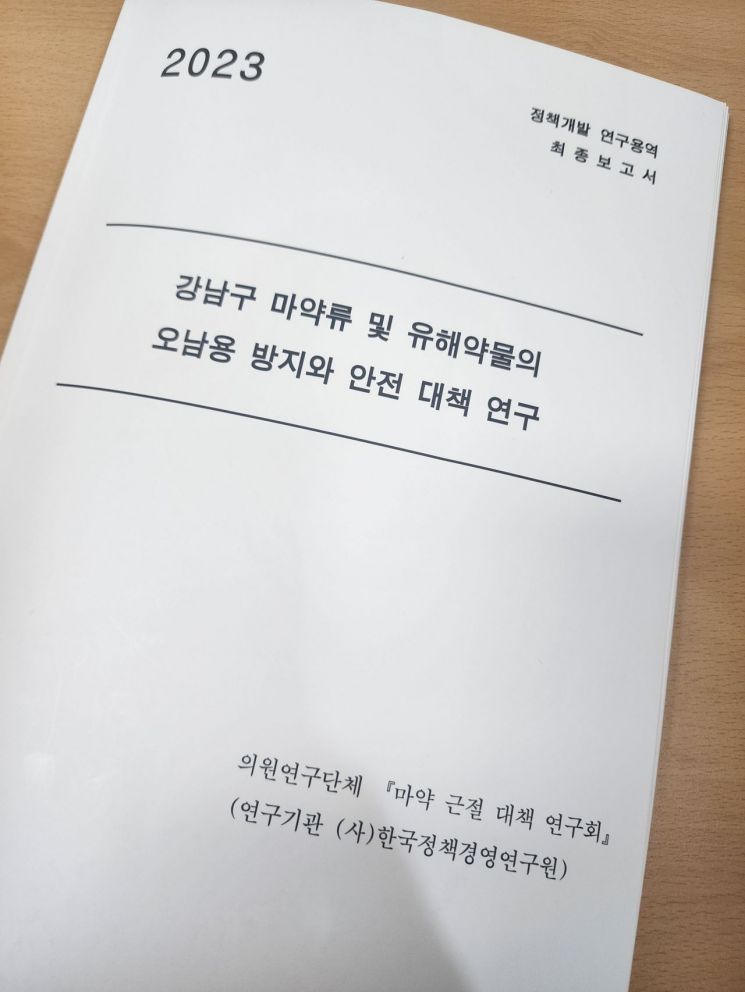 The Drug Eradication Policy Research Group, a council member research organization of Gangnam District Council, recently proposed various policies to prevent the abuse and spread of narcotics in Gangnam District through a 103-page policy development research report. Photo by Minjin Kim enter@
-What should be done for prevention and resolution?
▲Residents we met in the field believe that while drug crimes should be strictly punished, thorough education on the dangers of drugs for young students and prevention education for parents are necessary. Considering the nature of addiction, rehabilitation and treatment are also important.
Eradicating drugs is not just Gangnam-gu’s issue, nor can Gangnam-gu handle it alone. It requires forming a drug countermeasure council involving police, judicial authorities, education, and medical sectors for close cooperation.
-Are there any other countermeasures?
▲The Gangnam District Health Center, which has the most medical clinics in the country, can directly inspect and crack down on clinics handling narcotics. However, the health center is severely understaffed compared to the number of clinics. It is necessary to increase drug monitoring officers and thoroughly manage the handling of medical narcotics.
Recently, the illegal prescription and distribution of medical narcotics have been repeatedly reported in the media, but this problem cannot be solved by crackdowns alone. The medical and pharmaceutical associations need to take a more active role in self-regulation regarding medical narcotics prescriptions and medication guidance, and the medical community must make official declarations to comply with these standards as part of self-purification efforts.
It is necessary to strengthen prevention education that informs young students about the dangers of drugs. In the United States, parent drug prevention groups have been established to conduct prevention campaigns and educational instructor activities. Considering the high interest of our residents, such a system can definitely be introduced.
Please remember that weight loss drugs, sleeping pills, and concentration-enhancing drugs, which people start taking easily thinking they are safe because they are prescribed by hospitals, can eventually become channels through which drugs are introduced.
Even the highly dangerous zombie drug fentanyl was initially developed as a painkiller by a major pharmaceutical company called Janssen and was highly regarded. Addictive drugs should be more strictly prescribed. Residents also need to be aware of the risks when taking them. We ourselves need to be cautious and vigilant about the misuse of medical narcotics.
© The Asia Business Daily(www.asiae.co.kr). All rights reserved.
![Clutching a Stolen Dior Bag, Saying "I Hate Being Poor but Real"... The Grotesque Con of a "Human Knockoff" [Slate]](https://cwcontent.asiae.co.kr/asiaresize/183/2026021902243444107_1771435474.jpg)

















