Purchased for 59 Trillion but Plummeted to 26 Trillion
Core Advertiser Costs Reduced by 67%
Twitter, the social networking service (SNS) that once dominated the world, has seen its corporate value halved just one year after being acquired by Elon Musk, CEO of Tesla. Although Twitter has transformed into 'X' and is undergoing a transition into a super application (app), it has yet to show significant results. Analysts say Musk's regret over the enormous costs publicly voiced after the acquisition has become a reality.
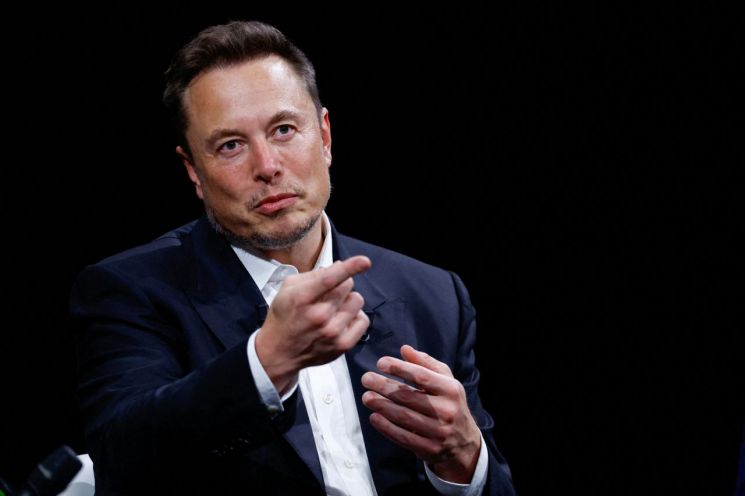
"Should Have Bought at Half the Price" Musk's Regret Realized
Bloomberg News, The New York Times (NYT), and others reported on the 30th (local time), citing internal documents from X, that the company's current valuation is approximately $19 billion (about 26 trillion KRW). Considering that Musk paid a total of $44 billion at $54.20 per share when acquiring Twitter in October last year, this represents about a 55% decrease in corporate value.
X disclosed its self-assessed corporate value during the process of granting stock grants to employees. Stock grants are an incentive method where the company awards its own shares to executives and employees free of charge.
The decline in X's corporate value was anticipated by Musk himself, who is currently the owner and Chief Technology Officer (CTO) of X. From immediately after the acquisition, he consistently expressed that he had paid too high a price. His attempt to cancel the contract citing fake accounts shortly after declaring his intention to acquire Twitter in April last year also appears to have been for this reason.
In an email sent to employees last March, Musk valued the company at $20 billion and referred to it as an 'inverse startup.' In an interview with the media last April, he repeatedly stated that the company's value was about half of what was paid.
To cover the costs of the aggressive acquisition of Twitter, X took on $13 billion in debt. Bloomberg reported that as a result, X pays about $1.2 billion annually in interest.
Declining Users and Advertisers, Paid Subscription Model Also 'Not Great'
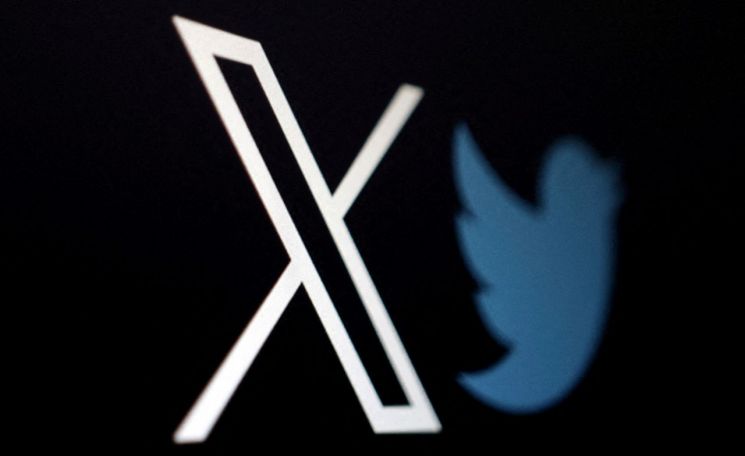
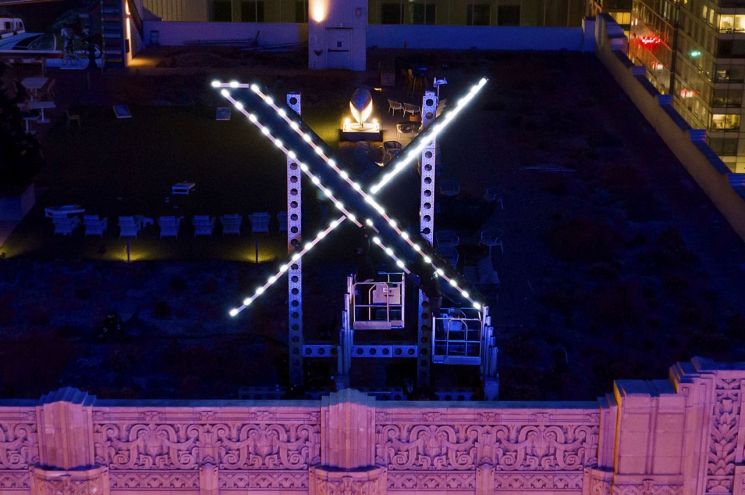
X plunged into chaos under Musk's radical policies. Immediately after acquiring Twitter, Musk lived and worked in the headquarters building, overseeing every business detail. During this process, mass layoffs occurred, and core businesses were shaken. The company name was changed, and the iconic 'blue bird' logo, a core part of the brand value, was replaced with a black alphabet 'X.'
X's performance over the one year since Musk's acquisition has been nothing short of a 'failure.'
First, the number of users declined. According to data company Apptopia, the number of daily active users logging into X decreased by 13% from October last year to September this year. This contrasts with other SNS platforms like YouTube, Instagram, TikTok, and Snapchat, which have seen user growth. After Musk's acquisition, the surge of misinformation and various disturbances on Twitter led many users to migrate to other SNS platforms.
In this process, the core revenue model, advertising, significantly decreased. Before delisting, X generated $4.5 billion annually in advertising revenue. According to data from market intelligence firm Sensor Tower, X's top five advertisers reduced their advertising spending by 67% compared to before Musk's acquisition. This is interpreted as a reduced need to advertise on X, which has fewer users and a damaged image.
Musk himself publicly acknowledged in June that the company was experiencing 'negative cash flow' and that advertising revenue had been halved.
With X's revenue structure heavily reliant on advertising, Musk introduced a paid subscription model immediately after the acquisition to diversify the business structure.
However, even this has not been smooth. Bloomberg cited independent researcher Travis Brown's analysis, estimating that the number of users subscribing to the premium service at $8 per month is between 950,000 and 1.2 million. This is less than 1% of the users who were offered the subscription. Bloomberg explained, "This means X generates less than $120 million annually from subscription services."
Matt Navarra, an SNS strategist and commentator, told Euronews Next, "We don't see X as dead. But it has regressed, deteriorated, lost value, and become less useful."
Musk's Ambition for a Super App Remains
Despite these external evaluations, Musk remains optimistic about X's future. According to a recording obtained by the NYT, Musk expressed at an internal meeting commemorating the first anniversary of the acquisition last week that X could become an all-in-one app with various functions such as dating services and recruitment.
Following the recent launch of voice and video call features, Musk is also experimenting with integrating recruitment services and announced plans to create a news wire service called 'XWire.' He added that he plans to compete with Google's YouTube, Microsoft's LinkedIn, and Cision's PR Newswire.
Linda Yaccarino, the current CEO of X, encouraged employees at this meeting not to pay attention to those who do not see X's vision or what is happening at X.
It is reported that CEO Yaccarino shared ideas about new products and services that X will launch during meetings with financial stakeholders earlier this month.
© The Asia Business Daily(www.asiae.co.kr). All rights reserved.
![Clutching a Stolen Dior Bag, Saying "I Hate Being Poor but Real"... The Grotesque Con of a "Human Knockoff" [Slate]](https://cwcontent.asiae.co.kr/asiaresize/183/2026021902243444107_1771435474.jpg)

















