With "Not a General Election Strategy but Responding to Local Residents' Long-Standing Projects"
"Seoul and Gyeonggi Citizens' Backlash? Will It Win the Capital Region's Votes?"
The People Power Party announced that it will push for the "incorporation of Gimpo City, Gyeonggi Province into Seoul" as a party policy, initiating a public discussion process on administrative district reorganization. The opposition parties view this as part of a metropolitan area strategy ahead of next year's general election and criticize it as an "election strategy."
On the 30th, Kim Gi-hyeon, leader of the People Power Party, stated at the 'Metropolitan New Town Transportation Meeting' held at the Gimpo Hangang Vehicle Base, "If Gimpo City gathers citizens' opinions and proceeds with the procedures, we intend to officially adopt the incorporation into Seoul as a party policy."
The demand for Gimpo City's incorporation into Seoul arose during Gyeonggi Province's push to establish the Northern Gyeonggi Special Autonomous Province. Governor Kim Dong-yeon advocates for the establishment of the Northern Gyeonggi Special Autonomous Province, which includes Gimpo City, while Mayor Kim Byung-soo of Gimpo judged that now is the right time for incorporation into Seoul amid the movement to separate northern and southern Gyeonggi Province.
Gimpo City bases its claim on the fact that 85% of its population commutes to Seoul, considering that in terms of living area, school district, and commuting between workplace and residence, Gimpo City belongs to the Seoul living area.
There are two methods for Gimpo City's incorporation into Seoul. First, after obtaining the consent of the Gimpo City Council, Gyeonggi Provincial Council, and Seoul City Council or securing a majority approval in a resident referendum, the Ministry of the Interior and Safety submits a special law to the National Assembly in the form of government legislation.
Once the bill passes in the National Assembly, the procedure is completed. However, since resident referendums cannot be held from 60 days before the election day until the election day itself ahead of the general election on April 11 next year (Resident Referendum Act Article 14), it appears that public opinion gathering and public discussion must be completed within a tight timeframe.
The second method is to enact a special law in the form of member legislation. The People Power Party is also primarily considering this option, but it requires the opposition party's consent as well.
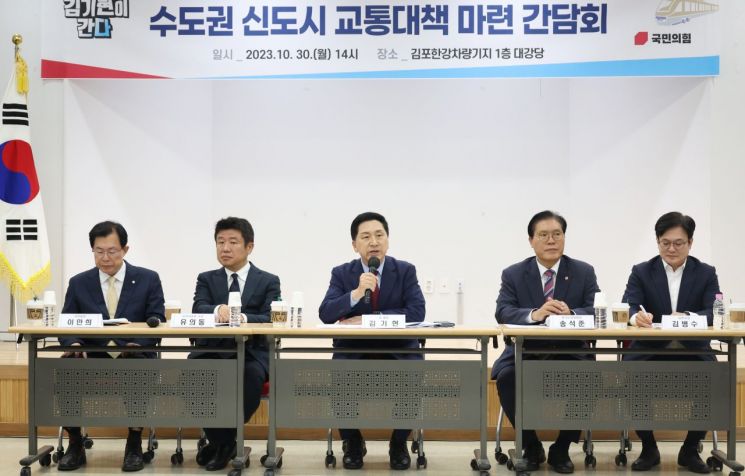 Kim Ki-hyun, leader of the People Power Party, is speaking at a meeting held on the 30th at the Gimpo Hangang Vehicle Base, which manages the Gimpo Gold Line, to discuss transportation measures for new towns in the metropolitan area.
 [Image source=Yonhap News]
Regarding the ruling party's push for "Gimpo City's incorporation into Seoul," Ko Min-jung, senior member of the Democratic Party of Korea, said, "The moment I saw the news, I thought that President Yoon Seok-yeol and Leader Kim Gi-hyeon and these people have not changed at all," and criticized, "How can they ignore procedures and proceed to the next step in a democratic country?"
In an interview on the 31st with SBS Radio's 'Kim Tae-hyun's Political Show,' Ko said, "Whether it's Gimpo City or Guri City, incorporating them into Seoul requires the consent of the Gyeonggi Governor, the National Assembly, and residents, but there is no preparation for such a process," adding, "There is no talk about how to persuade the Gyeonggi Governor and the opposition in the National Assembly, and someone even said that not only the residents concerned but also Seoul citizens would like it. Then, try holding a resident referendum among Seoul citizens," she criticized.
Aside from procedural issues, there is also an evaluation that this is not an appropriate strategy for the metropolitan general election. Since there could be opposition among Seoul citizens and nearby Gyeonggi residents who share living areas with Seoul but have not been incorporated into Seoul may harbor dissatisfaction, it is questionable whether the ruling party can gain metropolitan area votes through this strategy. New towns in Seongnam City, Gyeonggi Province, as well as Gwacheon, Gwangmyeong, and Hanam cities have also long advocated for incorporation into Seoul.
Former Justice Party lawmaker Park Won-seok appeared on CBS Radio's 'Kim Hyun-jung's News Show' on the 31st and said, "Since this involves sharing Seoul's resources, the districts in the areas wanting incorporation probably won't be very pleased, and there will likely be strong opposition from nearby Gyeonggi areas not subject to incorporation."
Park added, "Incorporation into Seoul further strengthens Seoul concentration, so the question is whether this is a sound policy. Everything is already concentrated in Seoul, so there will be such counterarguments."
However, the People Power Party rebutted that this is not an election strategy but a response to the long-standing demands of local residents. Yoon Jae-ok, floor leader of the People Power Party, told reporters after the party's floor strategy meeting at the National Assembly that day, "It means that the party will proactively address the long-standing demands of local residents," and added, "It is the party's duty to respond to local residents' demands ahead of elections." The People Power Party is expected to enact a special law in the form of member legislation in the National Assembly.
© The Asia Business Daily(www.asiae.co.kr). All rights reserved.
![Clutching a Stolen Dior Bag, Saying "I Hate Being Poor but Real"... The Grotesque Con of a "Human Knockoff" [Slate]](https://cwcontent.asiae.co.kr/asiaresize/183/2026021902243444107_1771435474.jpg)















