Three Scenarios Presented According to the Escalation Pattern
The World Bank (WB) has warned that oil prices could soar to $150 per barrel due to the war between Israel and the Palestinian armed group Hamas.
In its commodity market outlook released on the 30th (local time), the WB stated that the immediate impact of the Israel-Hamas war is limited, but if the conflict spreads, prices of commodities such as oil could surge sharply.
Oil prices have risen about 6% since the Israel-Hamas clashes. Prices of other commodities such as agricultural products and metals have not changed significantly. If this trend continues, oil prices are expected to fall from the current average of $90 per barrel to $81 per barrel next year due to a global economic slowdown. Overall commodity prices are also projected to decline by 4.1% next year.
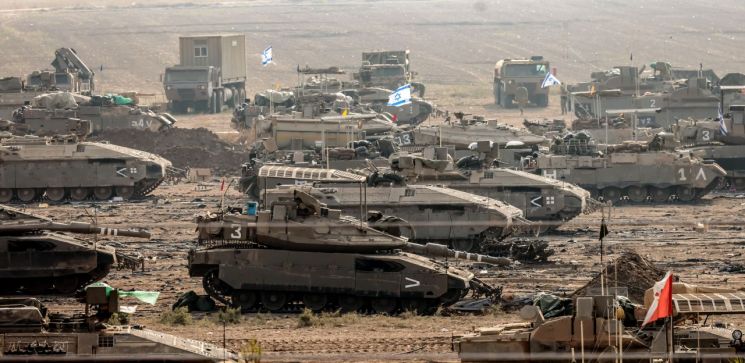
The problem arises if the conflict spreads throughout the Middle East. Based on historical cases, the WB presented three scenarios, predicting that oil prices could surge to ▲$93?102 ▲$109?121 ▲$140?157 per barrel depending on the scenario.
First, in a scenario where global oil supply decreases by 500,000 to 2 million barrels per day, oil prices are expected to rise to $93?102 per barrel, which is 3?13% higher than the current quarterly average. This assumes a reduction in oil supply similar to the level during the 2011 Libyan civil war.
Next, a scenario is presented where oil supply decreases by 3 to 5 million barrels per day, similar to the 2003 Iraq war, with oil prices potentially rising by 21?35% to $109?121 per barrel.
The final scenario assumes a decrease in global oil supply of 6 to 8 million barrels per day. This is comparable to the first oil shock in 1973, when Arab countries banned oil exports to countries such as the United States that supported Israel during the Yom Kippur War. In this scenario, oil prices could surge by 56?75% to $140?157 per barrel.
Indermit Gill, WB Chief Economist, said, "The recent conflict in the Middle East is the biggest shock to commodity markets since the Russia-Ukraine war, which has had the greatest impact since the 1970s," expressing concern that "if the conflict spreads, the global economy will face a dual energy shock for the first time in decades."
The WB also forecasted that if this upward trend in oil prices continues, it could lead to rising food prices and worsen the food crisis in developing countries.
© The Asia Business Daily(www.asiae.co.kr). All rights reserved.
![Clutching a Stolen Dior Bag, Saying "I Hate Being Poor but Real"... The Grotesque Con of a "Human Knockoff" [Slate]](https://cwcontent.asiae.co.kr/asiaresize/183/2026021902243444107_1771435474.jpg)















