First Report Reviewed by Expert Committee on Potential Risk Factors Identified by Ministry of the Interior and Safety
The Ministry of the Interior and Safety has published an analysis report for the first time on potential disaster risk factors that may arise in the future due to climate change, technological advancements, and other influences. In particular, the ministry pointed out that the possibility of large-scale fires involving electric vehicles is high and that urgent countermeasures are needed.
On the 30th, the National Disaster Safety Research Institute, an affiliated agency of the Ministry of the Interior and Safety, released the report on its website. The institute plans to continue identifying new risk factors and publish analysis reports semiannually. The report includes step-by-step analyses such as cause analysis, detection of risk signals from media and social networks (SNS), expert warnings and future tasks, and disaster development scenarios. It also features scoring the likelihood and damage scale (impact) of each risk factor on a 5-point scale.
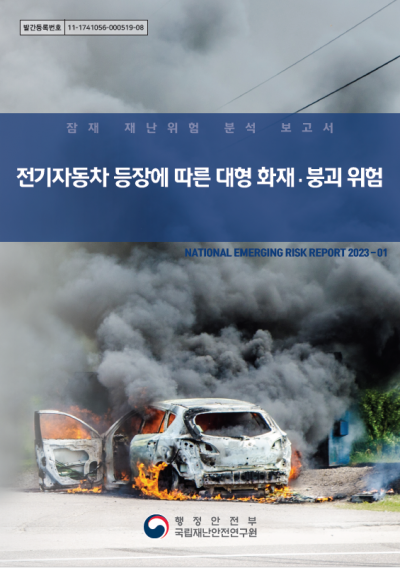
▲Large-scale electric vehicle fire and collapse risk (Likelihood 4.1 points, Damage scale 4.2 points)= The report pointed out that with the carbon neutrality declarations of major countries worldwide and the expansion of electric vehicle distribution, electric vehicle fire accidents are increasing domestically as well. According to the Fire Agency, the number of electric vehicle fire incidents per 10,000 vehicles in Korea was 1.12 last year, which is lower than 1.84 for internal combustion engine vehicles, but it has rapidly increased from 0.4 in 2017.
Additionally, the institute analyzed that electric vehicle batteries can rapidly raise temperatures up to 1000℃ in flames, spreading the fire and making it difficult for occupants to evacuate. As seen in last year's fire at an electric vehicle parking lot in Delhi, India, where about 100 vehicles were destroyed, electric vehicle fires are difficult to extinguish and pose a high risk of spreading into large fires in enclosed spaces such as underground parking lots.
Furthermore, the institute forecasted that electric vehicles cause new risks as their weight is heavier than internal combustion engine vehicles due to the installation of dedicated parts such as battery packs. In particular, the heavy load of electric vehicles imposes fatigue loads on aging buildings and can lead to the collapse of artificial structures vulnerable to vehicle loads, such as mechanical parking lots, increasing the possibility of large-scale fire accidents.
The report emphasized the need to prepare countermeasures against major risk factors such as underground parking lot fires, which are harder to extinguish than general roads, passenger ship (car ferry, etc.) fires, and mechanical parking lot collapses. It also advised electric vehicle businesses to provide accurate information about the characteristics and risks of battery fires to electric vehicle owners and users and to distribute action guidelines and manuals to minimize damage in crisis situations.
▲Inland tornadoes (Likelihood 2.2 points, Damage scale 2.9 points)= The second risk is inland tornadoes, which have been rare domestically but have caused significant damage overseas.
The report cited expert opinions predicting that the risk of tornadoes occurring inland in Korea will gradually increase due to expanded atmospheric instability caused by climate change. It pointed to the tornado in the South Moravia region of the Czech Republic in 2021, which caused five deaths, emphasizing that although tornadoes are mainly known to occur in plains, they can also occur in Korea’s mountainous terrain.
As a countermeasure, the report highlighted the need for securing technology and investing in research and development (R&D) related to tornado prediction, observation, and investigation. It noted that tornadoes are relatively rare and difficult to predict in Korea, so if they occur, they could cause significant confusion, and therefore, easy-to-understand response guidelines should be developed and promoted to the public.
▲Vibrio sepsis (Likelihood 3.3 points, Damage scale 2.9 points)= Lastly, Vibrio sepsis was selected due to the risk of infection not only through ingestion but also through seawater contact as seawater temperatures rise, raising awareness of the risk situation.
As mentioned in the report, Vibrio sepsis bacteria pose a risk of spreading infection not only through food poisoning from seafood consumption but also through skin contact with wounds. Overseas cases have shown a sharp increase in Vibrio sepsis patients exposed to contaminated seawater due to storm surges and flooding that caused seawater to overflow and come into contact with wounds.
Vibrio sepsis is a serious and critical disease with a mortality rate exceeding 50%. The causative bacteria multiply and spread massively when seawater temperature rises and salinity decreases. Experts warned that the surface seawater temperature in Korea’s coastal waters has risen by 1.23℃ over the past 50 years, with an annual increase of 0.0241℃, and that the incidence rate could increase by 4 to 10 times compared to before.
The report pointed out that the phrase “activation of infectious disease prevention and quarantine systems” should be explicitly stated in the collaborative function activities section of the “Storm and Flood Disaster Crisis Management Standard Manual.” It also recommended operating a “Vibrio sepsis bacteria prediction system” centered on the Ministry of Food and Drug Safety. Additionally, it emphasized the need to supplement manuals regarding Vibrio sepsis infection through wound contact.
© The Asia Business Daily(www.asiae.co.kr). All rights reserved.
![Clutching a Stolen Dior Bag, Saying "I Hate Being Poor but Real"... The Grotesque Con of a "Human Knockoff" [Slate]](https://cwcontent.asiae.co.kr/asiaresize/183/2026021902243444107_1771435474.jpg)















