Hankyung Association Releases Report on Expanding Bilateral Economic Cooperation
"Utilizing Public-Private Partnership Expansion Policy"
"Regularizing High-Level Talks to Maintain Wasta (Connections)"
In the process of entering the Saudi Arabian market, the largest in the Middle East with a scale of up to 1,500 trillion won, it has been analyzed that cooperation should be accelerated mainly in the fields of construction, infrastructure, information and communication technology (ICT), and eco-friendly energy, and that high-level talks should be regularized to maintain wassta (personal connections).
On the 30th, the Korea Economic Association stated this based on the report "Measures to Expand Korea-Saudi Economic Cooperation" commissioned to Dankook University's GCC (Gulf Cooperation Council) Country Research Institute. Since President Yoon Suk-yeol made a state visit to Saudi Arabia and achieved results worth about $15.6 billion (approximately 21 trillion won), it was said to be a golden opportunity to expand economic cooperation between the two countries.
The report recommended active cooperation centered on large-scale construction and infrastructure, ICT, and eco-friendly energy industries. As of last year, Saudi Arabia's economy was $1.1081 trillion (about 1,505 trillion won), accounting for 25.1% of the total GDP of the Middle East and North Africa, which is $4.4144 trillion (5,995 trillion won).
First, it was urged to actively utilize the "Saudi Vision 2030" project in the large-scale construction and infrastructure sector. The main goal of Vision 2030 is to increase the contribution of non-oil sector exports to GDP from 16% to 50% and diversify the economy.
Korea is one of the eight key cooperation countries announced by the Saudi government. Over the past 60 years, it has won over 1,800 projects worth $160 billion (about 217 trillion won). This year, until the end of last month, 15 projects worth $6.24 billion (about 8.5 trillion won) were secured, surpassing last year's total of $3.48 billion (about 4.726 trillion won).
Recently, joint investment projects between the private sector and government have been increasing in the Saudi construction market. It is necessary to understand trends in localization-related systems such as the local employment quota system (Nitaqat), the regional headquarters establishment system, and the privatization law enactment.
Nitaqat is a licensing system divided into three grades?Platinum, Green, and Red?based on the local employment ratio. Generally, a Medium Green grade or higher is required to operate stably in the local market. In the construction industry, to obtain a Green grade, the employment rate must be maintained at least 19%.
The regional headquarters establishment system, scheduled to be implemented in January next year, restricts multinational companies without regional headquarters in Saudi Arabia from participating in Saudi government procurement programs.
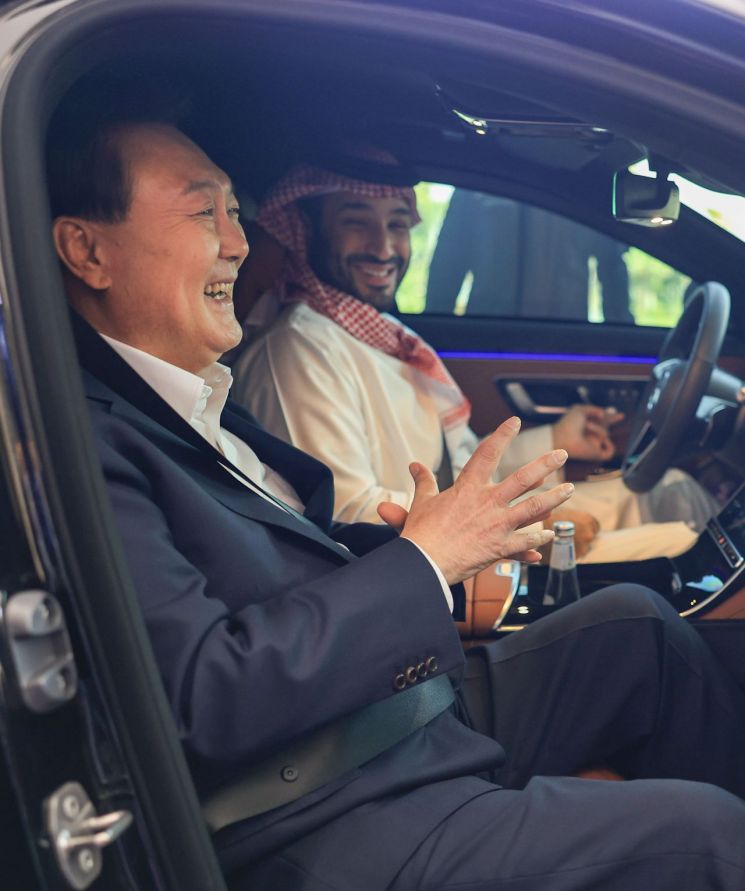 President Yoon Suk-yeol boarded a vehicle on the 24th (local time) together with Crown Prince Mohammed bin Salman of Saudi Arabia, who visited the Riyadh Guest Palace, to attend the Future Investment Initiative (FII) Forum.
 [Photo by Yonhap News]
In the ICT sector, promising areas include ICT manufacturing, infrastructure, digital transformation in the public sector, artificial intelligence (AI), and 5th generation mobile communication (5G). The ICT industry in Saudi Arabia is a key part of the "National Innovation Program," a detailed implementation project of Vision 2030.
Global research firm Technavio estimated this year that the Saudi IT market will have an average annual growth rate of 7.5% from 2022 to 2027. Cybersecurity and Internet of Things (IoT) sectors are expected to show double-digit growth. AI, 5G, and cloud computing sectors are also anticipated to continue growing.
In the eco-friendly energy industry, the report advised focusing on renewable energy power plant construction, the solar power industry, and hydrogen-related sectors. The Saudi government plans to secure about 50% of total energy generation from renewable energy such as solar and wind by 2030 and achieve carbon neutrality by 2060. It has established the National Renewable Energy Program (NREP) to build 48 solar, wind, and solar thermal energy power complexes.
The renewable energy power plant project, conducted in six phases, has currently completed the third phase of bidding. To win future contracts, it is advantageous to form consortia with companies that already have contract experience or leading global firms, the report analyzed.
In the solar power industry, mutual cooperation should focus on secondary batteries and modules. It was analyzed that polysilicon and ingots are difficult areas due to China's low-price offensive dominating the global market. In the hydrogen sector, cooperation is becoming visible, such as hydrogen fuel cell manufacturer Gaoncell building a production plant in the Saudi-Korea Industrial Valley (SKIV).
The report stated that a culture of "jealousy" is widespread in Saudi Arabia. Considering this, it emphasized the need to regularize summit diplomacy and high-level official talks to maintain wassta. It also argued that participation of "One Team Korea" companies in new industries such as ICT and eco-friendly energy should be increased. One Team Korea is an organization supporting the winning of construction and infrastructure projects. Additionally, it is necessary to increase multinational corporate partnerships to enhance the possibility of winning projects and to learn know-how and technology.
Choo Kwang-ho, head of the Economic and Industrial Headquarters at the Korea Economic Association, said, "During this (presidential) tour, we signed memorandums of understanding and contracts worth more than $15.6 billion (about 21 trillion won) in exports and orders, and achieved the adoption of a joint statement between the two countries for the first time in 43 years." He added, "We hope that Korea-Saudi economic cooperation will expand further through strengthening the government-private cooperation system as 'One Team Korea.'"
© The Asia Business Daily(www.asiae.co.kr). All rights reserved.

















