The institutionalization of artificial intelligence (AI) medical devices and digital therapeutics (DTx) within the National Health Insurance is now underway. AI medical devices will receive a separate fee of up to approximately 3,000 KRW, and DTx will have additional prescription fees and effectiveness evaluation fees reflecting the characteristics of the devices.

On the afternoon of the 26th, the Ministry of Health and Welfare announced that, following discussions at the 21st Health Insurance Policy Deliberation Committee meeting, it had prepared specific National Health Insurance fee proposals for digital therapeutics (DTx) and artificial intelligence (AI) medical devices. This proposal was developed by further discussing the 'DTx·AI Medical Device Temporary Listing Plan' debated at the Health Insurance Policy Deliberation Committee in July, deciding fees tailored to the characteristics of each field.
First, for medical software applying AI technology, compensation will be provided by adding an additional fee of about 10% on top of the existing fees in an add-on manner.
This compensation method considers the diagnostic support nature and the need for clinical application, determining fees by considering the examination time and frequency required in clinical practice for each field, and applying additional add-ons if the potential value is highly evaluated during the innovative medical device review and evaluation process.
Accordingly, an additional fee of 2,920 KRW will be applied when used for pathological examinations among imaging tests and AI medical devices; 1,810 KRW for special imaging diagnostics such as magnetic resonance imaging (MRI), computed tomography (CT), and positron emission tomography (PET); 1,180 KRW for endoscopy and ultrasound; and 310 KRW for others. However, if a significant improvement in accuracy or error reduction compared to existing technology is recognized as necessary for value assessment, an additional add-on of about 1.1 to 1.2 times the respective fee will be applied.
Even when included under the National Health Insurance system, if applied as non-reimbursable, upper limits will be set by field to prevent excessive patient burden.
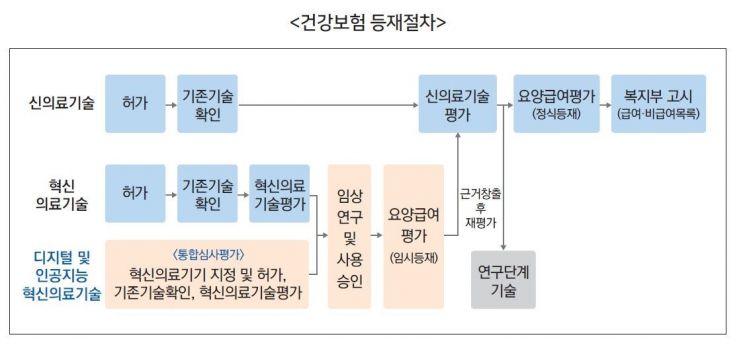 Digital Therapeutics (DTx) and Artificial Intelligence (AI) Technology Health Insurance Listing Procedures
 Photo by Health Insurance Review & Assessment Service
As a result of this National Health Insurance application, the first innovative AI medical technology to meet patients within the insurance system is expected to be JLK's AI-based ischemic stroke subtype classification solution 'JBS-01K' using MRI. This technology assists diagnosis by classifying cerebral infarction patients into four types, and based on opinions from related academic societies and companies, it will be assigned a preliminary code during the evaluation period of accumulating real-world data (RWD) as an innovative medical technology, with non-reimbursable application expected.
JBS-01K is currently undergoing the 'Innovative Medical Device Integrated Review and Evaluation' process, which integrates the Ministry of Food and Drug Safety's designation of innovative medical devices, the Health Insurance Review and Assessment Service's confirmation of reimbursement eligibility, and the Korea Health Industry Development Institute (NECA)'s innovative medical technology evaluation. The company plans to complete the review soon and deploy it in medical settings starting next month.
Following the first application of National Health Insurance last year to innovative medical technologies such as stem cell therapy and cancer prognosis gene diagnostic tests, this expansion to software medical devices (SaMD) is considered highly significant.
However, the industry appears to be entering strategic deliberations regarding reimbursement, non-reimbursement, and National Health Insurance application. A representative from an AI medical device company said, "With the full-scale reimbursement under National Health Insurance, the market can be grown in the long term," but added, "The fees seem to be lower than expected, so we need to make decisions regarding reimbursement."
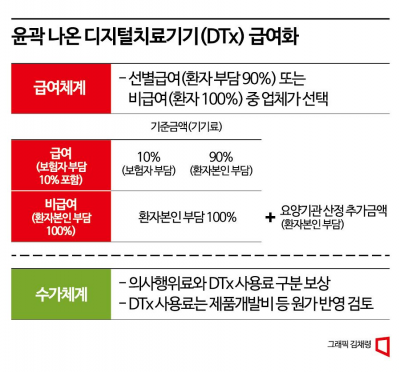
For DTx, a new fee of about 20,000 KRW has been established for prescribing medical personnel. This measure is explained as necessary considering the effective management required mainly for mental and chronic diseases.
Initially, a 'prescription fee' of 5,230 KRW is set for device activation and usage education at the first prescription, and an 'effectiveness evaluation fee' of 16,130 KRW is set for comprehensive compensation covering patient usability confirmation, treatment effect evaluation, and treatment plan management after usage completion.
The Ministry of Health and Welfare explained, "Considering that explanations, education, and evaluations are mainly outpatient-centered, the same fee will be compensated regardless of device type or whether reimbursement or non-reimbursement is selected," and added, "To encourage active monitoring in the early introduction phase and alleviate patient burden, it will be applied as reimbursable."
© The Asia Business Daily(www.asiae.co.kr). All rights reserved.
![Clutching a Stolen Dior Bag, Saying "I Hate Being Poor but Real"... The Grotesque Con of a "Human Knockoff" [Slate]](https://cwcontent.asiae.co.kr/asiaresize/183/2026021902243444107_1771435474.jpg)

















