7 Major US Big Tech Companies Increase Market Capitalization by 5,400 Trillion Won This Year
Despite multiple adverse factors sweeping global stock markets, such as the sharp rise in U.S. Treasury yields and the armed conflict between Israel and Palestine, the U.S. stock market continues to thrive alone. The AI boom has fueled the prosperity of major U.S. tech stocks, adding momentum to the overall U.S. stock market, and it is expected that this enthusiasm will hardly fade anytime soon.
According to major foreign media on the 24th (local time), the market capitalization of the seven major U.S. big tech companies known as the "Magnificent 7"?Nvidia, Apple, Microsoft (MS), Meta, Amazon, Alphabet (Google), and Tesla?has increased by about $4 trillion (approximately 5,400 trillion KRW) this year.
Thanks to the pull from the Magnificent 7, the upward trend in the U.S. stock market has not been broken. A British media outlet noted, "Despite the recent rise in long-term interest rates (U.S. Treasury yields surpassing 5% again), the stock prices of major U.S. tech companies have been relatively less affected," adding, "The structural leadership of the U.S. stock market by the Big 7 tech companies has helped it avoid the impact of such adverse factors." Recently, the combination of three major negative factors?the sharp rise in U.S. Treasury yields, uncertainty in the U.S. presidential election, and geopolitical instability in the Middle East due to the Israel-Palestine armed conflict?has dampened global stock market investor sentiment.
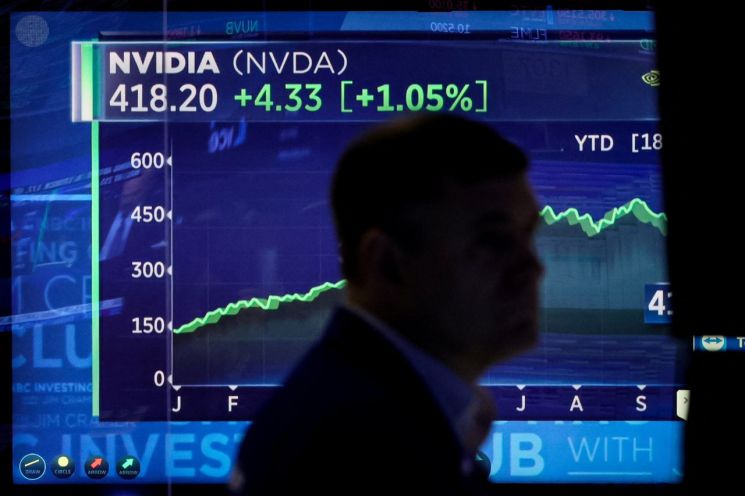
Experts predict that the bullish trend in the U.S. stock market, led by the Magnificent 7, will continue. They cite the fact that the valuation of the global AI company 'OpenAI,' which has driven this year's AI boom and was a key growth engine for these stocks, has surged more than threefold in the market. Max Gokhman, Chief Investment Strategist at U.S. asset management firm Franklin Templeton, said, "Many investors are still caught in the 'value trap,'" and noted that U.S. stocks have remained a long-term performing asset class largely due to the contribution of U.S. tech stocks.
In particular, this year, the U.S. stock market has moved more according to the short-term momentum of the AI boom rather than geopolitical factors. Thanks to the AI boom, the U.S. stock market is relatively overvalued compared to other major countries such as Europe, China, and Japan. According to JP Morgan Asset Management, the 12-month forward price-to-earnings ratio (PER) of the S&P 500 index stands at 18 times, meaning it would take 18 years of earnings to match the current stock price. In contrast, the PER of the Morgan Stanley Capital International (MSCI) ACWI index, which excludes U.S. stocks, is around 12 times.
If this trend continues, the proportion of U.S. market capitalization in the global stock market is expected to increase again this year. This proportion has shown an expanding trend for nine consecutive years until last year. The market capitalization share of U.S. companies in the MSCI ACWI, which covers major stock markets worldwide, has increased from below 50% ten years ago to 61% currently. In particular, the top 10 stocks by market capitalization, including the Magnificent 7, have more than doubled their weight in the MSCI ACWI index from 8% to 19% during the same period.
© The Asia Business Daily(www.asiae.co.kr). All rights reserved.
![Clutching a Stolen Dior Bag, Saying "I Hate Being Poor but Real"... The Grotesque Con of a "Human Knockoff" [Slate]](https://cwcontent.asiae.co.kr/asiaresize/183/2026021902243444107_1771435474.jpg)















