Before Qingdao, 'Naked Kimchi', 'Artificial Eggs'
"Strict Food Law Enforcement but Lack of Safety Management"
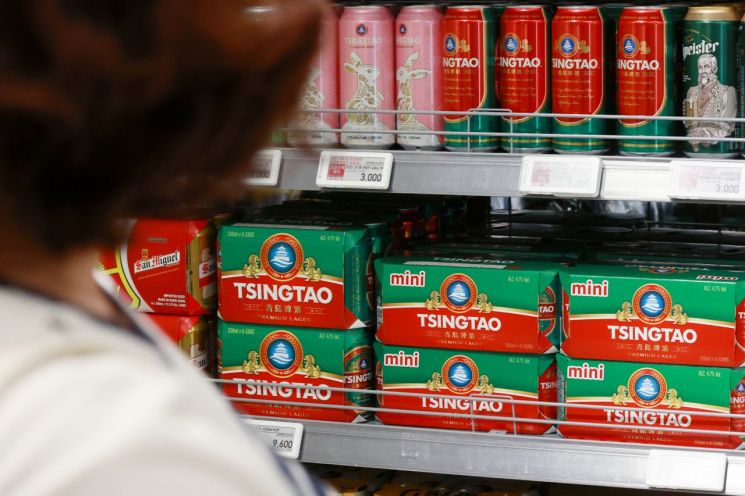
A controversy has erupted after a video surfaced showing a man urinating in the raw material (malt) storage area at a local factory of China's representative beer brand, Qingdao. According to the beer importer and the Ministry of Food and Drug Safety, the beer produced at the factory in question has not been imported into Korea, but consumer suspicion toward Chinese food products in general is growing, making it difficult to ease public anxiety.
Hygiene incidents involving Chinese food products, such as the so-called "Naked Kimchi" case that shocked the public in 2021, keep recurring whenever they seem to be forgotten.
Kim Yong-gil, a former professor at Wonkwang University Law School specializing in Chinese food law, appeared on CBS Radio's "Kim Hyun-jung's News Show" on the 24th and explained, "Among the incidents known in Korea, there was the so-called garbage food incident in 2005, the artificial egg incident in 2007, and the melamine milk powder incident in 2008."
Professor Kim added, "Besides these, there was also the Japanese death incident caused by Chinese pesticide dumplings, the industrial gelatin medicinal capsule incident in 2012, the lamb meat incident in 2013, and the Haeryungjang frozen food food poisoning death incident in 2020, among many other major and minor cases."
He continued, "China has enacted a Food Safety Law and enforces it strongly, so such incidents do not commonly occur. However, it is true that some individuals still lack awareness of food safety and hygiene."
Regarding the repeated controversies over Chinese food hygiene, Professor Kim explained, "China promotes itself as a major food-producing country and uses food for political, diplomatic, and cultural activities. When such incidents occur, it causes international embarrassment, so they have made considerable efforts to improve these issues."
He also said, "However, because China is such a large country, food safety management and hygiene supervision are divided among four ministries?the Ministry of Agriculture, the State Administration for Market Regulation, the General Administration of Quality Supervision, Inspection and Quarantine, and the Ministry of Health?so food safety standards and solutions differ somewhat, and when problems arise, they may shift responsibility to each other, causing coordination issues."
He further pointed out, "The environment in rural areas where food factories are located is very poor. There is a shortage of enforcement agencies, and the capacity to carry out the complex and difficult tasks of food safety management and hygiene supervision seems somewhat lacking. There also appear to be some individual deviations due to insufficient hygiene awareness regarding food."
After hygiene issues arise, the Korean government investigates through the food safety traceability system and may take measures such as sales suspension, recalls, and import bans, according to Professor Kim.
However, preventing hygiene problems during the manufacturing process inside local factories remains a challenge.
Professor Kim said, "No country in the world has perfect food safety. It is extremely difficult to manage all the food that citizens consume daily in a completely safe manner. Consumers should always carefully check the expiration date, the nutritional content of packaged foods, the amount of trans fats, and the functions of nutritional components when making purchases."
© The Asia Business Daily(www.asiae.co.kr). All rights reserved.
![Clutching a Stolen Dior Bag, Saying "I Hate Being Poor but Real"... The Grotesque Con of a "Human Knockoff" [Slate]](https://cwcontent.asiae.co.kr/asiaresize/183/2026021902243444107_1771435474.jpg)
















