Analysis of Japan's Nihon Keizai Shimbun
4.6%p Increase Compared to Previous Work 14
Reduced Proportion of Japanese and Chinese Products
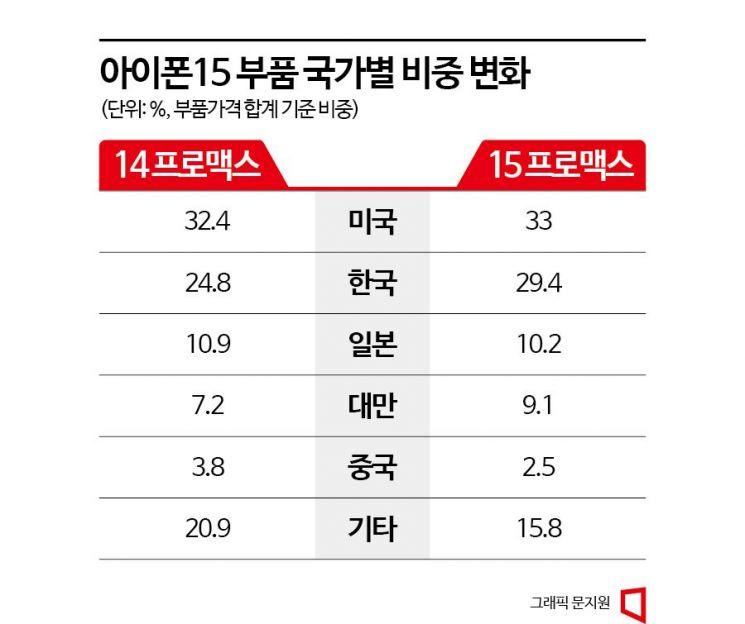
The proportion of Korean-made components in the iPhone 15 has increased compared to its predecessor, the iPhone 14, approaching 30%. Nearly one-third of the parts are 'Made in Korea.' Meanwhile, the share of Chinese and Japanese components has decreased.
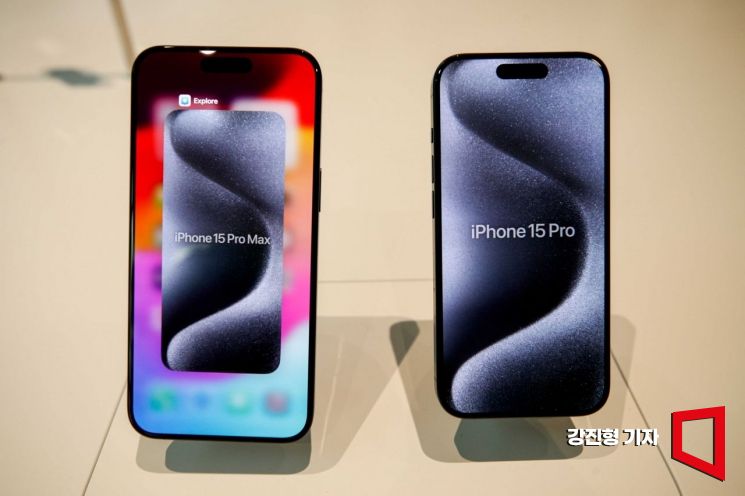 On the 13th, the official domestic release date of the iPhone 15 series, the iPhone 15 and iPhone 15 Pro Max are displayed at the Apple Store Myeongdong in Jung-gu, Seoul. Photo by Jinhyung Kang aymsdream@
Recently, Japan's Nihon Keizai Shimbun (Nikkei) analyzed the country-by-country share of components based on price after disassembling the iPhone 15 Pro Max by Tokyo-based mobile device research firm Formalhaut Techno Solutions. The total cost of components was $558 (approximately 750,000 KRW). Components made in the U.S. accounted for the largest share at 33%, followed by Korean-made parts at 29.4%. The share of Korean components increased by 4.6 percentage points compared to the iPhone 14. Japanese-made parts accounted for 10.2%, and Chinese-made parts 2.5%. The shares of Japanese and Chinese components decreased by 0.7 and 1.3 percentage points respectively compared to the iPhone 14. This means Korea is closing in on the U.S. while widening the gap with China and Japan.
The noticeable increase in the share of Korean components compared to the previous model is due to Chinese company BOE, which had planned to supply OLED (organic light-emitting diode) panels, failing to implement hole display technology. As a result, the volume allocated to BOE was shifted to Samsung Display. Hole display technology involves drilling a hole at the top front of the display to secure space for camera module lenses and other components. Nikkei estimated the price of the OLED panel used in the iPhone 15 at $115 (approximately 155,000 KRW) per unit, meaning the panel accounts for 20% of the total cost.
The supplier of the periscope-type 'folded camera,' introduced for the first time in the iPhone lineup, is also a Korean company, LG Innotek. LG Innotek, Apple's largest camera module supplier, is exclusively supplying the folded camera in addition to the existing camera modules. The estimated supply price per camera is $30 (approximately 40,000 KRW). In the first half of the year, LG Innotek's sales totaled 8.283 trillion KRW, of which 6.2215 trillion KRW (75%) came from transactions with Apple. Additionally, LX Semicon supplies display driver ICs (DDI), Samsung Electro-Mechanics supplies multilayer ceramic capacitors (MLCC), LG Chem and Samsung SDI supply batteries, and Samsung Electronics and SK Hynix supply memory semiconductors to Apple. As of fiscal year 2022, Apple has 11 domestic partner companies in Korea.
Meanwhile, the profit margin of the iPhone 15 is reported to have declined compared to its predecessor. In the U.S., the selling price remains the same as the previous model, but the cost has increased. Nikkei stated, "The cost of the iPhone 15 Pro Max increased by 12% compared to the iPhone 14, and the proportion of cost in the selling price rose from 48% to 52%. Experts predict that Apple will pass on the increased costs to consumers next year." This suggests that Apple's 'price freeze policy' implemented this year is unlikely to apply to the next product.
© The Asia Business Daily(www.asiae.co.kr). All rights reserved.
![Clutching a Stolen Dior Bag, Saying "I Hate Being Poor but Real"... The Grotesque Con of a "Human Knockoff" [Slate]](https://cwcontent.asiae.co.kr/asiaresize/183/2026021902243444107_1771435474.jpg)












