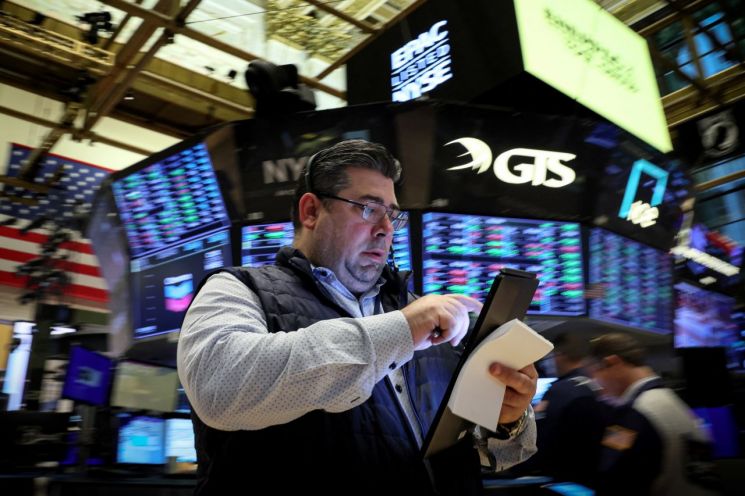
The three major indices of the U.S. New York stock market all opened lower on Monday, the 23rd (local time), as investors monitored movements in Treasury yields. Amid ongoing geopolitical risks stemming from the Middle East, this week will see earnings reports from major big tech companies including Google Alphabet and Amazon, as well as inflation data closely watched by the Federal Reserve (Fed).
At around 10 a.m. at the New York Stock Exchange (NYSE), the Dow Jones Industrial Average, which focuses on blue-chip stocks, was trading at 33,078, down 48.41 points (0.15%) from the previous close. The S&P 500, centered on large-cap stocks, fell 7.16 points (0.17%) to 4,217, while the tech-heavy Nasdaq dropped 35.16 points (0.27%) to 12,948.
Within the S&P 500, eight of the eleven sectors, excluding industrials, real estate, and communication services, were in decline. The energy sector's losses exceeded 1%. Oil giant Chevron was down more than 2% after news broke that it would acquire competitor Hess for $171 per share, totaling $53 billion. Hess's stock showed slight gains. Apple traded slightly lower following a Global Times report that its major partner Foxconn is under investigation in China for tax and land use issues. Walgreens Boots Alliance rose more than 3% after JP Morgan upgraded its rating with increased weighting.
Investors are closely watching Treasury yield movements and the ongoing conflict between Israel and Hamas while awaiting this week’s major big tech earnings and economic data releases. In the New York bond market, the benchmark 10-year U.S. Treasury yield, which had earlier surpassed 5%, fell to around 4.91% as of 10 a.m. The 30-year yield stood near 5.05%, and the 2-year yield, sensitive to monetary policy, hovered around 5.09%. CNBC reported that "a 10-year yield above 5% signals that investors have lost faith that the Fed will cut rates anytime soon," calling it "a strong signal that could pressure the stock market."
Tony Dwyer, Chief Market Strategist at Canaccord Genuity, expressed concern over the recent rise in Treasury yields, saying, "The already weakening economic conditions will accelerate due to higher interest rates." Mike Wilson of Morgan Stanley predicted increased market volatility through the end of the year. Wilson’s year-end S&P 500 target is 3,900, about 7% below last Friday’s closing price on the 20th. Adam Crisafulli of Vital Knowledge noted in an investor memo that rate hikes, geopolitical tensions, U.S. federal government dysfunction, and tax issues are key factors continuously pressuring the market.
This week will also feature earnings reports from major companies. Investor attention is particularly focused on the performance of leading big tech firms such as Alphabet, Meta Platforms, Amazon, and Microsoft (MS). These big tech companies, which drove the New York stock market in the first half of the year, will be closely watched to see if their results can revive investor sentiment dampened by the recent surge in Treasury yields and the war between Israel and the Palestinian militant group Hamas. However, there is also concern that disappointing earnings or guidance could negatively impact stock prices. Tesla’s stock, for example, plunged sharply last week following an earnings miss that disappointed investors.
According to Bank of America (BoA), about 40% of companies listed on the S&P 500 will report earnings this week. Besides big tech, earnings reports are expected from General Motors (GM), Coca-Cola, Boeing, IBM, and Merck. BoA strategist Savita Subramanian noted, "The Q3 earnings season has so far exceeded previous quarters, but guidance is lagging."
Additionally, investors are awaiting Fed Chair Jerome Powell’s keynote speech in Washington, D.C., the U.S. third-quarter gross domestic product (GDP) growth rate, and the release of the personal consumption expenditures (PCE) price index, the Fed’s preferred inflation gauge. The September PCE price index is expected to rise 0.4% month-over-month. This week will also see interest rate decisions from the European Central Bank (ECB), the Bank of Canada, and the Central Bank of T?rkiye.
European markets showed mixed performance. Germany’s DAX and the UK’s FTSE indices were down 0.28% and 0.51%, respectively, while France’s CAC index rose 0.33%.
© The Asia Business Daily(www.asiae.co.kr). All rights reserved.
![Clutching a Stolen Dior Bag, Saying "I Hate Being Poor but Real"... The Grotesque Con of a "Human Knockoff" [Slate]](https://cwcontent.asiae.co.kr/asiaresize/183/2026021902243444107_1771435474.jpg)
















