Top Executives Secure Talent Through University Lectures
Warning of Semiconductor Workforce Shortage in 2031
Display Industry Also Faces Shortage of 2,000 Professionals
Chief Executive Officers (CEOs) are directly engaging in the 'talent war.' Although the importance of the semiconductor and display industries is increasing, workforce supply is not keeping pace. Beyond HR personnel, CEOs are actively involved in talent scouting, recognizing that the company's future competitiveness depends on securing excellent talent.
On the 26th, Choi Ju-seon, President of Samsung Display, is scheduled to give a special lecture in a seminar class at his alma mater, the Department of Electrical and Computer Engineering at Seoul National University. This will be Choi's first university lecture since his appointment.
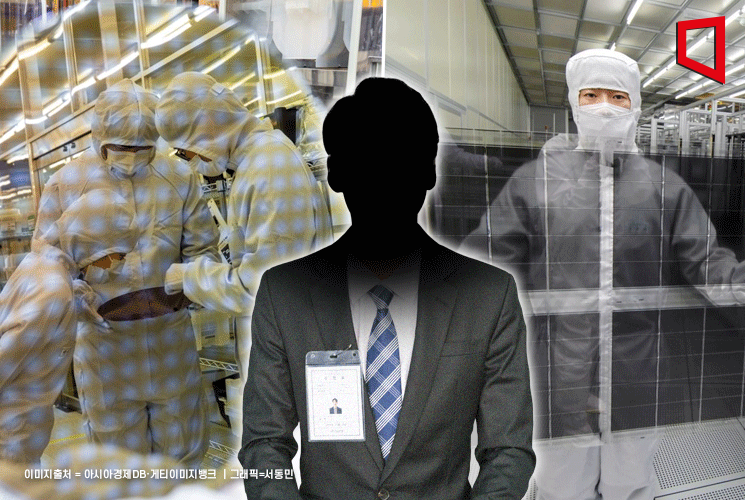
Choi’s visit to Seoul National University aims to secure outstanding talent from the university. On the same day, Samsung Display will hold a campus recruitment event called 'Display Day' at Seoul National University. The company plans to focus on showcasing future products and setting up recruitment consultation booths to communicate its vision to students.
With an emergency in talent acquisition, it has become a familiar scene for CEOs in the electronics industry to visit major university campuses and give lectures in person.
Kyung Kye-hyun, President of Samsung Electronics’ DS (Semiconductor) Division, visited KAIST (Korea Advanced Institute of Science and Technology) and Yonsei University in May and June to give lectures under the theme 'Samsung Semiconductor of Dreams and Happiness, Sustainable Future.' Last month, he also visited his alma mater, Seoul National University, to deliver a lecture on the same topic. President Kyung emphasizes the importance of talent acquisition in every lecture. At a lecture at Seoul National University on the 5th, he said, "There are limits to finding people. We are investing heavily in manpower and wafers, and if you come to Samsung Electronics, there is no shortage of resources to prevent development." Heads (Presidents) of Samsung Electronics’ divisions such as Memory, Foundry, and System LSI have also been visiting major universities following last year’s trend.
Kwack No-jung, President of SK Hynix, gave a lecture at KAIST on the 11th under the theme 'Making the World Happier with Advanced Technology.' This is Kwack’s first university lecture. On November 2nd, he is scheduled to give a commemorative lecture for the 60th anniversary of the College of Engineering at his alma mater, Korea University.
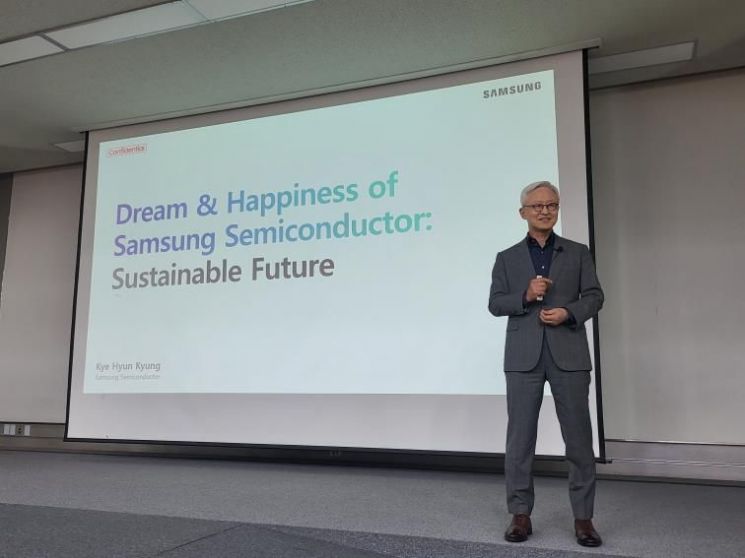 Kyung Kye-hyun, President of the Device Solutions (DS) Division, gave a lecture titled "Samsung Semiconductor of Dreams and Happiness: A Sustainable Future" at Seoul National University on the 5th of last month.
 [Photo by Samsung Electronics] [Image source=Yonhap News]
The semiconductor workforce shortage is not a new issue, but as global competition intensifies, the importance of securing technical talent is expected to grow even further.
The Korea Semiconductor Industry Association warned that while the domestic semiconductor workforce, which was 179,000 in 2021, is expected to increase to 304,000 by 2031, there could be a shortage of 30,000 to 50,000 personnel.
The display industry faces a similar situation. According to the 'Prospects for Industrial Technology Personnel in Promising New Industries' report published by the Korea Institute for Advancement of Technology in April, as of the second half of 2021, the next-generation display industry had about 43,000 technical personnel. The shortage was approximately 2,000, with a 6% shortage rate for master's and doctoral degree holders. This is higher than the average shortage rate of 4.4% for master's and doctoral degree holders in promising new industries. Compared to other industries with higher industrial maturity, there is a greater shortage of advanced R&D personnel.
Major companies are also strengthening benefits for contract departments established in partnership with universities to nurture future employees. Samsung Electronics has decided to invest $1 million (approximately 1.32 billion KRW) in a talent development program at Texas A&M University in the United States. It has also formed a partnership with the University of Texas and plans to provide a total of $3.7 million to support local workforce development. Domestically, Samsung operates semiconductor contract departments at four locations nationwide and plans to open related departments at three science and technology institutes, including Ulsan National Institute of Science and Technology (UNIST), earlier this year. SK Hynix signed an agreement to support students from Korea University’s Semiconductor Engineering Department to study at UC Davis in the United States.
There have also been changes in corporate recruitment systems. Samsung Electronics conducted foreign experienced hires in the research and development (R&D) field for the first time this year. Foreigners currently residing in Korea who meet the graduation requirements for master's and doctoral students were eligible for recruitment. This indicates the severity of the talent shortage to the extent that foreign experienced recruitment is necessary.
© The Asia Business Daily(www.asiae.co.kr). All rights reserved.
![Clutching a Stolen Dior Bag, Saying "I Hate Being Poor but Real"... The Grotesque Con of a "Human Knockoff" [Slate]](https://cwcontent.asiae.co.kr/asiaresize/183/2026021902243444107_1771435474.jpg)
















