60,024 Houses to 38,988 Houses in 5 Years
As aging and population decline in rural areas nationwide become more pronounced, it has been revealed that there are approximately 66,000 vacant houses.
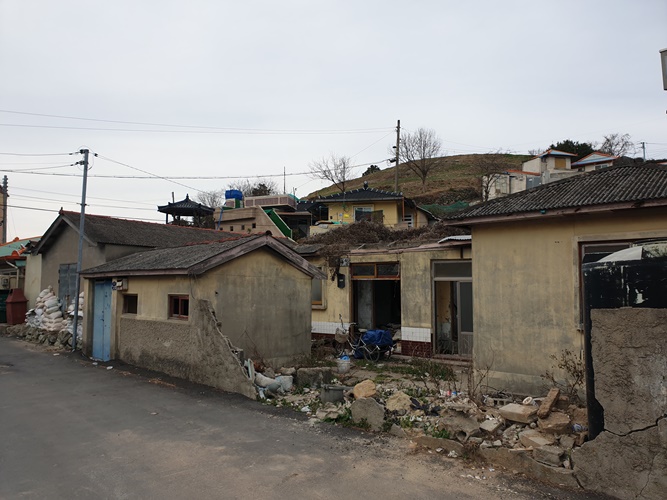
According to data submitted by the Ministry of Agriculture, Food and Rural Affairs to Ahn Byung-gil, a member of the National Assembly's Agriculture, Forestry, Livestock, Food, and Maritime Affairs Committee from the People Power Party on the 23rd, the issue of aging and population decline in rural areas is accelerating, confirming that the problem of vacant houses in rural areas across the country is becoming more severe.
Looking at the ratio of vacant houses in rural areas by province, the numbers were highest in the following order: ▲Jeonnam 16,310 houses (24.7%) ▲Gyeongbuk 13,886 houses (21.0%) ▲Jeonbuk 9,904 houses (15.0%) ▲Gyeongnam 9,106 houses (13.8%).
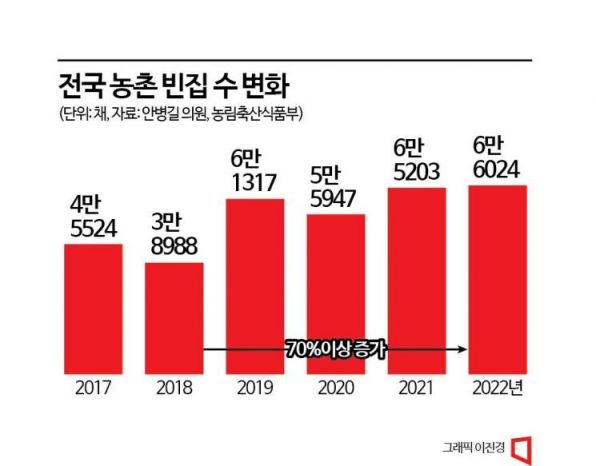
The number of vacant houses in rural areas continues to increase. By year, the figures were ▲2017 (45,524 houses) ▲2018 (38,988 houses) ▲2019 (61,317 houses) ▲2020 (55,947 houses) ▲2021 (65,203 houses) ▲2022 (66,024 houses), showing that the number of vacant houses in rural areas nationwide in 2022 increased by nearly 70% compared to 2018 over five years.
The government announced that to increase the utilization rate of vacant houses, it would make maximum use of available vacant houses through projects supporting return-to-farming and return-to-village initiatives and rural space maintenance projects, and swiftly manage those that need demolition. However, according to Ahn, both the utilization and demolition of rural vacant houses have been sluggish.
The proportion of vacant houses identified as needing demolition that were actually demolished nationwide in rural areas was ▲2019 (17.2%) ▲2020 (23.5%) ▲2021 (18.8%) ▲2022 (18.5%), indicating that the demolition rate has remained stagnant compared to four years ago.
The utilization-type vacant house projects were also sluggish. Among vacant houses identified as usable in rural areas nationwide, the proportion actually utilized was ▲2019 (0.81%) ▲2020 (0.81%) ▲2021 (0.94%) ▲2022 (0.74%), confirming that the utilization rate still does not exceed 1%.
Ahn emphasized, "If the vacant houses left in rural areas are left unattended like this, not only will the existing residents leave, but it will also become an obstacle that blocks new inflows. It is necessary to recognize the rural vacant house problem as a national issue rather than a local government issue and actively expand the personnel and budget required for response."
© The Asia Business Daily(www.asiae.co.kr). All rights reserved.
![Clutching a Stolen Dior Bag, Saying "I Hate Being Poor but Real"... The Grotesque Con of a "Human Knockoff" [Slate]](https://cwcontent.asiae.co.kr/asiaresize/183/2026021902243444107_1771435474.jpg)

















