Reports of American White-Marked Tussock Moth Larvae Sightings Continue
Deciduous Tree Leaf-Eating Pest... Korea Forest Service Issues 'Alert'
Larvae of insects resembling pine caterpillars have appeared nationwide this fall. In particular, sightings have been reported among people visiting Hangang Park in Seoul. Moreover, these insects are known pests that damage fruit trees and other plants.
Recently, on social networks (SNS) and other platforms, there have been continuous reports stating, "The walking paths in Hangang Park are covered with pine caterpillars." Some people said they laid out mats to watch the sunset but found about 100 crawling around, while others were startled when one fell onto their shoulder while sitting in the shade of a tree.
These insects, often mistaken for pine caterpillars due to their similar appearance, are larvae of the American white moth (Amerikan Huinbulnamang). The American white moth is native to North America and was introduced to Korea via Japan during World War II.
The Korea Forest Service announced at the end of August that "an increase in the density of American white moths has been confirmed nationwide, including in Gyeonggi, Chungbuk, Gyeongbuk, and Jeonbuk provinces," and raised the outbreak alert level from 'Interest' (Level 1) to 'Warning' (Level 3). This is the first time since the American white moth was presumed to have entered Korea in 1958.
According to Article 6 of the Forest Pest Control Regulations, the warning level applies when invasive or sudden outbreak pests spread to two or more cities or counties or cause damage over an area of 50 hectares or more.
Unlike the so-called 'Lovebug' red-backed velvet fly, which appears in summer and is a beneficial insect that enriches the soil, the American white moth larvae feed on the leaves of broadleaf trees and mainly damage street trees, ornamental trees, and fruit trees in urban and agricultural areas.
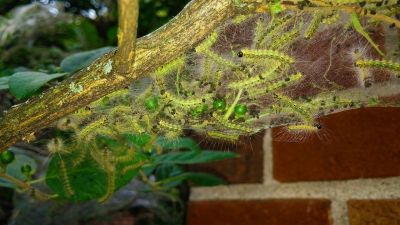
American white moth larvae have a voracious appetite, eating leaves down to the veins, with a single larva consuming 100 to 150 cm² of leaf area. In Korea, significant damage occurred in the 1960s, believed to have been introduced through imported timber. Additionally, contact with these larvae can cause allergies, keratitis, and skin diseases in humans.
However, controlling American white moth larvae is challenging due to their habit of laying eggs in clusters on broadleaf tree leaves and hiding inside silken nests.
In particular, since Hangang Park is designated as a water supply protection zone, chemical pesticides cannot be used. A representative from the Green Space Management Division of the Future Hangang Headquarters said, "We mainly use high-pressure water sprays to knock down the pests and then clean them up," adding, "Even if they fall, they crawl back up the trees or move sideways, making complete control difficult."
Dr. Kim Minjung of the Forest Pest Research Division at the National Institute of Forest Science stated, "According to the Korea Forest Service survey, the damage rate caused by American white moth larvae increased more than double from 12% last year to 27-28% this year," and added, "If many larvae appear this year, there is a risk of high occurrence next year as well, so we raised the outbreak alert level to warning."
The American white moth's egg-laying period is from late July to early August, with an average female laying about 600 eggs. Typically, the female lays eggs and dies within a year, and the second generation hatches from these eggs and becomes adults.
Dr. Kim estimated, "This year's higher autumn temperatures likely contributed to the increase in population." Analysis suggests that with autumn temperatures rising 1 to 2 degrees Celsius above average this year, the proportion of third-generation adults hatched from eggs laid by the second-generation adults of American white moth larvae increased.
© The Asia Business Daily(www.asiae.co.kr). All rights reserved.

















