Cost of Training Skilled Fighter Pilots Approximately 10 Billion Won
About 100 Leave Annually...Low Pay and Competition
Air Force fighter pilots, trained at a cost exceeding approximately 10 billion KRW each, are leaving the service every year.
There are about 1,700 active-duty Air Force fighter pilots in South Korea. The majority are captains (780) and majors (540). Among them, there is a high turnover rate at the major level. Approximately 100 pilots in their prime, who should be performing missions on the Air Force's main fighter jets such as the F-15K, leave the military annually.
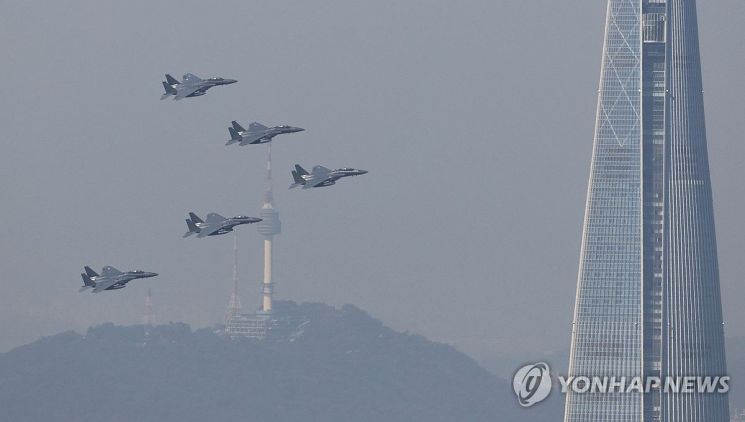 An F-15K fighter jet is flying over the Seoul Airport area in Seongnam, Gyeonggi Province on the 17th of last month.
 [Photo by Yonhap News]
In 2017, 106 pilots left, and in 2018, 125 departed. The number dropped to 7 in 2021 due to the significant impact of COVID-19, but it increased again this year, with 58 leaving as of last month. Most of those who left are estimated to have joined civilian airlines as pilots.
Training one experienced fighter pilot costs roughly over 10 billion KRW. The expenses for pilot training mainly consist of 'pilot training education costs' and 'combat readiness training costs.'
For example, an FA-50 fighter pilot introduced in 2013 requires 1.25 billion KRW per person for flight training and tactical introduction, plus 5.69 billion KRW for combat readiness training. The total cost over the 10 years it takes to become a skilled pilot amounts to 6.94 billion KRW, approximately 7 billion KRW.
Similarly, a KF-16 pilot with comparable experience costs 12.26 billion KRW, and an F-15K pilot costs 21.08 billion KRW in training expenses.
The reasons for Air Force fighter pilot attrition can be viewed from three main perspectives. First, the pay is lower compared to civilian airlines for similar experience levels. Second, the limited time available to spend with family due to emergency sorties and standby duties is a challenge. Lastly, the fatigue from competition for promotion is also cited as a reason for considering discharge.
The Air Force is implementing various improvement measures to delay pilots' discharge or prevent their attrition. First, it has increased the number of colonel positions by 25 to improve the pilot personnel structure and abolished the age limit for employment in civilian airlines.
Additionally, the Air Force is pushing a plan to increase fighter pilot flight allowances by 20% by next year, investing 3 billion KRW annually. It is also preparing a budget to provide extended service incentive allowances of 1 million KRW per month not only for pilots in their 21st year of service but also for those in their 22nd year and beyond.
An Air Force official stated, "We are continuously promoting welfare and treatment improvement projects such as increasing flight allowances so that pilots can focus on their military service," adding, "Considering changes in the times, we are also pursuing measures to improve service satisfaction by reflecting the opinions of young pilots in their 20s and 30s."
© The Asia Business Daily(www.asiae.co.kr). All rights reserved.
![Clutching a Stolen Dior Bag, Saying "I Hate Being Poor but Real"... The Grotesque Con of a "Human Knockoff" [Slate]](https://cwcontent.asiae.co.kr/asiaresize/183/2026021902243444107_1771435474.jpg)















