The New York stock market fell due to the burden of interest rates following news that the yield on the U.S. 10-year Treasury bond surpassed the psychological resistance level of 5%.
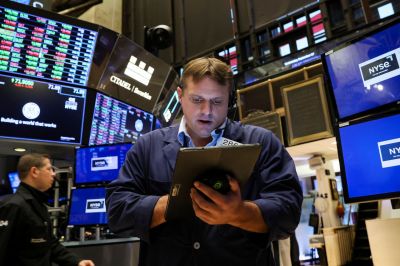
On the 20th (Eastern Time), at the New York Stock Exchange (NYSE), the Dow Jones Industrial Average closed at 33,127.28, down 286.89 points (0.86%) from the previous session.
The Standard & Poor's (S&P) 500 index fell 53.84 points (1.26%) to 4,224.16, and the Nasdaq index closed down 202.37 points (1.53%) at 12,983.81.
Investors focused on movements in the bond market, remarks by Federal Reserve (Fed) Chair Jerome Powell the previous day, and corporate earnings. Chair Powell said at an event the day before that inflation remains too high, and while policy is restrictive, it is not overly tight.
Powell stated, "Considering the uncertainties, risks, and how far we have come, the committee is proceeding cautiously," but also noted that he does not think interest rates are at too high a level, leaving the possibility of further tightening open.
In the U.S. interest rate futures market, the probability that the Fed will hold rates steady at the November meeting is seen at over 90%.
Following Powell's remarks the previous day, the yield on the 10-year U.S. Treasury briefly surpassed 5%, the highest level since 2007. Although yields turned downward again that day, concerns that the high-interest-rate environment may persist exerted downward pressure on stock prices.
The 2-year yield fell more than 8 basis points (0.08 percentage points) to 5.08%, the 10-year yield dropped over 6 basis points to 4.92%, and the 30-year yield declined about 2 basis points to 5.08%.
There were also remarks from officials suggesting that the Fed’s rate cuts might only be possible by the end of next year. Raphael Bostic, President of the Federal Reserve Bank of Atlanta, said in an interview with CNBC that when asked about the timing of Fed rate cuts, "(When inflation) gets close to 2%." When asked for a specific time, he said, "I would say the end of 2024."
Fed officials have previously expected the benchmark rate to reach a median of 5.1% by the end of next year. Considering the current benchmark rate is between 5.25% and 5.50%, this suggests that only one or two rate cuts might be possible next year (including one additional hike this year).
Loretta Mester, President of the Federal Reserve Bank of Cleveland, said that although the federal funds rate has reached or is near its peak, she supports further rate hikes.
Patrick Harker, President of the Federal Reserve Bank of Philadelphia, reiterated his stance that "maintaining the policy rate steady is a prudent choice," advocating for a rate hold.
© The Asia Business Daily(www.asiae.co.kr). All rights reserved.
![Clutching a Stolen Dior Bag, Saying "I Hate Being Poor but Real"... The Grotesque Con of a "Human Knockoff" [Slate]](https://cwcontent.asiae.co.kr/asiaresize/183/2026021902243444107_1771435474.jpg)
















