Hong Young-pyo "Analysis Based on This Year's Economic Forecast by Tax Revenue Estimates"
If This Year's Economic Forecast Changes, Tax Revenue Predictions Will Be Incorrect
The National Assembly has issued a warning that if the Ministry of Economy and Finance insists on this year's economic outlook as 'high in the first half and low in the second half,' another tax revenue discrepancy may occur. The key variables for the government's tax revenue forecast for next year, such as export growth rate, private consumption growth rate, and nominal GDP growth rate, are based on the 'high in the first half and low in the second half' economic outlook, but the economic situation in the second half is turning out to be completely different. Therefore, there have been suggestions to re-estimate next year's tax revenue.
On the 20th, Hong Young-pyo, a member of the Democratic Party of Korea, warned through a press release that after reviewing the problems of this year's tax revenue estimation method, which resulted in a large-scale tax revenue shortfall, next year's tax revenue forecast could also be wrong.
First, Hong diagnosed the cause of this year's tax revenue shortfall, which was about 59 trillion won less than the original budget, and concluded that "the main cause was confirmed to be the government's failure to predict exports, private consumption, and nominal GDP."
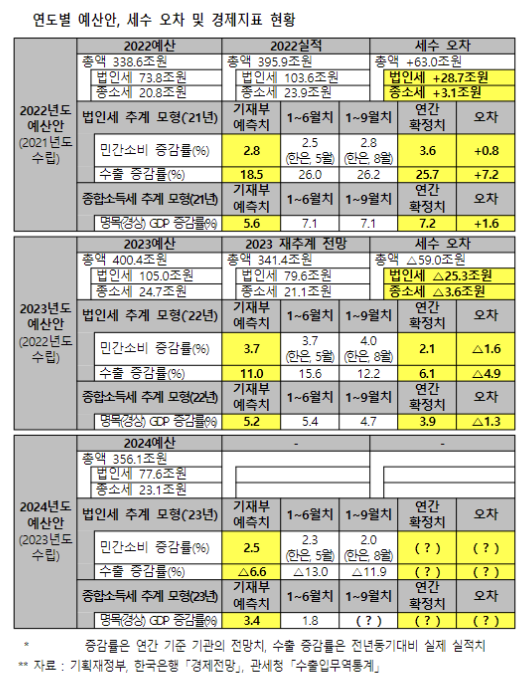
According to Hong's analysis, the key variables in the government's estimation model for corporate tax and comprehensive income tax are the export growth rate, private consumption growth rate, and nominal GDP growth rate. In particular, for corporate tax and comprehensive income tax, this year's economic indicators are used when estimating next year's tax revenue. As a result, if this year's economic outlook is wrong, tax revenue discrepancies occur the following year.
Specifically, this year's budget was submitted to the National Assembly in September last year, at which time the Ministry of Economy and Finance forecasted last year's private consumption growth rate at 3.7% and export growth rate at 11.0%. However, the actual figures confirmed four months later were 2.1% and 6.1%, respectively. There was a difference of 1.6 percentage points and 4.9 percentage points between the forecast and actual figures. Consequently, the corporate tax revenue shortfall reached 25.3 trillion won.
For comprehensive income tax, the Ministry of Economy and Finance expected a GDP growth rate of 5.2% when submitting last year's budget. However, the actual figure confirmed four months later was 3.9%. The difference of 1.3 percentage points between the forecast and actual figures triggered a tax revenue shortfall of 3.6 trillion won.
The Ministry of Economy and Finance has repeatedly failed in tax revenue forecasting. Starting with a surplus tax revenue of 61.4 trillion won in the 2021 budget established in 2020, large-scale tax revenue discrepancies have occurred for three consecutive years. In 2022, there was a surplus tax revenue of 63 trillion won, and this year, a tax revenue shortfall of about 59 trillion won is expected.
The problem lies with next year's budget. The government forecasted the annual export growth rate at -6.6%, private consumption growth rate at 2.5%, and nominal GDP growth rate at 3.4% as assumptions for next year's tax revenue. However, the actual and forecast figures for the first half of this year show an export growth rate of -13.0%, private consumption growth rate of 2.3%, and nominal GDP growth rate of 1.8%, showing a significant gap from the assumptions used for tax revenue forecasting. For the tax revenue forecast to be accurate, the economic situation in the second half of this year would have to dramatically reverse.
Hong said, "Contrary to the government's 'high in the first half and low in the second half' outlook, recent economic indicator results and forecasts show a visible decline in exports and private consumption," and added, "Instead of stubbornly sticking to the 'high in the first half and low in the second half' outlook and failing again in next year's budget and tax revenue estimation, the government should consider conducting a comprehensive re-estimation in October or November."
© The Asia Business Daily(www.asiae.co.kr). All rights reserved.
![Clutching a Stolen Dior Bag, Saying "I Hate Being Poor but Real"... The Grotesque Con of a "Human Knockoff" [Slate]](https://cwcontent.asiae.co.kr/asiaresize/183/2026021902243444107_1771435474.jpg)
















