"Considered a Competent Team Member and Trusted"
'Social Loafing' Phenomenon Occurs Even with Robots
A study has found that people tend to be less focused on tasks when working with robots. In experiments involving collaboration with robots, people’s task concentration decreased over time, leading to an increase in errors.
Researchers led by Dietlind Helene Simek from the Technical University of Berlin in Germany revealed this in a paper published on the 18th (local time) in the scientific journal Frontiers in Robotics and AI.

The researchers mentioned the phenomenon of 'social loafing.' When people work in groups, teamwork can improve performance, but some individuals may lose motivation and not put in their best effort, thinking their contributions will go unnoticed. The research team extended this phenomenon from 'person-to-person' to 'person-to-robot' interactions.
In a simulation experiment, 42 participants were shown images of electronic circuit boards with 0 to 2 defects on a monitor and asked to inspect them. The circuit boards were blurred except for the area under the cursor, which was shown clearly to track the inspection process.
Half of the control group was shown a robot named Panda inspecting the circuit board first and heard sounds indicating that the task was a collaboration with the robot.
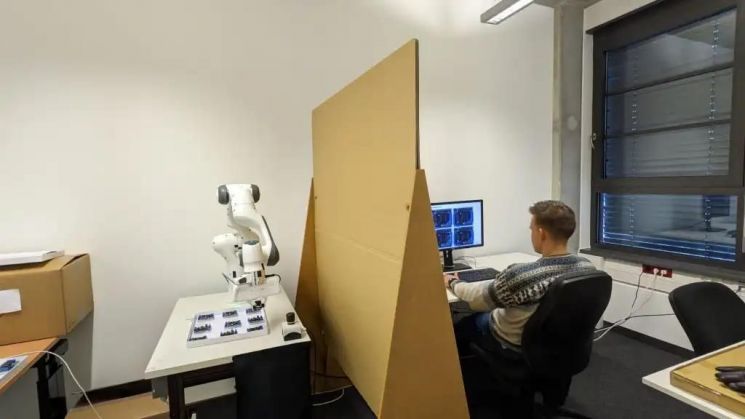 Collaboration experiment scene between humans and robots
 Photo by Dietlind Helene Cymek/Technische Universit?t Berlin, courtesy of Yonhap News
When the researchers examined the defect detection rates of the two groups, the group working with the robot found an average of 3.3 defects, while the group working alone found an average of 4.2 defects. The researchers interpreted this as "people working with the robot paying less attention than those working alone."
As the task progressed, participants working with Panda increasingly missed errors that Panda had already detected. The researchers explained, "People collaborating with robots may become accustomed to relying on something else, leading to a mental state of being 'looking but not seeing,' where they are less mentally engaged."
This can be interpreted as the collaborators believing they are equally responsible and putting in equal effort, but mentally relying on the robot, which lowers their motivation to perform the task.
Co-researcher Dr. Linda Onasch stated, "The phenomenon of internal motivation decreasing due to reliance on robots can negatively impact work outcomes in manufacturing, especially in safety-related fields where double checking is common."
© The Asia Business Daily(www.asiae.co.kr). All rights reserved.
![Clutching a Stolen Dior Bag, Saying "I Hate Being Poor but Real"... The Grotesque Con of a "Human Knockoff" [Slate]](https://cwcontent.asiae.co.kr/asiaresize/183/2026021902243444107_1771435474.jpg)
















