Daejeon City is embarking on the creation of a space industry cluster in collaboration with local research institutions. The plan is to establish a private sector-led space industrial ecosystem to generate future growth engines for the region.
On the 20th, Daejeon City signed a business agreement on the previous day at Daejeon City Hall with five research institutions: Korea Advanced Institute of Science and Technology (KAIST), Korea Aerospace Research Institute (KARI), Korea Astronomy and Space Science Institute (KASI), Korea Institute of Geoscience and Mineral Resources, and Electronics and Telecommunications Research Institute (ETRI).
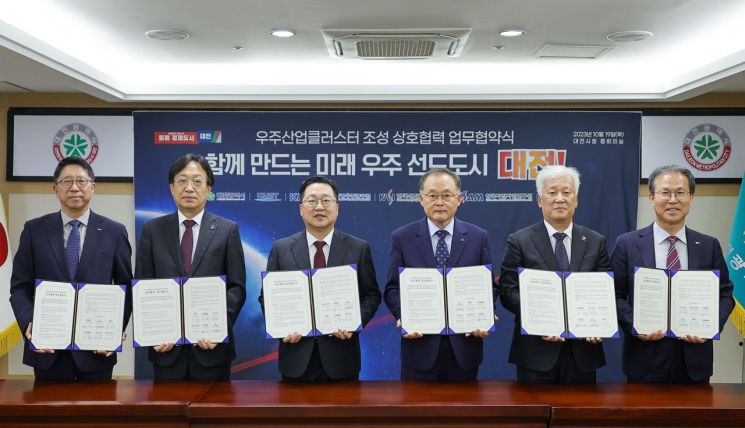 Lee Jang-woo, Mayor of Daejeon (third from the left), is taking a commemorative photo after signing a business agreement with five local research institutions at Daejeon City Hall on the 19th to establish a private-led space industrialization ecosystem. Photo by Daejeon City
Earlier, in December last year, Daejeon was designated as a specialized zone for space industry cluster research and talent development. Subsequently, in August this year, it was confirmed that the preliminary feasibility study exemption for the space industry cluster creation project was granted, securing a total project budget of 97.3 billion KRW.
The agreement was signed to consolidate the capabilities of local research institutions and to actively promote the establishment of a private space development industrial ecosystem across the entire space industry based on this foundation.
The participating research institutions, including KAIST, are already leading research and development in comprehensive fields of space development such as satellites, launch vehicles, payloads, and satellite communications, while collaborating with related companies to carry out space development missions. They also play a pivotal role in training specialized personnel in the space sector and in the industrialization of space.
Furthermore, based on the agreement, Daejeon City and the five research institutions plan to mutually cooperate in the future on ▲ establishing a space industry cluster in research and development and talent cultivation ▲ technology development and corporate support for fostering the space industry ▲ building domestic and international space industry technology exchange and cooperation networks, among other initiatives, to expand infrastructure necessary for space industry research and development and to activate convergence research among industry, academia, and research institutes.
Ultimately, Daejeon City aims to nurture the local space industry by enabling space technology development, private technology transfer, and the entry and market creation of small and medium-sized enterprises into the space industry through cooperation with local research institutions.
It also plans to create a virtuous cycle ecosystem in the space industry where space talents cultivated locally can demonstrate their capabilities within the region.
Lee Jang-woo, Mayor of Daejeon, stated, “Daejeon will serve as one pillar of the national space industry cluster,” adding, “Starting with the Space Technology Innovation Talent Development Center next year, Daejeon City will actively promote the creation of the space industry cluster and strive to create a definite future growth engine for the region through private sector-led space industrialization.”
© The Asia Business Daily(www.asiae.co.kr). All rights reserved.
![Clutching a Stolen Dior Bag, Saying "I Hate Being Poor but Real"... The Grotesque Con of a "Human Knockoff" [Slate]](https://cwcontent.asiae.co.kr/asiaresize/183/2026021902243444107_1771435474.jpg)















