"This area (Myeongdong) commercial district? It feels like it has recovered to about 70% of the pre-COVID-19 level. There are many Japanese and Chinese tourists, but tourists from Southeast Asia such as Taiwan and Malaysia have noticeably increased." (A representative from the Myeongdong Underground Shopping Center Merchants Association)
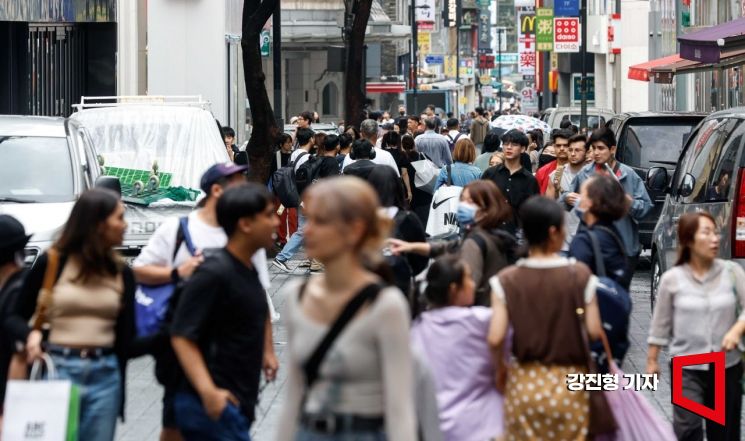 China has lifted the restrictions on group tours to Korea for the first time in 6 years and 5 months, raising expectations that this will be a boon for the domestic travel, hotel, and duty-free industries. On the 11th, foreign tourists including Chinese and Japanese were strolling the streets of Myeongdong, Jung-gu, Seoul. Photo by Kang Jin-hyung aymsdream@
As foreign tourists return and Myeongdong regains its vitality, the vacancy rate in Seoul's major commercial districts has fallen back into the 10% range for the first time since COVID-19. Although there are differences by district, some brands proactively opened new stores despite the COVID-19 pandemic, which is analyzed to have had a positive impact. The ripple effect of 'pop-up stores,' retail spaces designed for consumer experience, cannot be overlooked either.
According to the '2023 Seoul Retail Street Commercial District Report' released on the 19th by global real estate consulting firm Cushman & Wakefield, the average vacancy rate across six major Seoul commercial districts (Myeongdong, Hongdae, Hannam·Itaewon, Cheongdam, Garosu-gil, Gangnam) in the second quarter of this year was 18.7%, down 5.0 percentage points from the same period last year. The vacancy rate, which had consistently exceeded 20% since the first quarter of 2021 when the impact of COVID-19 became full-scale, dropped to the 10% range after about a year.
The district leading the recovery was Myeongdong, where the vacancy rate fell from 52.5% in the second quarter of last year to 14.3% in the second quarter of this year, a decrease of 38.2 percentage points. Before COVID-19, Myeongdong's vacancy rate was 4.5%, but it surged to 23.2% in 2020 and 49.9% in 2021, reaching 52.5% in the first half of last year. Cushman & Wakefield stated, "Even during the period when vacancies surged on Myeongdong streets, global brands opened large flagship stores, and recently the commercial district has been expanding mainly around the main roads with good visibility." They added, "Brands such as Dynafit, ABC Mart, and Olive Young opened new stores in Myeongdong, and small cosmetics brands targeting tourists have resumed operations."
During the same period, the vacancy rates in Gangnam (19.2%) and Hannam·Itaewon (10.0%) districts also decreased by 3.7 percentage points and 0.8 percentage points, respectively. Gangnam, with its abundant foot traffic and high visibility, is characterized by excellent brand advertising effects and large floor areas that allow for the development of large-scale stores. Global burger franchises Five Guys and Super Duper also opened their first stores in the Korean market in Gangnam. Hannam·Itaewon district, where emerging designers and beauty brand showrooms are concentrated, is highly favored by the MZ generation (born early 1980s to early 2000s). Additionally, as foreign tourists seeking K-fashion and K-beauty have increased, the vacancy rate recorded the lowest among the six major districts at 10.0%.
On the other hand, the vacancy rate in the Garosu-gil district rose by 7.8 percentage points from a year ago to 36.5% in the second quarter of this year. This was due to many independent clothing stores, which formed the core of the area, closing down because of declining sales and inability to bear rent costs. Although some brands, viewing the symbolic value of Garosu-gil positively, opened new stores such as Ami and Charles & Keith, Cushman & Wakefield predicted that the recovery would be slower compared to other districts.
Meanwhile, Cushman & Wakefield also paid attention to the Seongsu commercial district, often compared to "Korea's Brooklyn," outside the six major street commercial districts. The Seongsu-dong area, once an industrial zone, has transformed into a unique commercial district with cafes and restaurants remodeled inside old factory frames. Recently, the proliferation of pop-up stores has been attracting the MZ generation. The vacancy rate in Seongsu district was very low at 5.8% in the second quarter of this year.
Cushman & Wakefield stated, "Offline stores still provide consumers with spatial experiences and satisfaction that online channels cannot offer," adding, "This is why many brands open experiential stores in major commercial districts." They further explained, "Seongsu has emerged as a battleground for the pop-up store market, which allows brands to efficiently reach customers in a short period," and "Consumers visiting pop-up stores tend to stay longer, creating a virtuous cycle that also revitalizes nearby commercial districts."
© The Asia Business Daily(www.asiae.co.kr). All rights reserved.
![Clutching a Stolen Dior Bag, Saying "I Hate Being Poor but Real"... The Grotesque Con of a "Human Knockoff" [Slate]](https://cwcontent.asiae.co.kr/asiaresize/183/2026021902243444107_1771435474.jpg)















