Suspended Sentence for Management Company CEO in On-Site Worker Fall Death
One Company Manages an Average of 24 Complexes
Expert: "Amendment and Review of the Serious Accident Punishment Act Needed"
Apartment management office employees' fatal fall accident has led to the representatives and managers of multi-family housing management companies being convicted in the first trial for violating the Serious Accident Punishment Act, leaving the multi-family housing management industry in a state of bewilderment. Due to the nature of sites such as apartments, where there are numerous workplaces and employees to manage and educate, and because companies must bear full responsibility even if accidents occur due to individual negligence, the operational burden is significant. Experts point out the need for legal amendments that consider the characteristics of each industry.
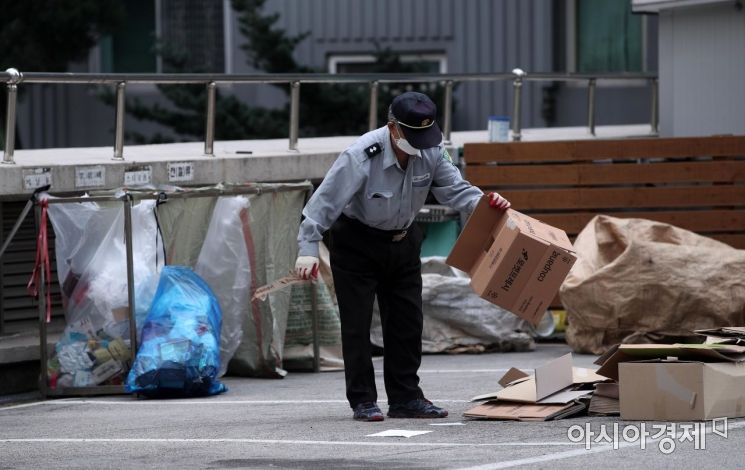
The Seoul Northern District Court Criminal Division 5 (Presiding Judge Lee Seok-jae) on the 12th sentenced apartment manager Bae (63) and multi-family housing management company representative Jeong (62), who were indicted for violating the Serious Accident Punishment Act, to eight months in prison with a two-year probation. They were charged with violating their duty of care in connection with the death of a worker in his 60s, Mr. B, who worked in the mechanical and electrical section of an apartment management office in Dongdaemun-gu, Seoul, and died after falling 1.5 meters from a ladder while repairing ceiling leaks on April 15 last year. This is the first time a guilty verdict has been handed down to a multi-family housing management company since the Serious Accident Punishment Act came into effect in January last year. Additionally, the Ministry of Employment and Labor is currently investigating whether the Serious Accident Punishment Act was violated in a case where an apartment management office employee in Yongin-si, Gyeonggi Province, died after falling while repairing the roof of a recycling station on the 13th.
The multi-family housing management industry is in a state of emergency. The industry expresses frustration, saying the measures do not consider the characteristics of the sector. A representative from a management company said, "Unlike other industries, multi-family housing management involves dozens of sites. We have to conduct risk assessments and specialized training for all locations, which is very challenging." He added, "Many on-site employees do not properly attend industrial safety and health training. It is practically difficult to enforce training for security guards and cleaners stationed in apartment complexes." According to the Ministry of Land, Infrastructure and Transport's '2022 Housing Work Manual,' as of the end of 2021, 546 housing management companies managed 13,270 apartment complexes nationwide. This means one company manages an average of 24 complexes. Another management company representative said, "Elderly workers often collapse during night shifts and strenuous physical labor due to health reasons. It is impossible to foresee and prepare for accidents at all sites with different circumstances."
Industrial accidents in multi-family housing management sites continue unabated. According to the industrial accident status announced by the Ministry of Employment and Labor in December last year, from 2019 to 2021, there were 719 compensated industrial accident cases (workers who suffered work-related injuries or illnesses that could not be cured within three days) and 17 deaths in the 'real estate and rental business' category, which includes residential real estate management. By type, there were 174 cases of falls, 120 cases of drops, 68 cases of occupational diseases, and 58 cases of cuts, lacerations, or stabs. There were only six cases of accidents directly caused by company negligence such as traffic accidents, electric shocks, or explosions within workplaces.
The Serious Accident Punishment Act aims to punish not only corporations but also business owners or management officials when a serious industrial accident occurs. Serious industrial accidents are defined as ▲one or more deaths ▲two or more injuries requiring treatment for six months or longer from the same accident ▲three or more occupational disease cases caused by the same harmful factor within one year. The Act applies to businesses or workplaces with five or more regular employees. In the case of entrusted multi-family housing, the Industrial Safety and Health Act considers each apartment as an individual workplace. However, the Serious Accident Punishment Act applies based on the business, so even if an apartment management office has fewer than five regular employees, if the company’s total number of employees exceeds five, the law applies. For example, even if the apartment complex’s on-site management office has three employees, if the company has more than five employees in total, that apartment is subject to the Serious Accident Punishment Act. An apartment management company representative said, "The purpose of the Serious Accident Punishment Act is accident prevention, not to turn someone into a criminal," adding, "I hope the focus will be more on accident prevention measures in line with the original intent of the law."
Experts suggest that improvements to the Serious Accident Punishment Act are necessary. Seo Jin-hyung, co-representative of the Fair Housing Forum and professor at Gyeongin Women's University, said, "If sufficient economic compensation and agreements with bereaved families are made, it is worth considering exceptions to the law’s application," adding, "It would be more efficient for accident prevention to subdivide the scope of application by business type and have various stakeholders such as clients share responsibility." Jeong Jin-woo, professor of Safety Engineering at Seoul National University of Science and Technology, said, "The accident prevention effect of the Serious Accident Punishment Act is not significant, so a review is needed," and added, "We should move away from a strict punishment-only approach and strengthen accident prevention effectiveness through concretizing the Industrial Safety and Health Act."
© The Asia Business Daily(www.asiae.co.kr). All rights reserved.
![Clutching a Stolen Dior Bag, Saying "I Hate Being Poor but Real"... The Grotesque Con of a "Human Knockoff" [Slate]](https://cwcontent.asiae.co.kr/asiaresize/183/2026021902243444107_1771435474.jpg)
















