US Releases Satellite Images Showing Signs of North Korea-Russia Arms Deal
North Korea Criticizes Japan's Missile Capability Enhancement Without Mentioning It
South Korea, US, Japan Likely to Consider Response Measures Including 'Additional Sanctions'
As the United States released satellite images showing evidence of arms transactions between North Korea and Russia, there are observations that the military equipment contained in 1,000 container boxes transferred by North Korea to Russia could potentially change the course of the war in Ukraine. South Korea, the United States, and Japan are expected to discuss response measures, including 'additional sanctions' against North Korea, through consultations among their senior nuclear representatives.
A government official told Asia Economy on the 16th, "If it is true that military equipment is contained in the 1,000 containers sent by North Korea to Russia, the amount is enough to overturn the course of the war in Ukraine." Russia, the world's most powerful nuclear-armed country, has been struggling for nearly two years since it invaded Ukraine in February last year, due to support for Ukraine from Western countries including the European Union. With the prospect that the large-scale arms deal between North Korea and Russia could change the prolonged dynamics of the Ukraine war, concerns in the international community are expected to grow.
Earlier, John Kirby, Coordinator for Strategic Communications at the U.S. National Security Council (NSC), revealed on the 13th (local time) that "North Korea provided Russia with military equipment and ammunition exceeding 1,000 containers," and released satellite images showing containers being transported at the Nakhodka port, identified as the 'arms transaction site' between North Korea and Russia.
Among the three photos released by the U.S. NSC, one shows about 300 20-foot containers stacked at North Korea's Nakhodka port on September 8. A photo taken on September 12 shows the Russian-flagged vessel Angara docked at the Dunay port in eastern Russia, carrying about 300 containers. The October 1 photo shows a train carrying containers arriving at an ammunition depot in Tikhoretsk, Russia. The depot is located about 290 km from the Ukrainian border.
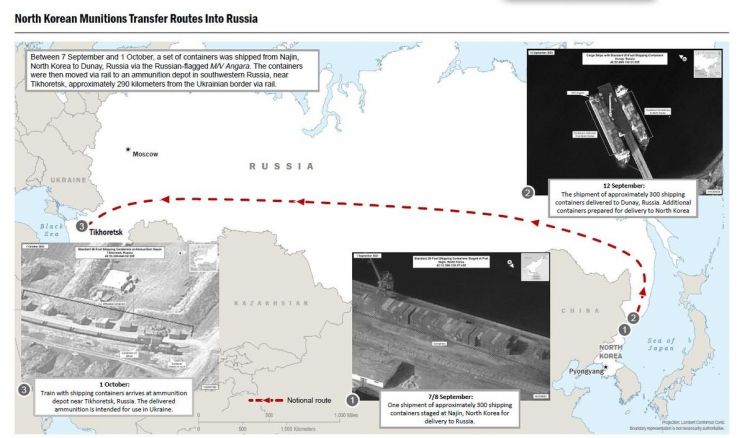 Satellite images released by the U.S. government showing North Korea supplying more than 1,000 containers worth of military equipment and ammunition to Russia through the Najin Port.
 [Photo by U.S. White House National Security Council (NSC)]
This announcement by the United States violates United Nations Security Council Resolution 1874, which prohibits "all exports of weapons and related materials from North Korea and forbids all countries from procuring weapons and related materials from North Korea using their own vessels." Since concerns over North Korea-Russia military cooperation have increased, the government has repeatedly expressed its position that it may consider 'independent sanctions.' Therefore, during the North Korea nuclear senior representative consultations among South Korea, the U.S., and Japan held over two days starting today in Jakarta, Indonesia, trilateral cooperation measures including sanctions are expected to be discussed.
Coordinator Kirby stated, "We condemn North Korea for providing weapons to Russia that are used to attack Ukrainian cities and kill Ukrainian civilians," and announced plans to impose additional sanctions on those who assist North Korea-Russia arms transactions in the future. A Foreign Ministry official said, "In close cooperation with allied countries including the United States, we will continuously monitor military cooperation trends including North Korea-Russia arms transactions and consider additional measures," adding, "We are also closely monitoring violations of UN Security Council sanctions against North Korea."
Meanwhile, North Korea did not comment on the U.S. State Department's announcement regarding the North Korea-Russia arms transactions but fired back by criticizing Japan's attempts to strengthen its missile capabilities. This is interpreted as an attempt to shift the responsibility for tensions on the Korean Peninsula to external forces.
On the 16th, the Korean Central News Agency warned in a commentary about Japan's recent push for early deployment of long-range missiles, stating, "Japan's arrogant choice will create new challenges to security and will result in further escalating tensions on the Korean Peninsula and in the region." It also claimed, "Japan's re-invasion and war state are not fiction but reality." Earlier, Minoru Kihara, Japan's Defense Minister, revealed on the 10th that they are reviewing whether to advance the deployment of domestically produced intermediate-range missiles, originally planned for the 2026 fiscal year (April 2026 to March 2027).
North Korea expressed discomfort by pointing out Japan's military moves linked with the trilateral cooperation of South Korea, the U.S., and Japan. First, it raised concerns about Defense Minister Kihara's meeting with U.S. Secretary of Defense Lloyd Austin on the 4th, where they agreed to advance by one year the plan to introduce Tomahawk cruise missiles, stating, "Japan's moves for re-invasion have entered a very serious stage."
Regarding the trilateral military exercises agreed upon at the August summit among South Korea, the U.S., and Japan this year, North Korea also criticized, saying, "The Japanese Self-Defense Forces gaining a 'legitimate pretext' to be deployed to the Korean front in an emergency is tantamount to granting a license to intervene in the Korean Peninsula."
© The Asia Business Daily(www.asiae.co.kr). All rights reserved.
![Clutching a Stolen Dior Bag, Saying "I Hate Being Poor but Real"... The Grotesque Con of a "Human Knockoff" [Slate]](https://cwcontent.asiae.co.kr/asiaresize/183/2026021902243444107_1771435474.jpg)















