Bloomberg Analyzes Economic Impact of Israel-Palestine War Scenarios
More Participating Countries Worsen Inflation... Lower Economic Growth Rate Expected
If the armed conflict between Israel and the Palestinian militant group Hamas escalates into a war between Israel and Iran, oil prices could exceed $150 per barrel, and next year's global economic growth rate (GDP) could be 1.0 percentage point lower than expected, according to forecasts.
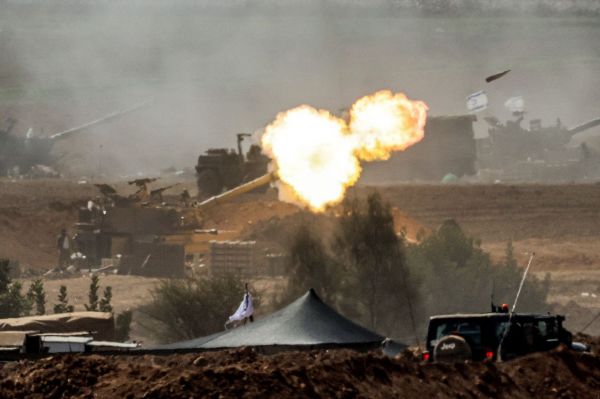
Bloomberg Economics, the economic research arm of Bloomberg News, stated this on the 13th (local time) in a report predicting the economic impact depending on the future developments of the war.
Bloomberg Economics sees three possible scenarios for the situation: a limited conflict within the Gaza Strip, a proxy war between Iran and Israel involving Lebanon and Syria, and a direct war between Israel and Iran.
In the worst-case scenario where Iran intervenes, international oil prices are expected to surge by $64 per barrel from current levels, surpassing $150 per barrel, triggering an 'oil shock.' Iran, as a major oil producer, controls the Strait of Hormuz through which 20% of the world's oil shipments pass, allowing it to pressure the global economy. If Iran participates in the war and blocks this strait, it would be difficult to prevent a sharp rise in oil prices with only the spare production capacity of Saudi Arabia or the United Arab Emirates.
Bloomberg analyzed that if Iran intervenes in the war, risks in the financial markets will increase, with the volatility index (VIX) rising by more than 16 points.
This kind of oil shock could further worsen the already severe global inflation caused by the Ukraine war. With crude oil prices soaring, next year's global inflation rate is projected to rise by 1.2 percentage points above the baseline to reach 6.7%.
Global economic growth is expected to fall by 1.0 percentage point from forecasts, causing an estimated loss of about $1 trillion (approximately 1,335 trillion won) worldwide.
Bloomberg also noted that even if the war remains a limited clash in the Gaza Strip and Israel, or if nearby pro-Iran factions such as Lebanon's Hezbollah and Syria join the conflict, oil prices are likely to rise. On the 13th, international oil prices jumped about 6% amid speculation that Israeli ground forces would soon enter the Palestinian Gaza Strip.
The longer the war drags on and the worse the relationship between the U.S. and Iran becomes, the greater the rise in oil prices could be. Although Iran showed signs of improving relations with the U.S. this year and increased oil production by 700,000 barrels per day, it could withdraw this decision if U.S. pressure continues. In that case, oil prices could rise by $3 to $4 per barrel, and if the war expands to Lebanon and Syria, prices could increase by $8 per barrel, Bloomberg analyzed.
This would also affect inflation and economic growth rates. If the conflict remains a regional dispute between Israel and Palestine, next year's inflation rate is expected to rise by 0.1 percentage point and GDP to decrease by 0.1 percentage point, causing a global economic loss of $300 billion. If the conflict expands to Lebanon and Syria, the GDP decline could deepen to 0.3 percentage points and inflation could rise by 0.2 percentage points.
Bloomberg said the possibility of the situation escalating into an Israel-Iran war is low but not impossible if hostility between the two countries intensifies as it is now.
© The Asia Business Daily(www.asiae.co.kr). All rights reserved.
![Clutching a Stolen Dior Bag, Saying "I Hate Being Poor but Real"... The Grotesque Con of a "Human Knockoff" [Slate]](https://cwcontent.asiae.co.kr/asiaresize/183/2026021902243444107_1771435474.jpg)















