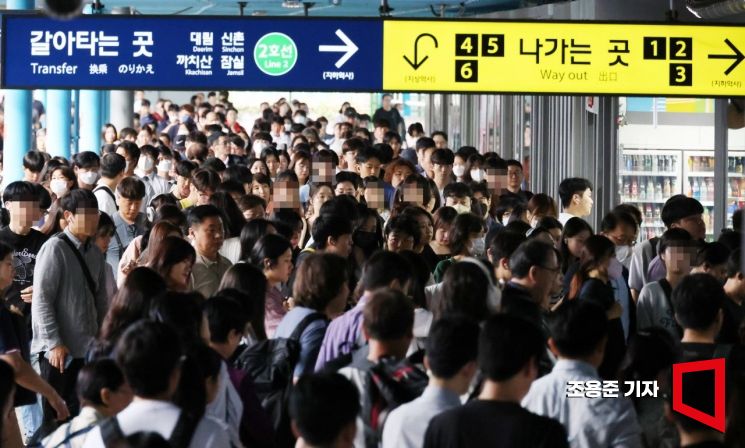
Labor-management wage and collective bargaining negotiations between Seoul Metro Corporation, which operates subway lines 1 to 8 in Seoul, are facing difficulties, raising concerns about a potential strike.
According to the Seoul Metro Corporation and the labor unions on the 15th, the joint bargaining committee of the two unions has been conducting a member vote on whether to hold a general strike in November since the 12th. The joint bargaining committee plans to announce the results once the vote concludes on the 16th.
If the mediation meeting at the Regional Labor Relations Commission on the 17th ends without success, a strike warning press conference is scheduled for the 18th, followed by a general assembly of union members on the 19th.
Previously, the corporation and the joint bargaining committee held a total of 10 negotiation sessions since the first main negotiation on July 11, but ultimately failed to reach an agreement. On the 4th of this month, the joint bargaining committee applied for labor dispute mediation at the Seoul Regional Labor Relations Commission.
In particular, both sides have reportedly been unable to narrow their differences over the issue of workforce reduction. The management, which has been suffering from massive deficits, insists that workforce reduction is inevitable for business normalization.
Seoul Metro Corporation’s net losses were 1,113.7 billion KRW in 2020, 964.4 billion KRW in 2021, and 642 billion KRW in 2022. The figures for 2021?2022 include financial support from the Seoul Metropolitan Government; excluding this, the corporation has effectively recorded deficits exceeding one trillion KRW for three consecutive years. Additionally, as of last year, the corporation’s accumulated deficit reached 17.6808 trillion KRW, with a capital erosion ratio of 61.9%. The management is reportedly proposing a plan to reduce 2,211 employees by 2026 to overcome this deficit situation. This accounts for about 13.5% of the corporation’s total workforce.
The labor unions are opposing the management’s business innovation plan, arguing that it shifts responsibility onto the workers. They also claim that excessive workforce reduction could directly impact safety and are demanding the withdrawal of the reduction plan.
Meanwhile, on the 25th of last month, the corporation signed an essential services agreement with the joint bargaining committee to prepare for a strike. The agreement allows employees to return to work within necessary limits even during a strike in cases of natural disasters or social disasters such as fine dust pollution.
© The Asia Business Daily(www.asiae.co.kr). All rights reserved.
![Clutching a Stolen Dior Bag, Saying "I Hate Being Poor but Real"... The Grotesque Con of a "Human Knockoff" [Slate]](https://cwcontent.asiae.co.kr/asiaresize/183/2026021902243444107_1771435474.jpg)















