FAO "Approximately 5000 Trillion Won Lost in the Last 30 Years"
Disasters Quadrupled in 20 Years... Climate Change as the Cause
A recent study revealed that losses of crops and livestock due to various disasters over the past 30 years have exceeded 5,000 trillion won. This means enough food to feed 500 million people has disappeared every year.
On the 13th (local time), the United Nations Food and Agriculture Organization (FAO) released a report estimating the losses of crops and livestock caused by disasters from 1991 to 2021 over 30 years at $3.8 trillion (approximately 5,134 trillion won). AFP news agency reported, "This is the first time a UN agency has quantified food production losses caused by disasters."
 Palestinian rescue workers are searching through the rubble of a building destroyed by an Israeli airstrike on the 12th (local time).
 According to the FAO, the loss amount corresponds to 5% of the world's total annual agricultural production. The average annual loss is about $123 billion (approximately 166 trillion won), which is enough food to feed up to 500 million people each year. This means that due to natural or man-made disasters such as heatwaves, floods, droughts, heavy rains, wildfires, insect infestations, diseases, and wars, food for 500 million people disappears annually worldwide.
The FAO added, "However, due to insufficient data and the exclusion of losses in fisheries and forestry, the actual damage amount may differ."

Agriculture accounts for about 23% of losses caused by disasters, making it the sector with the greatest damage. In the case of grains, an average of 69 million tons, equivalent to France's annual production over the past 30 years, was lost. Fruits, vegetables, and sugar each suffered annual losses of 40 million tons, while meat and dairy products lost 16 million tons annually.
By continent, Asia experienced the largest agricultural losses due to disasters (45%). Africa, affected by drought, lost an average of 15% of its crop production. Based on agricultural added value, Asia's loss was only 4%, but Africa's reached about 8%.
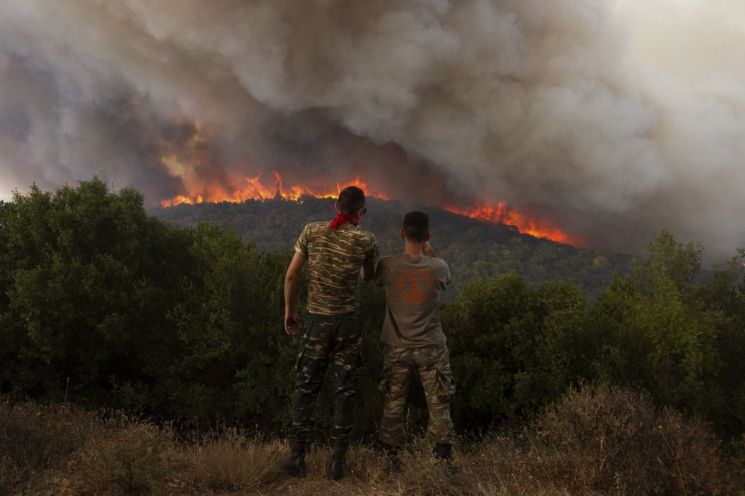 In August, a wildfire broke out near the village of Alexandroupolis in the Evros region of northeastern Greece, burning the forest.
 Piero Conforti, Deputy Director of the FAO Statistics Division, said, "Disasters are increasing tremendously worldwide," adding, "This is increasingly impacting food production."
The FAO noted that such disasters, which occurred about 100 times annually in the 1970s, have increased to 400 times per year over the past 20 years, citing climate change as the cause. Deputy Director Conforti said, "Damage can be reduced by preparing measures such as cultivating diverse plant varieties and introducing early warning systems."
© The Asia Business Daily(www.asiae.co.kr). All rights reserved.
![Clutching a Stolen Dior Bag, Saying "I Hate Being Poor but Real"... The Grotesque Con of a "Human Knockoff" [Slate]](https://cwcontent.asiae.co.kr/asiaresize/183/2026021902243444107_1771435474.jpg)

















