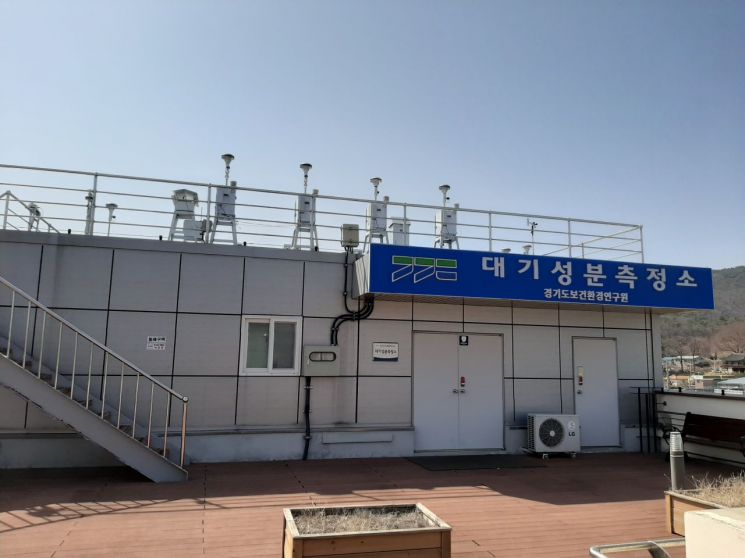
While the average concentration of fine particulate matter (PM-2.5) in the Gyeonggi region continues to decrease, the concentration of carbon dioxide, a representative greenhouse gas, has steadily increased.
The Gyeonggi-do Institute of Health and Environment Research published the "2022 Operational Report of Atmospheric Component Monitoring Stations by Four Regions in the Province" on the 13th, containing these findings.
According to the report, the average concentration of fine particulate matter (PM-2.5) in the province decreased from 26㎍/㎥ in 2019 to 21㎍/㎥ in 2020 and 2021, and further to 20㎍/㎥ in 2022.
Comparing 2021 and 2022, Pyeongtaek, which has many industrial complexes, saw a decrease of 1㎍/㎥ to 23㎍/㎥, and Gimpo, influenced by a marine climate, decreased by 4㎍/㎥ to 21㎍/㎥. The basin areas of Pocheon and Icheon remained unchanged at 19㎍/㎥ and 22㎍/㎥, respectively.
The composition ratio of fine particulate matter components showed that ions accounted for the largest proportion at an average of 50% across all four locations, followed by carbon at 25%, and heavy metals at 3%. Among the ions, nitrate, sulfate, and ammonium were predominant, similar to the levels in 2021.
The concentration of carbon dioxide measured in the southern and western regions steadily increased.
In Gimpo, it rose from 428.6 ppm in 2020 to 441.5 ppm in 2021 and 443.3 ppm in 2022, while in Pyeongtaek, it increased from 436.0 ppm in 2020 to 445 ppm in 2021 and 453.8 ppm in 2022.
Considering that the Korea Meteorological Administration analyzed the national annual average increase rate of carbon dioxide as 2.8 ppm, Gyeonggi-do’s increase is comparatively higher.
Hong Sun-mo, head of the Fine Dust Research Department at the Gyeonggi-do Institute of Health and Environment Research, stated, "To reduce fine particulate matter concentrations, it is important to identify local emission sources and pollution characteristics," adding, "We will continue atmospheric quality monitoring to respond to the worsening climate crisis, including rising ozone levels, high concentrations of fine dust, and global warming."
© The Asia Business Daily(www.asiae.co.kr). All rights reserved.
![Clutching a Stolen Dior Bag, Saying "I Hate Being Poor but Real"... The Grotesque Con of a "Human Knockoff" [Slate]](https://cwcontent.asiae.co.kr/asiaresize/183/2026021902243444107_1771435474.jpg)















