Meritz Capital, NongHyup Bank, Gyeongnam Bank, etc. Securitization of Auto Loans and Non-Performing Loans
High Interest Rates and Economic Recession Expected to Increase Asset-Based Financing
There is an increasing trend of financial companies securitizing loans and other assets they hold to raise funds. This is interpreted as a strategy to manage the soundness ratio of financial companies through asset securitization while securing liquidity at relatively lower interest rates amid high interest rate conditions.
According to the investment banking (IB) industry on the 13th, Meritz Capital raised 540 billion KRW by securitizing assets such as loans, leases, and installment financing. The company transferred a total of 37,065 cases worth 820.9 billion KRW of auto loans (Auto Loan) and other held assets to a special purpose company (SPC), then issued asset-backed securities using these as underlying assets (a type of collateral). Korea Investment & Securities, KB Securities, and Hi Investment & Securities acted as lead managers for the issuance of the asset-backed securities.
Meritz Capital has utilized asset securitization alongside bond issuance as a major funding method. However, it is known that the amount of securitization has significantly increased recently. An IB industry official said, "As assets accumulated internally, the scale of asset securitization has grown," adding, "With the continuous rise in funding costs due to recent project financing (PF) defaults, there has been an increase in securitization funding, which has relatively lower interest rates."
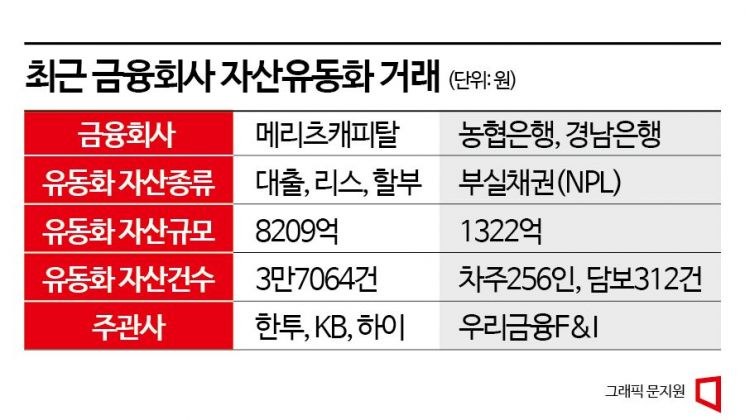
NongHyup Bank and Kyongnam Bank recently sold non-performing loans (NPLs) worth 132.2 billion KRW from 256 borrowers, raising 120.9 billion KRW in funds. Banks classify loan statuses based on the number of months overdue into normal, precautionary, fixed, doubtful recovery, and estimated loss categories. Among these, fixed, doubtful recovery, and estimated loss loans overdue for more than three months are collectively called substandard and below loans, referred to as NPLs.
Woori Financial Group's NPL company, Woori Financial F&I, acted as the lead manager for the securitization of NongHyup Bank and Kyongnam Bank's NPLs. Over 80% of the NPLs are secured debts backed by collateral such as commercial buildings, apartments, and factories. Woori Credit Information and MG Credit Information are responsible for asset management and plan to recover funds by disposing of collateral assets through public auctions and other methods.
A financial company official stated, "If banks continue to hold overdue assets, indicators of non-performing assets such as delinquency rates and substandard asset ratios worsen, and to maintain BIS ratios stably, additional capital must be accumulated," adding, "There is an increasing trend of banks securitizing NPLs to manage soundness ratios."
As the high interest rate environment prolongs and defaults increase due to economic recession, asset securitization by financial companies is expected to continue rising. An IB industry official said, "With the recent rise in bank bond yields, the funding rates for high-quality capital companies have also jumped to around 5%," and predicted, "The cases of raising funds through asset securitization will continue to increase to reduce funding costs."
© The Asia Business Daily(www.asiae.co.kr). All rights reserved.
![Clutching a Stolen Dior Bag, Saying "I Hate Being Poor but Real"... The Grotesque Con of a "Human Knockoff" [Slate]](https://cwcontent.asiae.co.kr/asiaresize/183/2026021902243444107_1771435474.jpg)
















